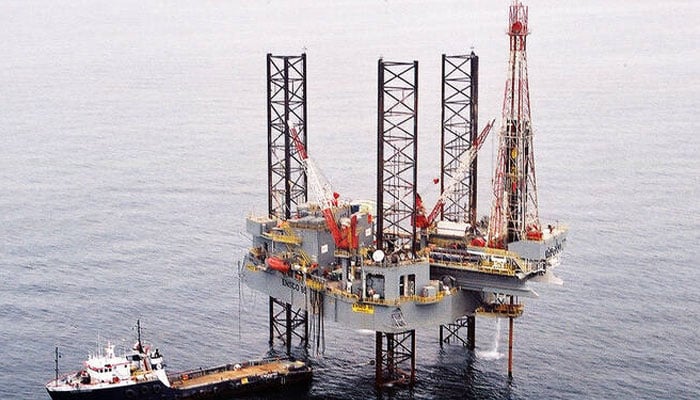
ISLAMABAD: Pakistan on Wednesday reopened its offshore energy frontier to oil and gas exploration after an almost 18-year pause, signing agreements for 23 deepwater blocks in a major push to reshape the country’s economic future and reduce dependence on imported fuel.
The agreements secure an immediate investment commitment of $82 million for seismic and geological studies, with the potential to attract up to $1 billion in capital inflows if initial surveys lead to deep-water drilling operations in the underexplored Indus and Makran basins.
At a high-profile signing ceremony here, Federal Minister for Petroleum Ali Pervaiz Malik finalised 21 production sharing agreements (PSAs) and exploration licences, officially completing the country’s Offshore Bid Round 2025 portfolio. The landmark deal brings the total number of awarded blocks to 23, spanning a sprawling 54,600 square kilometres across the under-explored Indus and Makran basins.
Two offshore blocks awarded under the same bid round, Offshore Deep-C and Offshore Deep-F, had earlier been executed on December 2, 2025, with Mari Energies Limited, Turkish Petroleum Overseas Company (TPOC) and Fatima Petroleum Company Limited during a ceremony held at the Prime Minister’s Office. With the signing of the remaining 21 PSAs on Wednesday, the contractual framework for the entire Offshore Bid Round 2025 portfolio now stands fully completed.
The sheer scale of the initiative highlights how virtually untouched Pakistan’s waters remain. Despite boasting a maritime economic zone covering more than 282,000 square kilometres, only 18 exploratory wells have been drilled since the country’s independence in 1947. Minister Malik termed the signing a defining milestone, stressing that the aggressive bidding reflects robust investor confidence driven by a modernised, transparent regulatory framework. Facing a chronic balance-of-payments crisis fuelled by skyrocketing fuel import bills, Islamabad is betting big that the ocean floor holds the key to long-term energy self-reliance.
State-run Mari Energies Limited emerged as the biggest player, picking up 18 blocks as operator and five more as a joint venture partner. The Oil and Gas Development Company (OGDCL) and Pakistan Petroleum Limited (PPL) each secured eight blocks, while Prime Global Energies was awarded one block as operator, United Energy Pakistan and Orient Petroleum also joined the effort. Turkish Petroleum Overseas Company was among the foreign participants.
Because offshore drilling is an expensive, high-stakes endeavour, the agreements are structured into two distinct financial phases to manage risk. During the initial three-year Phase-I licence period, companies will deploy the committed $82 million toward extensive geological and geophysical studies. Instead of drilling, advanced seismic vessels will use sound waves to map the seafloor adjoining the coasts of Sindh and Balochistan, pinpointing potential hydrocarbon traps. If these initial mapping results look promising, operations will transition to Phase-II, triggering the anticipated $1 billion capital influx to bring in heavy marine rigs and pierce the seabed.
The ultimate prize of this maritime push is economic survival. If these exploration activities yield commercial quantities of natural gas or oil, it will unlock hundreds of millions of dollars in follow-on investments for field appraisal and development. Beyond the critical macroeconomic relief of cutting the national energy import bill, the agreements legally bind the awardees to fund social welfare and capacity-building initiatives in vulnerable coastal communities. With government officials confirming that several other global energy majors are already auditing Pakistan’s offshore data packages, the next three years of maritime mapping could chart an entirely new financial future for the country.
Ali Pervaiz Malik said the round reflects genuine investor confidence and called it a milestone in reducing Pakistan’s heavy dependence on costly imported energy. The government has also introduced new Offshore Petroleum Rules and a standardised model contract to make the process more transparent and competitive.
Beyond energy, the government says commercial discoveries would bring jobs, technology and development spending to coastal communities in Sindh and Balochistan, regions that have long awaited the economic ripple effects of upstream oil activity.