Islamabad:Pakistan’s contemporary challenges and future opportunities require a particular focus on national identity, governance, institutional development, public trust, strategic vision and the country’s evolving role in a changing regional and global environment. In this context, intellectual depth, civic responsibility, institutional confidence and constructive dialogue are essential for shaping a more cohesive, resilient and forward-looking national future.
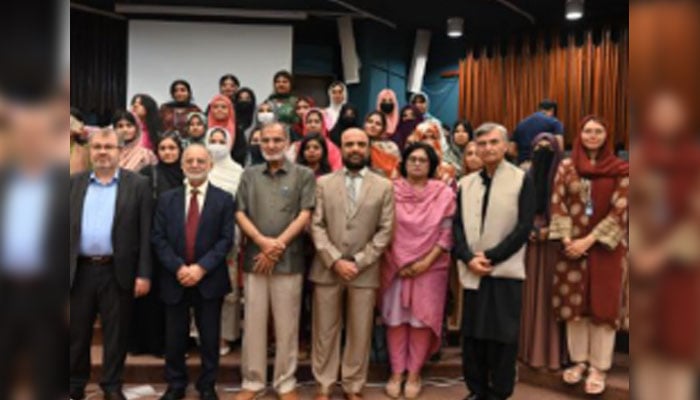
This was the crux of the observations made by leading scholars, policymakers and practitioners during the inaugural lecture of a 12-part series titled “Pakistan in Perspective: State, Society and Strategy,” on public policy, national identity and strategic thought organised by the Institute of Policy Studies in collaboration with the International Islamic University Islamabad.
The speakers included Air Marshal (r) Sohail Aman, former chief of the air staff; Prof Dr Ijaz Shafi Gilani, chairperson, Gallup Pakistan; Khalid Rahman, chairman, IPS; Prof Dr Manzoor Khan Afridi, dean, Faculty of Social Sciences, IIUI; and Dr Ghulam Mujaddid, assistant professor, National Defence University.
Elaborating on the lecture series, Dr. Manzoor Afridi said that it aims to provide an academic platform for discussions on Pakistan’s state, society, politics, economics, public policy, national identity and strategic thought, while encouraging meaningful intellectual engagement among scholars and students.
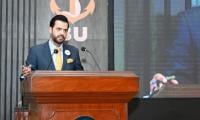
Delivering the keynote address, Air Marshal (r) Sohail Aman emphasised that nations progress when citizens develop confidence in their country and institutions. Highlighting the state’s responsibility to provide a secure and enabling environment, he called for a clearly defined national purpose focused on economic growth, technological advancement and human development. In light of changing geopolitical realities, he discussed the rise of the Global South, artificial intelligence and climate change, while emphasising investment in education, information technology, skilled human resources and institutional reform to support Pakistan’s long-term stability and competitiveness.
Reflecting on nationhood, statehood, democracy and civilisation, Dr. Ijaz Gilani argued that many modern political concepts emerged from colonial modernity and differ from historical Islamic political traditions. He stressed that universities should remain spaces for intellectual reflection, philosophical inquiry and critical dialogue rather than merely applied policy laboratories. He also highlighted the importance of understanding civilisations, cultures and historical trajectories in broader global contexts while cautioning against treating concepts such as nation, state and development as rigid absolutes detached from ethical and civilisational foundations.
Addressing the relationship between state institutions and society, Dr. Ghulam Mujaddid discussed the importance of public trust, democratic legitimacy and citizen engagement in governance. He observed that distrust in institutions, political polarisation, corruption perceptions and ineffective service delivery continue to weaken relations between citizens and the state in Pakistan. He emphasised that effective governance requires participatory policymaking, institutional transparency, accountability and stronger local government structures to strengthen democratic engagement and rebuild public confidence.
In his concluding remarks, Khalid Rahman emphasised the importance of intellectual depth, historical understanding and critical thinking in analysing national and global issues. He urged students to engage deeply with ideas rather than relying on superficial information flows shaped by modern media culture.
Stressing the need to examine root causes rather than quick conclusions, he encouraged informed judgment, intellectual curiosity and balanced analysis while cautioning against generalised pessimism regarding Pakistan’s society and institutions.