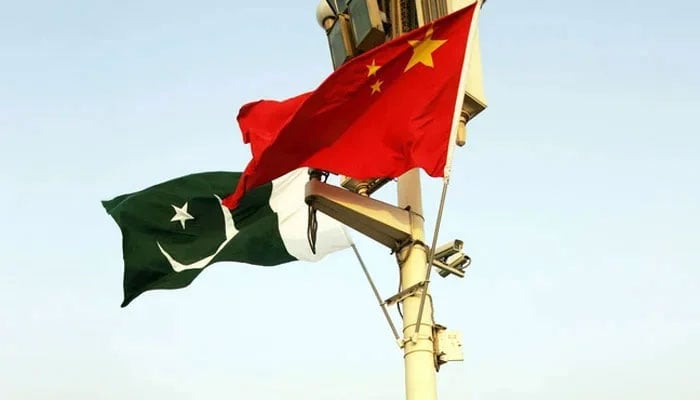
KARACHI: Pakistan and China have signed more than 300 memorandums of understanding (MoUs) and over three dozen joint venture agreements worth more than $13 billion over the past two years, Pakistan’s Ambassador to China Khalil Hashmi said on Monday.
Speaking during a meeting at the Karachi Chamber of Commerce and Industry (KCCI) attended by a 70-member delegation from China’s IBI Group, Hashmi said Pakistan had established mechanisms to convert agreements into practical business projects, with around 30 per cent of MOUs progressing into formal contracts.
During the meeting, KCCI and IBI Group signed an MoU aimed at promoting cooperation in the digital economy and industrial development.Hashmi also said Pakistan was in talks with Chinese battery manufacturer CATL regarding potential investment and cooperation in lithium-ion and sodium-based battery technologies. He added that Pakistan hoped to attract investment in advanced battery manufacturing and renewable energy sectors.
IBI Group Director Liu Junzhai said Karachi had the potential to become a regional hub for digital trade and smart industry due to its strategic location and industrial base. She said the company viewed Pakistan as an important long-term market for digital and industrial cooperation.
Businessmen Group Chairman Zubair Motiwala said bilateral trade between Pakistan and China had reached between $23 billion and $28 billion despite global economic challenges. However, he noted concerns over the widening trade imbalance, with Pakistan importing far more from China than it exports.
He called for greater focus on joint manufacturing, technology transfer, industrial cooperation and export-oriented investment under the next phase of the China-Pakistan Economic Corridor (CPEC).Motiwala also highlighted opportunities for Chinese investment in renewable energy, agriculture and food exports, including rice, seafood, halal meat and dairy products.