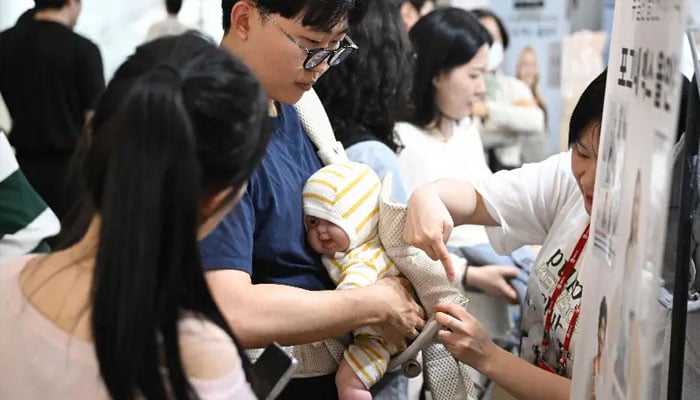
SEOUL: Kim Su-jin and her husband have set aside their doubts and embraced parenthood, joining a small but notable wave of South Korean couples having children despite the country´s steep demographic decline.
South Korea has one of the world´s lowest birth rates, and the government has spent billions of dollars trying to encourage citizens to have more babies and cushion the worst impacts of a shrinking population.
The Asian nation is still nowhere near reversing the trend, but a modest baby bump has come after years of consistently low statistics -- even as experts disagree on the underlying causes.
Kim, 32, a freelance music industry worker, gave birth to her daughter in January last year despite earlier financial concerns during her four-year marriage. She shook off worries over housing, schooling and work “because we believed that having (a baby) would bring us happiness”, she told AFP.
South Korea´s fertility rate hit a record low in 2023 but has picked up since then, with the number of monthly births consistently rising compared to the previous year.
Nearly 23,000 babies were born in February, the most for that month in seven years, according to the statistics ministry.
The on-year growth of 13.6 per cent was the highest for any February since records began in 1981.
The uptick in births has tracked a similar, though less even, rise in marriages going back to mid-2022, official figures show.
Experts said the trend may reflect more positive attitudes towards family among younger South Koreans.
But they differed on what was driving the shift and how important it was compared with factors such as pro-natalist policies.
Hong Sok-chul, an economics professor at Seoul National University (SNU), said the programmes had been “quite effective”.
“Rather than trying to force marriage or childbirth ... the government focused on lowering the direct and indirect costs to make these choices more rational,” he said.
Kim Woo-jin, 33, said vouchers she received from the government had “played a significant role in alleviating the financial burden” of pregnancy, childbirth and child-rearing.