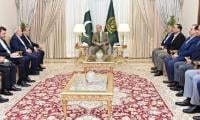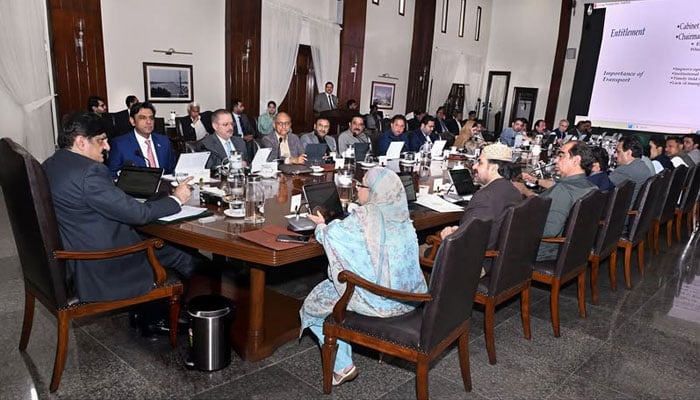
Sindh Chief Minister Syed Murad Ali Shah on Tuesday presided over a cabinet meeting that approved a development, welfare and reform agenda involving more than Rs30 billion in allocations, grants and institutional initiatives aimed at improving infrastructure, health care, governance, education and public relief.
Shah said his government is committed to accelerating development activities while ensuring direct relief to vulnerable communities affected by inflation and economic pressures. The government is simultaneously focusing on infrastructure development, social protection, healthcare reforms, digital governance and institutional strengthening to improve public service delivery, he added.
The cabinet approved a fuel subsidy package of Rs515 million to provide immediate financial relief to fishing communities in Karachi, Thatta, Sujawal and Badin. The government will provide targeted support to 9,634 registered vessels, with a specific focus on small-scale and coastal operations.
A total of 2,331 small boats measuring 18-24 feet with 20HP outboard engines will each receive a subsidy of Rs200,000, amounting to a total allocation of Rs466.2 million. A total of 488 boats measuring 10-15 feet with 5-10HP engines will each receive a subsidy of Rs100,000, totalling Rs28.8 million.
Shah approved a grant for consultancy services for the engineering design of a new 1.12km highway bridge over the River Indus between Hyderabad and Kotri, with an estimated cost of Rs147.2 million. The cabinet approved Rs252.206 million for the construction of a graveyard in Hyderabad, and Rs800 million for laying multiple new water supply pipelines in Qasimabad. A new line will also be laid to draw water from the canal for the 6mgd Khanpota Water Treatment Plant.
The cabinet approved Rs800 million for the construction of an underpass and a link road at Qasimabad-Hyderabad Chowk and Rs500 million for the construction of a sports complex in Latifabad.
The cabinet approved Rs1.2 billion to widen Shaikh Ayaz Road from the Sindh Museum to the Ali Palace Pumping Station in Hyderabad and to build a drainage system along the route, and Rs900 million for the construction of a drainage channel from Giddu Chowk to Ya Ali Colony via Mir Fateh Colony.
The cabinet approved Rs6.5 billion as grant-in-aid for the Karachi Metropolitan Corporation to rehabilitate road infrastructure across 24 town municipal corporations, and Rs2 billion for the S-III project’s STP-I at Haroonabad to complete stage-1 works. The cabinet also approved Rs4 billion to upgrade the drainage system in Larkana city.
Shah approved Rs48.9 million for the digitisation of cases and the issuance of electronically certified true copies at district courts. The meeting sanctioned Rs432.597 million for the construction of four court buildings in Moro. Shah also approved a one-time grant-in-aid of Rs25 million for the Pir Illahi Bux Law College in Dadu.
The cabinet approved Rs635.48 million for machinery and equipment at the 50-bed Trauma & Emergency Response Centre at Ghulam Mohammad Medical College Hospital, Sukkur. Shah also approved Rs80 million for the establishment of an orphan house in Umerkot.
Shah approved Rs90 million for St Patrick’s High School, Karachi, for the construction of an early childhood care education building. He also approved releasing Rs86.535 million for the second-year tranche of the Sindh Job Portal.
The cabinet approved Rs615.7 million for the Sehwan Development Authority, and Rs42.86 million was allocated to operationalise the Centre for Excellence on Countering Violent Extremism.
The cabinet moved to extend the Peoples Fuel Subsidy Programme through May 31 to process pending applications. Shah directed the finance department to release Rs2 billion for May. The cabinet also approved a proposal to lower the Sindh Sales Tax on motorbike passenger services from five per cent to two per cent.
The cabinet approved the creation of a dedicated China Desk within the investment department to facilitate investors and oversee the transition of MoUs signed during the president’s China visit into high-impact provincial projects.
The cabinet moved to modernise the appointment process for vice chancellors to broaden the candidate pool and attract experienced leadership. The amendments include raising maximum age for candidates from 62 years to 65 years for all categories, and the required experience from 15 years to 20 years.
The cabinet approved the draft recruitment rules & service regulations 2026 for all seven boards of intermediate and secondary education in Sindh. Positions will now be filled through a standardised search & selection committee process to ensure meritocracy.
The new rules set the age limit for the chairman (BPS 19/20) at 40-55 years, requiring a master’s degree (1st division) and 15 years of senior management experience. The cabinet also moved to ensure the full operationalisation of the Sindh Electric Power Regulatory Authority, approving the appointment of Faisal Malik as member (finance & policy).