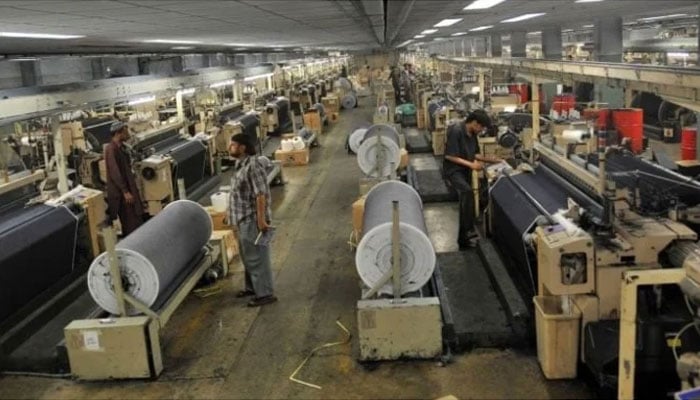
ISLAMABAD: The large-scale manufacturing (LSM) sector grew by 6.48 per cent during July-March 2025-26 over the same period of the last fiscal, driven by strong gains in automobiles, garments, food and petroleum products, the Pakistan Bureau of Statistics reported on Tuesday.
Production during these nine months increased from a year earlier in food, beverages and tobacco, textiles and apparel, paper and board, coke and petroleum products, rubber and non-metallic mineral products, fabricated metals, computers, electronics and optical goods, electrical equipment, automobiles and other transport equipment.
In contrast, output of leather products, paper & board, chemical products, pharmaceuticals, iron & steel products and machinery and equipments contracted.The overall growth of 6.48pc was mainly driven by food (179), tobacco (0.18), textile (0.13) garments (1.08), petroleum products (0.79) and cement (0.5). Sectors that weighed on growth included chemicals (-0.11), pharmaceuticals (-0.31), iron & steel Products (-0.27), electrical equipment (0.3), Machinery and Equipment (0.03), automobiles (1.5), other transport equipment (0.24) and furniture (0.26).
The LSM during March 2026 rose by 11.09 per cent year-on-year (YoY) and decline 5.2 per cent from February, pushing cumulative growth to 6.48 per cent during July-March of FY26. During the month under review, automobiles posted a growth of 61.35 per cent from a year earlier and other transport equipment at 38.4 per cent. Food output increased 53.7 per cent, tobacco 37.3 per cent, beverages 7.8 per cent, garments rose 1.8 per cent and electrical equipment climbed 26.36 per cent. Furniture output increased 90.7 per cent, machinery and equipment 140.6 per cent, rubber products 22.6 per cent and coke & petroleum products output up by 3.4 per cent over same month of the last year.
In contrast, textiles output contracted by 3.34 per cent, leather 4.9 per cent, football 13.4 per cent, chemicals 4.4 per cent, fertilisers 7.55 per cent and pharmaceuticals output reduced by 7.7 per cent. Similarly, iron and steel production reduced by 11.5 per cent, cement 6.6 per cent, non-metallic minerals 7.1 per cent and fabricated metals declined by 11.6 per cent.
LSM accounts for about 8.0 per cent of Pakistan’s gross domestic product (GDP) but has struggled in recent years under IMF-backed reforms that included import restrictions, a weaker rupee, high interest rates and recurring energy shortages.