KARACHI: The Pakistan stock market faces a sensitive week ahead, with direction likely to depend on geopolitical developments and the expected International Monetary Fund decision on a $1.2 billion tranche. Any easing in Middle East tensions or decline in oil prices could stabilise sentiment. Investors will also watch interest rate signals and currency stability. The market still trades at attractive valuations, which may support a rebound if external pressures ease.
According to AKD Research, a constructive resolution in geopolitical tensions remains the key near-term trigger for market direction, while softer oil prices could lift sentiment. The brokerage noted that the market continues to trade at appealing levels, with a price-to-earnings ratio of 6.9 times, which may attract value investors despite recent volatility.
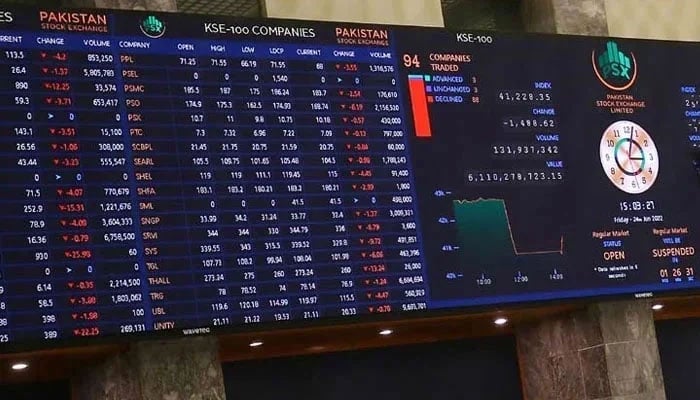
The benchmark KSE-100 Index declined sharply during the outgoing week, losing 7,677 points, or 4.5 per cent week-on-week (WoW), to close at 162,994 points. Trading activity also weakened, with average daily traded volume falling to 1.2 billion shares, down 30 per cent from the previous week. Investor sentiment turned negative after the collapse of Iran-US diplomatic talks, which raised fears of further escalation in the region. Reports that US President Donald Trump cancelled a planned diplomatic engagement added to uncertainty, while discussions on potential military options kept markets on edge.
Oil prices remained elevated throughout the week. The June 2026 Brent contract touched a high of $126 per barrel, driven by supply concerns linked to tensions in the Strait of Hormuz. Rising oil prices increased inflationary risks for Pakistan, prompting the State Bank of Pakistan to raise its policy rate by 100 basis points to 11.5 per cent. This marked the central bank’s first rate hike in over two and a half years. The Monetary Policy Committee cited prolonged geopolitical conflict as a key risk to inflation staying above target levels.
Syed Danyal Hussain, analyst at JS Research, said the index remained under pressure due to persistent geopolitical uncertainty and rising oil prices. He noted that inflation risks driven by external supply shocks forced the central bank to tighten monetary policy. He added that the upcoming IMF Executive Board meeting on May 8 is critical, as Pakistan expects approval of the $1.2 billion tranche after meeting most programme conditions.
Despite weak sentiment, some macro indicators offered support. The State Bank’s foreign exchange reserves rose by $730 million WoW to $15.8 billion as of April 24. The Pakistani rupee remained stable, closing at 278.8 against the US dollar. The government also cleared a $3.45 billion loan to the UAE, signalling improved external financial management. Plans to launch Panda bonds and IMF approval of a 60 per cent cut in gas levy also featured in the week’s developments.
Sector performance remained mixed. Textile weaving, tobacco, and auto assemblers posted gains of 19.1 per cent, 3.6 per cent, and 0.9 per cent respectively. On the downside, vanaspati, property, and woollen sectors fell by 13.9 per cent, 10.8 per cent, and 9.1 per cent. Market flows showed mutual funds and brokers as major net sellers, offloading $28.6 million and $3.1 million respectively. Individuals and companies emerged as net buyers, with inflows of $27.4 million and $1.4 million.
Among stocks, Honda Atlas Cars, Mehran Sugar, Indus Motor Company, Pakistan Tobacco, and Millat Tractors led the gainers. On the losing side, Yousuf Weaving, National Bank of Pakistan, Sui Southern Gas Company, and others faced strong selling pressure.
According to AHL Research, the market outlook remains closely tied to geopolitical developments and the duration of the conflict. The brokerage highlighted that IMF approval of the upcoming tranche could support sentiment. It also noted that the index trades at a price-to-earnings ratio of 7.6 times with a dividend yield near 6.7 per cent, offering value for long-term investors.
Overall, the market enters the new week with cautious optimism. Stability in oil prices and a positive IMF outcome could help restore confidence. However, continued geopolitical tension may keep volatility high.