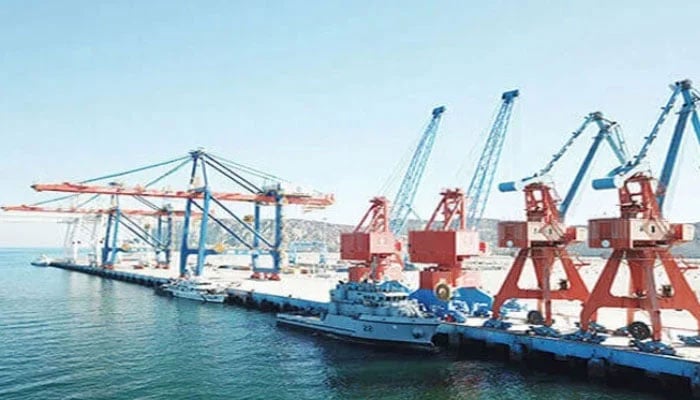
On April 16, two cargo vessels arrived at Gwadar Port, carrying 368.7 tonnes of machinery and general cargo goods, as well as 5,000 metric tonnes of fertiliser, reports The Diplomat.
Earlier in the month, another cargo ship brought over 14,000 metric tonnes of transshipment cargo goods. So far in April, Gwadar has handled around 11,000 standard shipping containers. For a port that handled around 8,300 containers in all of 2025 and historically has not seen more than 20 ships dock in an entire year, the current activity is unprecedented.
Some analysts have interpreted this surge as signalling a potential long-term opportunity for Gwadar, one that could improve its visibility in regional shipping networks, build operational credibility and perhaps, attract sustained commercial interest.
Gwadar’s location near the Strait of Hormuz, the narrow chokepoint through which almost 20 percent of global oil and liquified natural gas (LNG) flows, accords it strategic importance. This and the deep waters of Gwadar’s eastern bay, which give it the capacity to handle large cargo ships, attracted Chinese investment. But despite these advantages, the port has remained underutilized for much of the past two decades.
The recent surge in cargo traffic is driven by regional dynamics and geopolitical tensions, especially connected to the Strait of Hormuz. In recent months, Hormuz has dominated world media headlines to an extent that has rarely been seen before. This is largely because of the Israel-US war on Iran and the repeated closure, reopening, and blockade of the Strait of Hormuz. Being such an important global energy route, these disruptions have sent shockwaves through global markets, causing supply shortages and surging oil prices.
Additionally, vessels operating in the strait face security risks. This has increased insurance premiums, delays, and uncertainty in safe passage. In response, most shipping operators have avoided entering the Strait of Hormuz altogether. But cargo already in transit and which has to pass through Hormuz cannot be easily rerouted, forcing vessels to seek temporary anchorage in relatively safe and less congested locations along the Arabian Sea, including Gwadar Port.
The scope for rerouting is very limited. Only Saudi Arabia and the United Arab Emirates have operational pipelines. Saudi Arabia’s East-West pipelines run from its oil field to the Red Sea port, and the UAE’s pipeline connects Dubai’s field to Fujairah on the Gulf of Oman, outside the Strait of Hormuz. But these only partially bypass Hormuz and can handle a very limited share of exports. Most of the trade still requires dependence on maritime transit through the strait.
Additionally, goods destined for markets in West Asia, especially shipments from China that rely on Hormuz, can hardly reroute. Vessels cannot remain at sea indefinitely. They are seeking alternate places to dock or short-term storage options at nearby ports.
Pakistan’s Gwadar Port, given its proximity to the Strait of Hormuz, but relative distance from the immediate conflict zone, has emerged as one such logistical node. Thus, it is currently functioning not only as a transshipment point but as a port for safe anchorage, as vessels await clarity in regional conditions.
This perception of relative safety, in an otherwise unpredictable region, is also a result of Pakistan’s emergence as an unexpected mediator between Iran and the United States. On the one hand, this diplomatic role may be related to Pakistan’s own economic and geopolitical vulnerabilities. But it has also contributed to Pakistan’s image as a reliable actor on the global stage.
Islamabad also heavily relies on energy imports that transit through the Strait of Hormuz, disruption of which has already affected the economy with rising costs and supply pressures. At the same time, mediation has brought some short-term financial and political benefits, including $2 billion from Saudi Arabia as of April 15, with an additional $3 billion of financial support pledged. This may also provide temporary relief to Pakistan’s strained foreign exchange reserves.
Pakistan shares a roughly 900-kilometer-long border with Iran, making it vulnerable to instability in Iran spilling over into its own territory. It has suffered from the effects of the war in Afghanistan for decades. The impact of the war in Iran could be more severe as it relies on it for energy, food and other essential goods. Disruptions could also affect the informal cross-border trade that sustains thousands of livelihoods in the restive border province of Balochistan, with implications for the larger Pakistani economy.
However, for Gwadar, the current conditions and the increased activity at the port mean that cargo arriving at the port is meant not for local markets but is temporarily handled and stored before being sent onward to other destinations. Cargo is offloaded, stored for short durations, facilitated in part by the port’s provision of free storage up to a month, and then reloaded onto other vessels for onward shipment. Thus, this pattern suggests that Gwadar is currently functioning less as a trade hub and more as a temporary logistical buffer amid the ongoing uncertainty.
This activity may, no doubt, contribute to port utilization in the short-term and bring in more economic activity, but whether it contributes to any sustained commercial growth post-war or long-term economic viability remains to be seen. At present, Gwadar port is designed to handle around 16,000 standard shipping containers and offers over 90,000 square meters of storage capacity for general cargo.
The current demand of the port appears to be more of a temporary logistical need than a consistent, destination-based trade. As a result, the increased cargo traffic in Gwadar cannot yet be treated as the long-awaited transformation,
This raises the question again: how long will Gwadar continue to wait for its long-anticipated potential to materialise? A port’s growth or business, after all, should not depend on disruptions and wars, but on stability.