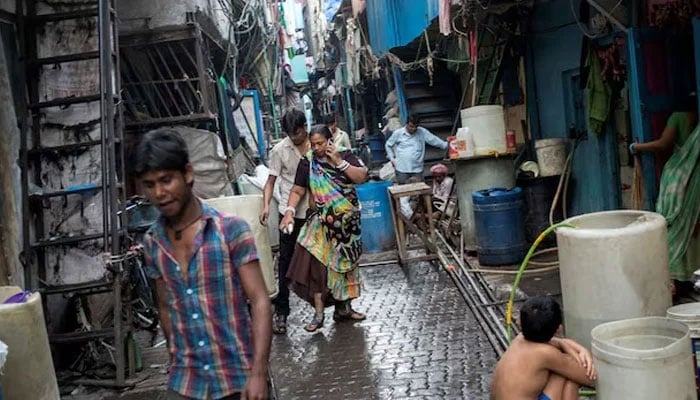
LAHORE: Slums in Pakistan do not exist because people prefer them, they exist because the economy leaves millions with no viable alternative. The real policy challenge is not to bulldoze these settlements, but to gradually make them unnecessary by aligning housing, jobs and education.
From Karachi to Lahore, the standard response to ‘katchi abadis’ has remained largely unchanged for decades: demolish informal settlements, relocate residents and promise better housing elsewhere. This approach is not only outdated, it has repeatedly failed.
The reasoning behind it appears simple. Slums are seen as overcrowded, unhygienic and incompatible with the vision of a modern city. But this perspective ignores a fundamental reality: people do not choose to live in slums; they are compelled to. These settlements are often located close to jobs, transport links and informal economic opportunities. Remove them without addressing these underlying needs, and the problem simply shifts, often worsening in the process.
Pakistan’s own experience reflects this pattern. Forced evictions in Karachi’s informal settlements or along nullahs have repeatedly displaced thousands of families, only for similar settlements to reappear nearby. Relocated households frequently face higher commuting costs, loss of livelihoods and weaker access to schools and healthcare. The result is not urban improvement, but a reshuffling of poverty.
Slums in Pakistan function as entry points into urban life, especially for migrants from rural areas of south Punjab, Sindh and Khyber Pakhtunkhwa (KP). For families with limited education, these settlements offer proximity to informal jobs (construction, transport, domestic work) and access, however inadequate, to schooling.
But this is where the paradox lies. While slums help households take the first step into the urban economy, they often prevent further progress. Public schools in these areas are typically under-resourced, overcrowded and unable to provide the quality of education needed for upward mobility. As a result, children raised in these environments struggle to transition into the formal economy.
Some families do manage to move out as their incomes improve. But many remain stuck in place, especially those with modest education who earn too little to afford formal housing, yet too much to justify returning to rural life. Meanwhile, new migrants continue to arrive, driven by the hope that cities will offer better opportunities for their children than villages can.
This constant inflow and limited outflow make slums highly dynamic. They are not static pockets of poverty; they are continuously replenished. That is why attempts to eliminate them through demolition alone are destined to fail.
The real issue lies in three structural gaps. First, there is a mismatch between where jobs are and where affordable housing exists. Formal housing schemes in Pakistan are often located far from economic centres, making daily commuting costly and impractical for low-income workers.
Second, the education system fails both at the origin and destination. Rural schools do not equip migrants with the skills needed to compete in urban labour markets, while urban slum schools do little to improve their prospects.
Third, the formal housing market does not cater to low-income households at all. Regulatory barriers, high land costs, and speculative real estate practices ensure that affordable housing near city centres remains out of reach.
If policymakers are serious about addressing the issue, the strategy must shift. Improving education within slums is essential, not just access, but quality. However, this alone may attract more migrants unless rural education is strengthened simultaneously. When people move to cities out of desperation rather than opportunity, informal settlements become inevitable.
At a more advanced stage of urbanisation, the focus must turn to integration. This means enabling slum residents to access formal employment, legal property rights, infrastructure and better schools for their children. Such changes cannot be achieved overnight; they require consistent policy over generations.
Housing policy must also be rethought. As long as affordable housing is unavailable near job centres, slums will continue to serve as the only practical option for millions.
Slums persist in Pakistan not because they are desirable, but because they are necessary. As long as the structural gaps between opportunity and affordability remain unaddressed, these settlements will continue to grow.