WASHINGTON/ISLAMABAD/DUBAI: US President Donald Trump discussed a new Iranian proposal on resolving the war with Tehran with his top national security aides on Monday.
Iranian sources disclosed Tehran’s latest proposal earlier on Monday, which would set aside discussion of Iran’s nuclear programme until the war is ended and disputes over shipping from the Gulf are resolved. That is unlikely to satisfy Washington, which says nuclear issues must be dealt with from the outset. Work has not halted to bridge gaps between the US and Iran, sources from mediator Pakistan said, despite the absence of face-to-face diplomacy after Trump called off a trip by his envoys over the weekend.
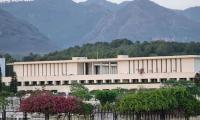
Hopes of reviving peace efforts have receded since the US president scrapped a visit on Saturday by his envoy Steve Witkoff and son-in-law Jared Kushner to Islamabad, where Iranian Foreign Minister Abbas Araghchi shuttled in and out twice over the weekend.
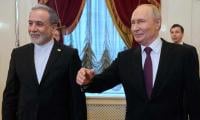
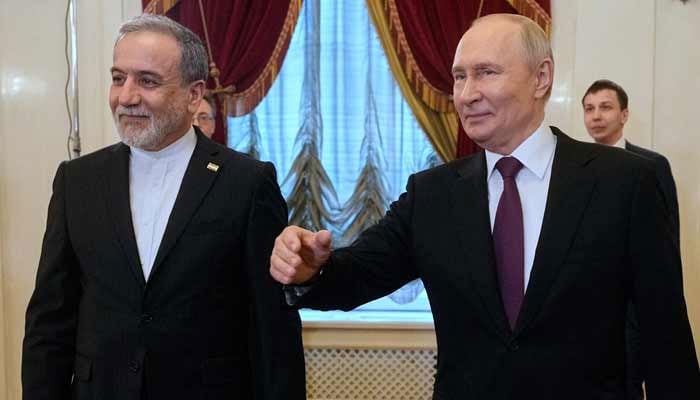
Araghchi also visited Oman over the weekend and went to Russia on Monday, where he met President Vladimir Putin and received words of support from a longstanding ally.
Trump met his national security team on Monday morning. “I don’t want to get ahead of the president or his national security team,” said White House spokeswoman Karoline Leavitt.
“What I will reiterate is that the president’s red lines with respect to Iran have been made very, very clear, not just to the American public, but also to them as well.”When asked about the reported Iranian plan — which would see both Iran and the United States lift their blockades ahead of further talks on the thorny issue of Tehran´s nuclear programme -- spokeswoman Karoline Leavitt told a White House briefing that “the proposal was being discussed.”
She said, “I wouldn’t say they’re considering it. I would just say that there was a discussion this morning that I don’t want to get ahead of, and you’ll hear directly from the president, I’m sure, on this topic.”
Araghchi said on Monday that Tehran was looking into Trump’s request for negotiations, according to a post on the minister’s Telegram account. He told reporters in Russia that Trump requested negotiations because the US has not achieved any of its objectives.
Senior Iranian sources, speaking on condition of anonymity, told Reuters the proposal carried by Araghchi to Islamabad over the weekend envisioned talks in stages, with the nuclear issue to be set aside at the start.
A first step would require ending the US-Israeli war on Iran and providing guarantees that Washington cannot start it up again. Then negotiators would resolve the US blockade and the fate of the Strait of Hormuz, which Iran aims to reopen under its control.
Only then would talks look at other issues, including the longstanding dispute over Iran’s nuclear programme, with Iran still seeking some kind of US acknowledgment of its right to enrich uranium for what it says are peaceful purposes.
In a sign that no face-to-face meetings are planned any time soon, streets reopened in Islamabad, which had been locked down for a week in anticipation of talks that never took place.
Pakistani officials said negotiations were still taking place remotely, but there were no plans to convene a meeting in person until the sides were close enough to sign a memorandum.
Iran has largely blocked all shipping apart from its own from the Gulf through the Strait of Hormuz since the war began. This month, the United States began blockading Iranian ships.
Six tankers loaded with Iranian oil have been forced back to Iran by the US blockade in recent days, ship-tracking data shows. Between 125 and 140 ships usually crossed in and out of the strait daily before the war, but only seven have done so in the past day, according to Kpler ship-tracking data and satellite analysis from SynMax, and none of them were carrying oil bound for the global market.
Secretary of State Marco Rubio meanwhile said Iran’s stance on the Strait of Hormuz did not meet US demands. “If what they mean by opening the straits is, ´yes, the straits are open as long as you coordinate with Iran, get our permission or we´ll blow you up and you pay us,´ that´s not opening the straits,” Rubio said in a Fox News interview.
“They cannot normalize -- nor can we tolerate them trying to normalize -- a system in which the Iranians decide who gets to use an international waterway, and how much you have to pay them to use it,” he said.
US outlet Axios had earlier reported that Trump would meet with his national security team to discuss an offer by Iran on re-opening the strait and postponing nuclear negotiations to a later stage. ABC News, citing two anonymous US officials, meanwhile reported that the deal fell short of Washington´s red lines.
Araghchi blamed Washington for the failure of Middle East peace talks during his visit to Russia, where President Vladimir Putin promised him Moscow’s support in bringing the war to a close. “The US approaches caused the previous round of negotiations, despite progress, to fail to reach its goals because of the excessive demands,” Araghchi said.
Following their meeting, Putin and Araghchi both voiced their commitment to the two countries’ “strategic relationship”. Putin promised that Russia would “do everything that serves your interests... so that peace can be achieved”, state media reported.
Araghchi said the war with the US and Israel had shown the world “Iran’s true power” and the stability of its governing system.
Russian President Vladimir Putin praised the Iranian people for battling to stay independent in the face of US and Israeli pressure. Putin received Araghchi in the presidential library in Russia’s former imperial capital St Petersburg.
Putin said he received a message from Iran’s new Supreme Leader, Mojtaba Khamenei, last week, and asked Araghchi to convey to him that Russia intended to continue its strategic partnership with Tehran. That 20-year agreement was sealed last year.
Russia is building two new nuclear units at Bushehr - the site of Iran’s only nuclear power plant - and Iran has supplied Russia with Shahed drones for use against Ukraine, the production of which Moscow has since localised.
Araghchi, who said he wanted to brief Putin on the situation around his country, thanked Putin for Moscow’s support.Russian Defence Minister Andrei Belousov, who is visiting Kyrgyzstan, held talks with Iran’s Deputy Defence Minister Reza Talaei Nik, state-run TASS news agency reported.
Belousov reiterated Russia’s longstanding position that the Iran war should be resolved exclusively through diplomatic means and said he was confident Moscow and Tehran would continue to support one another.
Deputy Prime Minister and Foreign Minister (DPM/FM) Senator Ishaq Dar on Monday discussed latest developments in the regional situation and ongoing peace efforts in phone calls with his British, Canadian and Egyptian counterparts.
UK Foreign Secretary Yvette Cooper appreciated Pakistan’s facilitation and continued efforts to promote dialogue and diplomacy, the spokesperson for the foreign ministry said in a statement. “Both sides underscored the importance of sustained engagement for peace and stability in the region and beyond. They agreed to remain in contact.”
Egyptian Foreign Minister Badr Abdelatty also appreciated DPM/FM’s efforts and Pakistan’s continued role in advancing dialogue and diplomatic engagement. He also apprised DPM/FM of his outreach with various regional and international counterparts in this regard. Both sides highlighted the importance of maintaining sustained engagement to support peace and stability in the region and beyond.
The DPM/FM and Canadian Foreign Minister Anita Anand also discussed ongoing efforts to promote peace and stability. Dar reiterated Pakistan’s continued commitment to dialogue and diplomacy, the Foreign Office spokesperson said in a press release. The two leaders also reviewed bilateral relations, including cooperation in trade, agriculture, and other sectors and emphasised the importance of high-level exchanges to further strengthen Pakistan-Canada ties.
France’s top diplomat said that Iran must be ready to make “major concessions” in talks to end a crisis triggered by the attack by the United States and Israel.
“There can be no lasting solution to this crisis unless the Iranian regime agrees to major concessions and a radical shift in its stance,” Foreign Minister Jean-Noel Barrot told the UN Security Council.
Barrot said that Iran must show a way “to peaceful coexistence within its region and for the Iranian people to be able to build freely their own future,” months after the cleric-run state ruthlessly repressed mass protests.
Barrot was attending a session initiated by Bahrain in which dozens of countries made a joint call for Iran to fully reopen the Strait of Hormuz, the gateway to the Gulf and one-fifth of the world’s oil.
Mike Waltz, the US ambassador to the United Nations, said that Iran’s laying of mines violated international law. “Indiscriminate planting of mines in international waterways -- that makes Iran international criminal pirates of the straits,” Waltz said. “Tehran admits to these crimes, but it’s so incompetent, it also admits to not knowing where the mines are.”
The Trump administration itself often denounces international law and institutions when US actions come under scrutiny.
Trump has also criticized Nato allies for not assisting the United States in the war, on which he did not previously consult them, although he has also insisted the United States does not need help. But Waltz said at the Security Council: “Now is the time for a coalition of like-minded partners to step up and step in with real capabilities and help.”
Barrot, while denouncing Iran’s actions, did not shy away from blaming the United States and Israel, saying they started the war “without a clearly defined goal and outside of international law.” “But the Iranian regime bears the overwhelming responsibility for this situation,” he said, pointing to its “obstinancy” on its nuclear and ballistic missile programs and “its continual support for terrorist groups.”
French President Emmanuel Macron said on Monday he would talk to Iranian authorities after his two-day trip to Andorra and would insist for the reopening of the Strait of Hormuz.
German Chancellor Friedrich Merz said Iran’s leadership was humiliating the United Statesand getting US officials to travel to Pakistan and then leave without results, in an unusually abrupt rebuke over the conflict.
Merz also said he not see what exit strategy the US was pursuing in the Iran war.“The Iranians are obviously very skilled at negotiating, or rather, very skilful at not negotiating, letting the Americans travel to Islamabad and then leave again without any result,” he said during a talk to students in the town of Marsberg.
“An entire nation is being humiliated by the Iranian leadership, especially by these so-called Revolutionary Guards. And so I hope that this ends as quickly as possible,” he added at the venue in the state of North Rhine-Westphalia.
Price controls introduced at German petrol stations to shield motorists from spiking oil prices amid the Middle East war have had the opposite effect and driven up the average cost of fuel, economists said Monday.
Iran has banned the export of steel slabs and sheets until May 30, state media reported on Monday without further details.European Commission President Ursula von der Leyen said on Monday that it was too early to drop sanctions imposed on Iran.
British Prime Minister Keir Starmer will host representatives from the Bank of England on Tuesday at a meeting of the government’s emergency response committee focused on the impact of the war in Iran.
British police said on Monday they had arrested a 37-year old man in relation to a series of attacks on Jewish-linked premises in north west London.