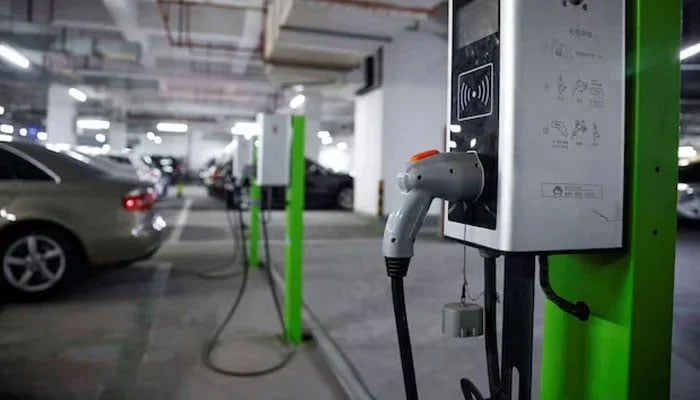
ISLAMABAD: Pakistan’s ambitious plan to transition towards electric mobility is facing friction as private-sector stakeholders raise concerns over regulatory barriers affecting the import and deployment of electric vehicle (EV) charging infrastructure.
At the centre of the issue is a disputed classification under Customs General Order (CGO) Entry No 938 in the Draft CGO No 3 (revised as of February 25, 2025), which industry players argue is hindering the timely rollout of EV charging stations across the country. The concerns have been formally raised in a letter by Go Green Avenue (Pvt) Ltd, a private EV solutions provider, to the Engineering Development Board.
The government’s New Energy Vehicles (NEV) Policy 2025-30 aims to convert 30 percent of new vehicle sales, including motorcycles, rickshaws, passenger cars, buses and trucks, to electric by 2030. A critical component of this transition is the installation of approximately 3,000 EV charging stations nationwide, including both standard and fast-charging units.
However, stakeholders warn that this target could be jeopardised by what they describe as “non-tariff barriers” that provide undue protection to certain local manufacturers.
According to industry sources, the company benefiting from CGO Entry No 938 claims to manufacture a full range of EV chargers. However, critics argue that its production capabilities are limited to Level 2 chargers with output power of up to 50 kW, and that it does not manufacture Level 3 DC fast chargers — considered essential for rapid public charging infrastructure.
Further concerns have been raised about compliance with international safety and performance standards. The chargers in question are reportedly certified only for basic physical protection, while lacking adherence to key global standards such as IEC 61851 and IEC 62196, which govern EV charging systems and connectors, as well as IEC 62311 related to electromagnetic field exposure.
In addition, experts highlight deficiencies in electromagnetic compatibility (EMC) and communication standards necessary for integrating EV chargers into a national network. These include internationally recognized benchmarks such as the ETSI EN 301 489 series and the EN IEC 61000 framework.
Questions have also been raised about whether the manufacturer complies with internationally recognised quality management standards such as ISO 9001:2015.Meanwhile, Go Green Avenue (Pvt) Ltd says its operations have been directly impacted by the policy. The company is actively working with automotive manufacturers and infrastructure partners to deploy a nationwide network of EV charging stations, including fast-charging units at shopping malls, motorways, and fuel stations.
The company has reported that one of its recent shipments of EV chargers remains held at Karachi Customs due to the disputed CGO classification, delaying several ongoing and planned projects.
In a formal appeal to the Engineering Development Board, the company has requested a revision or removal of CGO Entry No. 938, along with a one-time exemption to allow clearance of its current shipment.