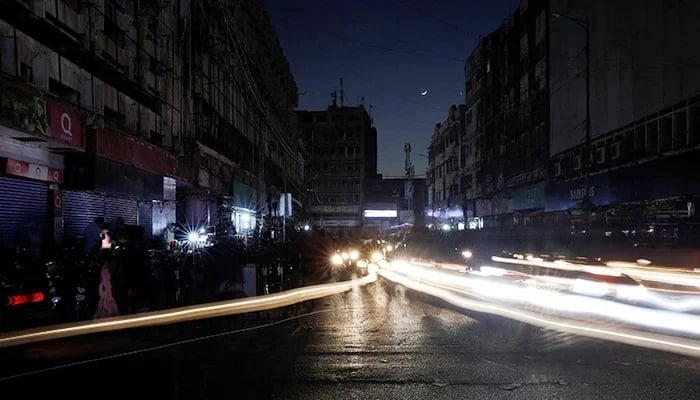
Pakistan has been here before. A global shock – a pandemic, a regional war, oil price shocks and now a blocked strait – tightens the screws on energy supply, inflation threatens to spiral and for a brief, uncomfortable moment, the fragility of our economy built on imported fuel becomes impossible to ignore.
Then the crisis passes, and so does the urgency. The question Pakistan never quite gets around to answering is: how do we make sure the next one does not hurt us the same way? Because there will be another one. That is not pessimism. It is economics.
In 1965, political economist Mancur Olson published ‘The Logic of Collective Action’, arguing that rational individuals, even when they share a common interest, will systematically fail to act on it when the costs of action are immediate and concentrated, but the benefits are diffused and long-term. He was writing about trade unions and lobbying groups. He could just as easily have been writing about Pakistan’s energy policy.
History makes this painfully clear. In the early 1990s and again across the blackout years spanning 2009-13, faced with a crippling power shortfall, Pakistan turned to an expedient fix: rapid installation of thermal power plants, locked in through capacity payment agreements that obligated the state to pay for power whether it was consumed or not.
Thermal plants were fast to build and promised immediate relief. What they also delivered was a generation of fuel import dependency, a circular debt that peaked at over Rs2.4 trillion in 2025 and tariffs that rose by over 155 per cent between 2021 and 2024, making Pakistani industry uncompetitive and Pakistani households unable to pay their bills. The major challenge resulting from this was the capacity payments that reached up to Rs2.5 trillion by mid-2025. The short-term fix became the long-term crisis. Pakistan did not stumble into this trap. It chose it.
This condition is termed ‘carbon lock-in’, in which economies are trapped in fossil fuel dependency, not because alternatives are unavailable, but because existing infrastructure, institutions and incentive structures actively resist transition. Lock-in is not inertia. It is a self-reinforcing system: LNG terminals need cargoes to justify their costs and capacity payments to independent power producers make every new renewable unit a financial threat to the old order. Built through the previous era of short-term planning, Pakistan today sits on a surplus of power generation capacity, replayed in a different decade with a different fuel, by a state that is yet to learn from the trap it keeps setting for itself.
Every stakeholder in Pakistan’s energy ecosystem had a short-term incentive to maintain the status quo. The state avoids the fiscal pain of restructuring legacy power purchase agreements, fails to leverage current opportunities and ignores the impact of ongoing trends. The fuel import lobby protects a business model built on volume and margin. Circular debt is refinanced rather than resolved. And the consumers who were burdened, exhausted and politically unorganised absorbed the cost in silence. No single actor bears enough of the collective loss to unilaterally shoulder the cost of change. And so, nothing changed for long. The conversation is deferred until the next crisis.
So, what happened against this backdrop was nothing alarming but clarifying. Olson mentioned the same. Without much coordinated policy support, Pakistan’s households, agricultural fields and industries built one of the world’s fastest-growing rooftop solar markets. By early 2026, Pakistan had imported around 52GW of solar PV (mostly in the last three years). Cumulatively, this people-led revolution has avoided an estimated $12 billion in oil and gas imports since 2018. This is not a subsidy-driven transformation. It is millions of rational economic actors reaching the same conclusion independently: that imported energy is too expensive, too unreliable, and too dangerous to depend on. The market has already sent its signal.
A recent high-level dialogue convened by the Sustainable Development Policy Institute (SDPI) brought together energy experts, economists and legal scholars to map the way forward. The recommendations that emerged – removing taxes on solar equipment, reversing the rollback of Pakistan’s net metering policy, investing in grid flexibility and storage, and localising clean energy manufacturing – are not radical propositions. They are the bare minimum required to translate a market signal into a policy framework: the institutional architecture, in Olson’s terms, needed to finally solve the collective action problem.
The argument that Pakistan cannot afford this transition has it precisely backwards. What Pakistan cannot afford is another decade of imported inflation and double-digit energy tariffs, where the bulk of the electricity bill goes not towards actual energy but towards servicing the structural debt of a broken system. The cost of inaction is not hypothetical.
So what needs to be done, and what trends is Pakistan positioned to leverage given its economic and environmental landscape? The EU’s Carbon Border Adjustment Mechanism, as of 2026, has entered its definitive phase, placing a carbon price on imports of energy-intensive goods. For Pakistan whose grid is more emission-intensive than the EU, it poses a direct threat to export-oriented sectors, especially once textiles are covered, given that the sector accounts for 60 per cent of Pakistan’s total exports and 75.8 per cent of its EU-bound trade.
The competitiveness of Pakistan’s largest export sector is, in this sense, now coupled with the carbon intensity of its grid. Hence, the competitiveness of Pakistan’s largest export-oriented sector is coupled with the carbon intensity of the grid, which needs to be decarbonised.
Along with these external pressures, there is already a developing economic case for the early retirement or repurposing of thermal power plants from within. Pakistan’s Indicative Generation Capacity Expansion Plan (IGCEP 2025) documents a decline in the utilisation rates of coal power plants, and with further grid deflection driven by rooftop solar, these assets are on a trajectory toward becoming stranded.
The time has come to explore the alternative financing mechanisms that can support their early retirement or repurposing to low-carbon resources. Mechanisms such as the ADB’s Energy Transition Mechanism, the Coal-to-Clean Credit Initiative and other alternative financing instruments can support a structured, phased exit of the fossil fuel fleet. The recent UNESCAP mission to Pakistan reinforces this, recommending the development of a National Energy Transition Investment Plan to mobilise and sequence the financing required for such a transition. Pakistan needs to redefine its energy and climate diplomacy to support its efforts to tap these opportunities.
Against this, the single most consequential reform enabler also emerges: energy storage. On the one hand, it can reinforce the dying utility-scale infrastructure, while also providing room for renewables to grow on the other hand. After solar PV, Pakistan is already experiencing a battery rush, with BESS imports accelerating sharply across residential, commercial and industrial segments. Storage improves grid flexibility, strengthens reliability of supply, manages industrial load and enables higher integration of VRE, making it the connective tissue between the solar revolution already underway and the dispatchable, clean grid that Pakistan’s industrial competitiveness now demands.
The enabling conditions are in place: cheap solar and falling battery costs. Hence, what Pakistan needs to focus on is the emerging clean-tech and move beyond technologies of the past. This would require an enabling case and a policy architecture that allows this transition to scale.
The window between crisis and complacency is narrow, and Pakistan has historically squandered it. The FY2026-27 budget is an immediate test – and not of ambition, which has been articulated often enough, but of institutional seriousness. A government that taxes solar panels while subsidising fossil fuel infrastructure is not making a neutral fiscal choice. It is choosing lock-in, with full knowledge of the consequences.
Pakistanis have already voted with their rooftops. The question is whether the state will finally count those votes or wait, once again, for the next crisis to force the same conversation all over again.
The writer is a senior researcher at the Sustainable Development Policy Institute (SDPI), Islamabad.