_akhbar.jpg)
There are moments in a nation's journey when one issue rises above all others and demands clarity, courage, and immediate action. For Pakistan, that issue is population.
For too long, we have treated population growth as a background issue-serious, yes, but somehow deferrable. It is not. It now sits at the heart of nearly every major national strain: education, health, jobs, food security, water stress, fiscal pressure, and the daily survival of ordinary families.
Pakistan's own census-based data now puts the country's annual population growth rate at 2.55%. That is not merely "high." It is alarming. It means Pakistan is adding people at a pace far above the global average and well above many countries in the region and the wider Muslim world. Pakistan's planning authorities have explicitly flagged 2.55% as a national challenge, while the 2023 census reported the population at about 241.5 million.
By comparison, the World Bank's latest estimates put recent annual population growth at about 0.9% in India, 1.2% in Bangladesh, 1.1% in Iran, while the world average is about 1.0%. Pakistan's census-based 2.55% therefore places it on a much steeper demographic curve than countries it is often compared with.
At this pace, the implications are severe. If one simply extends a 2.55% annual growth path from the 2023 census base of 241.5 million, Pakistan's population will rise to roughly 288 million by 2030, 327 million by 2035, and about 371 million by 2040. At that rate, the population would double in roughly 27 to 28 years-effectively within a generation.
These are not abstract numbers. They translate directly into pressure that the state is already struggling to bear.
Take education first. Pakistan already has an education emergency. UNICEF says over 26 million children of school age are out of school, one of the highest such figures in the world. At the same time, Pakistan's Economic Census reports about 242,616 schools nationwide. If population were to climb from 241.5 million to around 370.5 million by 2040, and if the country merely tried to preserve today's already inadequate school-per-capita ratio, it would imply the need for roughly 129,000 additional schools over time. That is not to achieve excellence; it is only to avoid falling further behind.
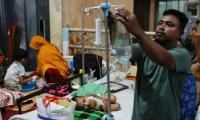
Healthcare is no less stark. Pakistan Bureau of Statistics (PBS) data says the country had 1,284 public hospitals in 2022. On the same crude per-capita basis, a population approaching 370 million would imply the need for roughly 680 more public hospitals just to preserve today's ratio. Yet today's ratio itself is far from adequate. The burden on maternal care, child health, emergency medicine, and basic public health infrastructure would become crushing.
The medical workforce challenge is equally serious. PBS notes the World Health Organization (WHO) yardstick of 1 doctor per 1,000 people; at a population of 241.5 million, that implies a need for 241,500 doctors. At a population of about 370.5 million, that benchmark rises to roughly 370,500 doctors. In other words, population growth alone would add a requirement of about 129,000 more doctors merely to meet a basic benchmark at 2040 population levels. And that says nothing about nurses, midwives, paramedics, technicians, or the uneven rural distribution of healthcare facilities.
This is why the family planning debate in Pakistan cannot be reduced to ideology, embarrassment, or slogan. It is fundamentally about whether the state can keep pace with the number of people it must educate, heal, employ, house, and feed.
It is also about the welfare of the household. Family planning is sometimes framed as a state agenda. That is a mistake. In reality, it is a family welfare agenda. When births are spaced, mothers are healthier, children receive more care, nutrition improves, and household resources stretch further. Fewer pregnancies in rapid succession can mean less maternal depletion, lower financial stress, and better outcomes for every child in the home. That is why birth spacing is not just a demographic instrument. It is an act of family protection.
This is also why the WAQFA framing matters. In Pakistan's social context, the most constructive conversation is not about abstract population control. It is about waqfa-a pause, spacing, balance, recovery, responsibility. It is about giving the mother time to recover, the child a fairer start, and the family breathing room to cope. It is humane, culturally resonant, and entirely consistent with the realities ordinary families already understand.
The comparison with Bangladesh should particularly trouble us. Bangladesh, once routinely assumed to be behind Pakistan on many social indicators, has moved to a much lower growth path. Its latest annual growth rate is about 1.2%, less than half Pakistan's census-based 2.55%. The lesson is not that Pakistan should imitate another country mechanically. The lesson is that demographic transition is possible when policy, outreach, services, and public communication move in the same direction.
Pakistan does not lack intelligence on this issue. It lacks sustained national seriousness. We cannot continue to add people at a pace that outstrips our ability to provide schools, hospitals, doctors, jobs, and dignity. Every year of delay compounds the deficit. Every year of hesitation deepens the strain on households already living close to the edge.
Population management is therefore not one policy priority among many. It is the platform on which all other priorities rest. Without it, gains in education, health, poverty reduction, and development will be diluted by sheer arithmetic.
This is now a survival issue.
Managing population is not optional. It is not a side conversation. It is not something we can postpone for a politically easier day. It is a no-option deal for Pakistan.
The Infrastructure Strain (2040 Projections) 371 Million People by 2040
Pakistan’s Projected population based on the current 2.55% growth trajectory
129,000 Additional Schools Required
Needed by 2040 just to maintain the current per-capita education ratio.
129,000 More Doctors Needed
Required to meet basic WHO benchmark of 1 doctor per 1,000 people.