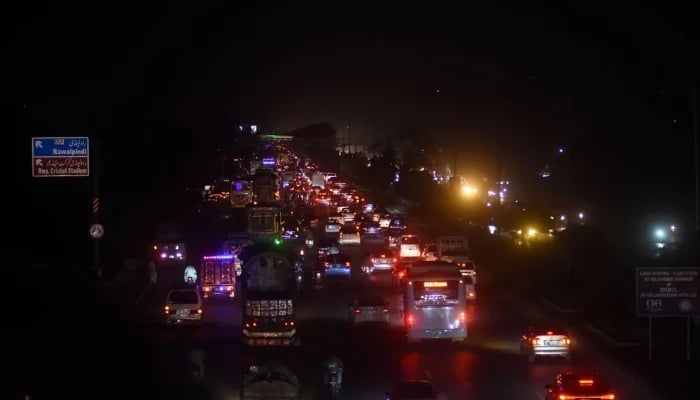
LAHORE: After a brief lull, unannounced loadshedding has resurfaced across the country, exposing a widening gap between official government claims and the ground reality being faced by electricity consumers.
The Power Division’s assertions of a stabilised national energy grid are increasingly being met with skepticism, as consumers continue to report power outages lasting up to three hours in various regions. While the federal energy ministry has highlighted a surge in hydroelectric production to 5,000MW and claimed that most distribution companies have avoided load management, complaints of prolonged and unannounced power suspensions continue to pour in from multiple areas.
According to an official, the recent increase in electricity demand, driven by rising temperatures, has once again triggered a cycle of loadshedding, with the overall power shortfall reaching approximately 4,900 megawatts. Against a total national demand of around 22,000MW, electricity generation has been limited to just 17,100MW, inevitably leading to increased outages across the system. This breakdown in service delivery comes at a time when areas served by major power distribution companies—including Lahore Electric Supply Company (Lesco), Islamabad Electric Supply Company (Iesco) and Karachi Electric (K-Electric)—have all experienced outages on Tuesday, particularly during evening hours when demand typically peaks.
The growing crisis is largely being attributed to a significant generation gap, as nearly 5,500MW of high-efficiency LNG-fired power plants remain completely offline due to the government’s inability to secure adequate fuel supplies. The continued reliance on seasonal water flows from dams to compensate for the inactivity of nearly 20 percent of the country’s installed capacity highlights the fragility of the system, which remains heavily dependent on weather conditions rather than consistent fuel management.
Compounding the situation is a sharp rise in temperatures, which has pushed electricity demand significantly higher. In the Lesco region alone, demand has surged by an additional 900MW, taking total requirements to approximately 3,600MW, while supply from the National Power Control Center remains limited to around 3,000MW, creating a substantial deficit.
Critics argue that the Power Division has attempted to frame these outages as a strategic policy targeting “line losses” and “electricity theft,” suggesting that such categorisation is being used to mask an underlying generation shortfall. By labeling blackouts as “policy-based management” rather than acknowledging systemic issues, the government is effectively shifting the burden onto consumers while failing to address core problems such as grid inefficiencies and delays in fuel procurement. The situation across several distribution companies indicates that even areas considered relatively stable are now facing erratic power cuts, raising concerns about the system’s ability to withstand further pressure as peak summer approaches. The persistence of outages at this stage suggests that authorities are already struggling to maintain grid stability.