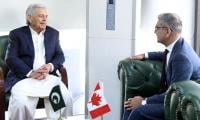
LAHORE: Pakistan’s active and effective role in brokering peace between the US and Iran will probably impact its economy positively in the short term but sustained growth will come with policy consistency, regulatory certainty and strong enforcement of rules.
Planners certainly know that even if Pakistan were somehow able to eliminate its external debt burden, it would not become economically self-reliant. Debt relief would provide breathing space, not transformation. Lower debt servicing would ease pressure on foreign exchange reserves and stabilise the currency. It would reduce the immediate need for emergency financing and allow policymakers some room to manoeuvre. However, it would not address the structural weaknesses that repeatedly push the country into economic stress.
Pakistan would have to strive for lasting peace with its neighbours as the recent tensions in the Middle East have once again exposed how quickly economic value can evaporate. In a matter of weeks, vast sums can be lost, not only in military hardware but also in oil infrastructure, real estate, logistics networks and agricultural output.
In fact Pakistan did not actively participate in the US-Iran war but could not escape the interconnected global system where shocks travel instantly across borders, markets, and currencies. Its economy suffered the consequential damage without firing a single shot. The first and most immediate impact comes through energy markets. The disruptions in oil-producing regions create price volatility, driven as much by fear as by actual shortages.
For Pakistan, which relies heavily on imported fuel, this translates into higher import bills, pressure on foreign exchange reserves, and a weakening currency. Energy costs then cascade through the economy, raising electricity tariffs, inflating production costs, and eroding household purchasing power.
Higher fuel costs slow industrial output, strain public finances, and complicate monetary policy. Growth weakens not because of domestic mismanagement, but because of external instability. All other economies that did not participate in war faced these problems. Pakistan, with its existing vulnerabilities, faces amplified pressure in such environments, often forcing it back into cycles of external assistance.
In times of global uncertainty, capital does not disappear; it retreats to perceived safety. Emerging markets are often the first to feel the consequences. Investment inflows decline, borrowing costs rise, and access to international capital markets becomes constrained. For Pakistan, any instability in the Gulf region carries direct implications for remittance flows, which remain a critical source of foreign exchange. Even minor disruptions can have outsized macroeconomic effects.
Pakistan must focus on self-reliance which is not dependent on debt levels alone; it is a function of productive strength. Currently its heavy dependence on low-value-added goods limits the country’s ability to earn foreign exchange sustainably. Without expanding into higher-value sectors — engineering goods, technology and processed industries — the imbalance between dollar inflows and outflows will persist.
Present high energy costs and unreliable supply undermine industrial productivity, making local firms less competitive in global markets. At the same time the government uses its limited tax base to eliminate borrowing and perpetuate fiscal fragility. Equally important is the question of governance. Policy inconsistency, regulatory uncertainty, and weak enforcement of rules discourage long-term investment. This brings the debate to austerity. While often presented as a solution, austerity is a double-edged instrument. When applied judiciously — by reducing wasteful expenditures, improving tax collection and targeting inefficiencies — it can stabilise the economy. But when it suppresses development spending or places disproportionate burdens on already strained sectors, it risks weakening the very foundations of growth.
Pakistan’s challenge, therefore, is not merely to survive external shocks but to build the capacity to absorb them. This requires a shift from crisis management to structural reform: expanding exports, improving productivity, broadening the tax base, and strengthening institutional credibility.
For Pakistan, the path to resilience does not lie in debt elimination alone, nor in austerity for its own sake. It lies in constructing an economy that generates its own momentum, one that earns, produces and adapts, rather than merely reacts.