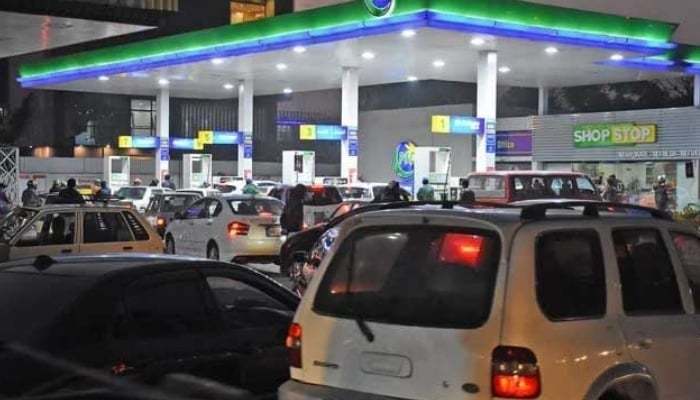
ISLAMABAD: National fuel consumption has seen a sharp decline in the first half of April 2026 compared to the previous year, as the government rolls out a stringent digital monitoring regime across all petrol pumps to regulate and minimise fuel usage.
Official data of Pakistan State Oil (PSO) reveals a significant year-on-year drop in sales in petrol pumps for the first 15 days of April -- amid surge in prices -- with Premier Motor Gasoline (PMG) falling by 14 percent and High-Speed Diesel (HSD) plunging by 26 percent.
On the other hand, the Ministry of Energy -- through the Oil & Gas Regulatory Authority (Ogra) -- has mandated through official letters and notifications available with The News that every retail outlet (petrol pump) across Pakistan maintain two dedicated mobile devices to run a pair of specialised applications.
A source in the energy sector on condition of anonymity explained that this “dual-app” system aims to achieve total visibility of the oil supply chain and implement fuel rationalisation at the consumer level. However, the source also highlighted that one of the applications -- National Fuel Pass -- is much likely to monitor individual consumption habits to enforce engine-based quota system.
“This has raised concerns regarding its implementation, efficiency alongside the practical challenge of differentiating between private and high-usage commercial vehicles to ensure fair fuel distribution,” said the source.
The first application, Ogra Sales Portal/Mobile App, is already operational. Developed in collaboration with the Punjab Information Technology Board (PITB), it requires dealers to upload stock receipts, sales volumes in litres and current inventory levels daily before 10:00am.
This platform is directly linked to a dashboard monitored by the Prime Minister’s Office, intended to prevent hoarding and “non-nozzle” sales by tracking oil movement from imports and local production down to the individual pump. Ogra has warned that any non-compliance or incorrect reporting will result in immediate regulatory action under the Oil Rules 2016.
Ogra app monitors the pump and the second app -- National Fuel Pass App -- is also serving the purpose. This application is reportedly being prepared for deployment. Although Oil Marketing Companies (OMCs) are currently awaiting final government directives, sources within the energy sector indicate this app will be used for “rationalisation” of petrol.
Under this proposed system, fuel consumption would be monitored per vehicle, with specific quotas assigned based on engine displacement (CC). This move suggests a shift towards a subsidised or restricted consumption model to manage the country’s energy demand.
Despite repeated attempts, the Ministry of Energy remained silent regarding the specifics of the National Fuel Pass. A questionnaire sent to the Minister of Energy seeking clarification on several critical issues has gone unanswered.
Key concerns include: 1) Whether the system will account for vehicle age and fuel efficiency or strictly engine size. 2) How the government will differentiate between private use and high-usage commercial services like deliveries. 3) What cybersecurity measures are in place to protect the individual consumption habits of citizens? 4) How dealers are expected to maintain “immediate compliance” with reporting deadlines during technical outages or hardware failures.
As the government pushes for “Most Urgent” implementation of these digital tools, the petroleum sector remains in a state of transition. While the digital trail aims to curb the black market and stabilise supply chain, the impending quota system signals a new era of regulated energy consumption for the Pakistani public.