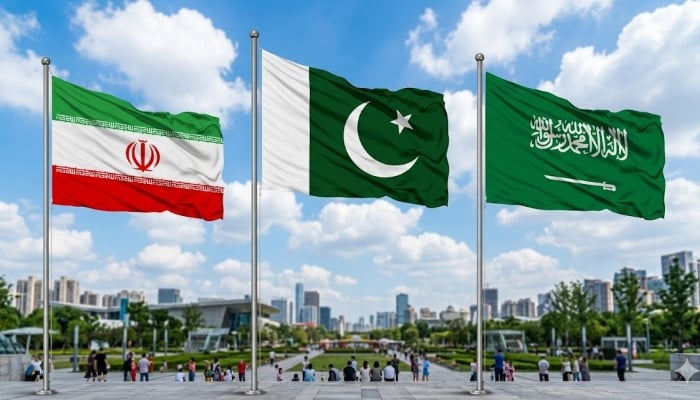
ISLAMABAD: Prime Minister Shehbaz Sharif and Chief of Army Staff (COAS) and Chief of Defence Forces (CDF) Field Marshal Syed Asim Munir on Wednesday undertook coordinated foreign visits to Saudi Arabia and Iran, respectively, as part of Pakistan’s diplomatic push to ease the Middle East tensions and promote lasting regional peace.
Shehbaz Sharif’s visit to the Kingdom of Saudi Arabia is part of his three-nation visit beginning Wednesday.
Makkah Region Deputy Governor Prince Saud bin Mashaal bin Abdulaziz, Saudi Ambassador to Pakistan Nawaf bin Saeed Al-Maliki and Pakistan’s Ambassador to Saudi Arabia Ahmed Farooq welcomed the premier and Pakistani delegation upon their arrival at the airport, reports Geo News.
According to a statement issued by the Prime Minister’s Office, Shehbaz held a meeting with Saudi Crown Prince and Prime Minister Muhammad bin Salman bin Abdulaziz Al-Saud in Jeddah. The meeting included discussions on the deepening of Pakistan-Saudi partnership, as well as the wider situation in the region.
Deputy Prime Minister/Foreign Minister Senator Muhammad Ishaq Dar, Minister for Information and Broadcasting Attaullah Tarar, Special Assistant to the Prime Minister Syed Tariq Fatemi and Prime Minister’s Spokesperson for Foreign Media Mosharraf Zaidi accompany the premier on the tour.
The prime minister will also travel to Qatar and Turkiye following his visit to the Kingdom, the FO said. It added that the visits to Saudi Arabia and Qatar will take place in a bilateral context, where the prime minister will meet the respective leadership to discuss the ongoing cooperation as well as regional peace and security.
During his visit to Turkiye, the prime minister will participate in the Antalya Diplomacy Forum, where he is scheduled to join the Leaders’ Panel alongside other global figures and present Pakistan’s perspective. The visit follows as Pakistan has taken the centre stage as host of high-stakes US-Iran talks in Islamabad, drawing global attention amid rising regional tensions.
On the sidelines of the forum, Shehbaz is expected to hold bilateral meetings, including with Turkish President Recep Tayyip Erdogan and other key world leaders, according to the FO. “Pakistan’s participation in the forum reflects its commitment to constructive diplomacy, multilateral cooperation and active engagement on global issues,” the FO added.
In a related development, Field Marshal Asim Munir and Interior Minister Mohsin Naqvi, along with a delegation, arrived in Tehran. Foreign Minister Abbas Araghchi warmly welcomed the Pakistani delegation at the airport, reports Muhammad Anis quoting the ISPR.
Meanwhile, in a major step towards stabilising Pakistan’s foreign exchange reserves, Saudi Arabia has announced an additional deposit of $3 billion, enabling Islamabad to repay the UAE’s outstanding loan of $2.5 billion. The loan is expected to be repaid next week.
Speaking with the media on the sidelines of spring meetings of IMF and World Bank in Washington, D.C., Finance Minister Muhammad Aurangzeb said the Kingdom of Saudi Arabia had committed $3 billion in additional deposits for Pakistan, with the disbursement expected in the coming week.
He said the existing $5 billion Saudi deposit would no longer remain subject to the earlier annual rollover arrangement and would instead be extended for a longer period. Aurangzeb shared with the media important details about the Saudi financial support for Pakistan and the government’s external financing strategy. The minister said the Saudi support came at a critical time and would help the government reinforce the country’s foreign exchange reserves and strengthen the external account.
He reiterated the government’s commitment to maintaining reserves in line with its obligations to markets and under the IMF-supported programme, including the objective of achieving around USD 18 billion in reserves, equivalent to approximately 3.3 months of import cover, by the end of the fiscal year. The finance minister noted that Pakistan had successfully repaid its USD 1.4 billion Eurobond last week, describing it as a “non-event,” and reaffirmed that the government remained fully committed to meeting all upcoming external obligations and maturities on time. He also emphasized that Pakistan’s external financing plan was clearly defined and was being implemented in a responsible and disciplined manner.
Referring to his engagements in Washington, Senator Aurangzeb said he, along with the State Bank governor and Pakistan’s ambassador to the United States, had held a detailed meeting with the Saudi Finance Minister Mohammed bin Abdullah Al-Jadaan.
Aurangzeb recalled that he had also met the Saudi finance minister in Islamabad the previous Friday but the government deliberately refrained from commenting publicly in the absence of formal communication, despite media reports and speculation, as such matters required clarity and joint understanding before being shared.
The finance minister expressed profound gratitude to the leadership of the Kingdom of Saudi Arabia, particularly Crown Prince Mohammed bin Salman, Saudi Finance Minister Mohammed bin Abdullah Al-Jadaan, and the Saudi vice finance minister, for their continued support and close cooperation. He particularly appreciated the efforts made to bring the support package to fruition.
Aurangzeb said sentiment and confidence were critically important at this juncture. He said Pakistan was receiving unprecedented appreciation from the international financial institutions, the IMF, World Bank, institutional investors and counterparts he was meeting in Washington. He noted that the international community was particularly recognising Pakistan’s recent diplomatic and facilitative role in dialogue between the parties that had not held face-to-face discussions for decades.
He said this international appreciation, coupled with Saudi Arabia’s timely financial support, provided Pakistan with important momentum and confidence going forward, both for the economy and for the external account, including its commercial dimensions.
Senator Aurangzeb further noted that Pakistan was advancing its broader external financing agenda, including the recently announced Global Medium-Term Note (GMTN) programme and the planned inaugural Panda Bond issuance, as part of efforts to diversify funding sources and strengthen market access. The finance minister concluded by reaffirming the government’s commitment to macroeconomic stability, fulfillment of external obligations, reform continuity, and sustained engagement with bilateral and multilateral partners. He said a more detailed interaction with the media would take place at the conclusion of the visit.
Meanwhile, speaking at the Atlantic Council on the topic “Pakistan’s Path to Reform and Resilience”, Aurangzeb underscored Pakistan’s emergence as a constructive force in global affairs, including its role in brokering a ceasefire between the United States and Iran.
He affirmed that Pakistan had achieved meaningful macroeconomic stabilization, underpinned by the ongoing programme with the International Monetary Fund (IMF), and supported by strong performance across both fiscal and external accounts. He reiterated Pakistan’s commitment to honouring its obligations as a responsible sovereign borrower.
The minister further noted that his recent engagement with the Saudi finance minister had yielded positive outcomes, including an agreement on extended maturities and additional financial support to help offset repayment pressures. Highlighting the government’s structural reform agenda, he outlined key initiatives, including the privatisation of state-owned enterprises, rightsizing of federal ministries and strengthening of public finance management systems.
He also elaborated on Pakistan’s ongoing digital transformation, aimed at reducing leakages, improving service delivery and enabling better-targeted subsidy programmes through digital public infrastructure. The finance minister signaled a shift in Pakistan-United States economic relations from an aid-based to a trade-based partnership, and noted substantive engagement with the US administration on critical minerals and infrastructure development. In his concluding remarks, Aurangzeb highlighted Pakistan’s energy transition agenda, noting that the country currently had approximately 8,000MWs of installed solar capacity and was pursuing an ambitious plan to scale up renewable energy.
Meanwhile, Iran’s Ambassador in Islamabad, Reza Amiri Moghadam, met with the JUIF chief Fazlur Rehman at his residence. The two sides discussed matters related to relations between the two countries and the Middle East conflict, a statement issued by the JUIF media cell said. Reza Amiri, on behalf of the Iranian nation, thanked the government and people of Pakistan for their strong support, reports Muhammad Anis.
Fazl said it was an honour for Pakistan to host the Islamabad Talks. He said besides desiring lasting peace in the region, the Muslim countries should decide on forming an Islamic bloc. “Formation of an Islamic bloc has always been vital part of our party’s manifesto,” he said. He said the Muslim rulers should be owner of their own resources by making the best use of them.
Amiri acknowledged that Pakistan’s balanced and strong stance was highly commendable. JUIF leaders Maulana Abdul Ghafoor Haideri, Senator Kamran Murtaza and Maulana Asjad Mahmood were also present on the occasion.