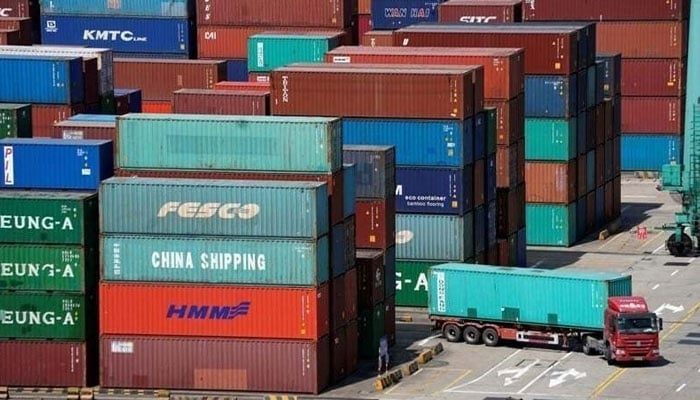
ISLAMABAD: The All Pakistan Textile Mills Association has welcomed a recent move by Pakistan Customs to slash scanning charges on export containers. However, the association has urged authorities to extend the same benefit to import containers used by export-oriented industries.
In a formal communication addressed to Project Director (AEES) at the Collectorate of Customs Appraisement (West) Mona Mehfooz, Aptma acknowledged the decision outlined in a notification issued on April 4. The notification announced a 50 per cent reduction in scanning charges for export containers, effective April 1, as part of efforts to facilitate trade amid ongoing global economic pressures.
Under the revised structure, scanning charges have been reduced to $10.5 for FEUs (forty-foot equivalent units) and $7.5 for TEUs (twenty-foot equivalent units). The initiative, implemented in coordination with the National Logistics Cell, also calls on terminal operators to correspondingly reduce their own handling charges.
Aptma described the measure as particularly significant given the persistent congestion at seaports, a challenge largely beyond exporters’ control. The association noted that lowering scanning costs would help improve export competitiveness, especially in a difficult global trading environment.
However, Aptma emphasised that the relief should not be limited to exports alone. It argued that many exporters rely heavily on imported raw materials, which are processed locally and re-exported as finished goods. Since these imports are effectively part of the export value chain, the association contended that extending reduced scanning charges to such containers would further ease cost pressures.
The association has called for an early decision on its proposal, highlighting the need for broader policy support to sustain Pakistan’s export sector.
The original customs directive was circulated to major terminal operators, including Karachi International Container Terminal (KICT), Karachi Gateway Terminal (KGTL), South Asia Pakistan Terminals (SAPT), and DP World’s Qasim International Container Terminal (QICT), instructing them to implement the reduced rates and pass on the benefit to traders.the need for broader policy support to sustain Pakistan’s export sector.
The original customs directive was circulated to major terminal operators, including Karachi International Container Terminal (KICT), Karachi Gateway Terminal (KGTL), South Asia Pakistan Terminals (SAPT), and DP World’s Qasim International Container Terminal (QICT), instructing them to implement the reduced rates and pass on the benefit to traders.