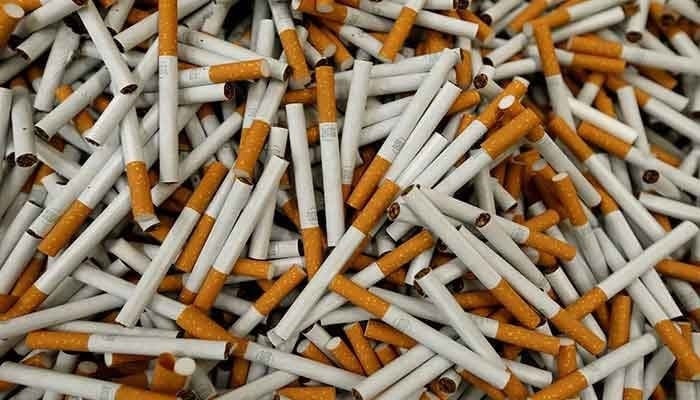
ISLAMABAD: Minister of State for Finance Bilal Azhar Kiani on Tuesday said illicit tobacco trade was causing annual losses of up to Rs200 billion to the national exchequer, citing estimates by the Federal Board of Revenue (FBR).
He said revenue losses from illegal cigarettes were estimated to range between Rs133 billion and Rs200 billion each year.The government, in coordination with provincial authorities, has launched a nationwide crackdown on the sale of illicit cigarettes to curb the expanding black market, Kiani said.
Separately, a report by Oxford Economics estimated significantly higher losses, placing the annual revenue impact between Rs274 billion and Rs343 billion. The study attributed the surge in illicit trade to increases in excise duties, which pushed the share of illegal cigarettes to 54 per cent in the fiscal year 2024-25.
Speaking at the launch of the report, titled ‘An Economic Assessment of the Illicit Cigarette Market in Pakistan’, Kiani said provincial governments would intensify enforcement operations to eliminate the widespread availability of untaxed cigarette brands.
He described curbing the illegal cigarette trade as “unavoidable”, warning that the unchecked market was eroding revenues, undermining the documented economy and discouraging compliant taxpayers.
Kiani added that several illegal manufacturing units had been shut down, while raids against retailers selling illicit products were ongoing.According to the Oxford Economics report, illicit cigarettes now account for more than half of Pakistan’s tobacco market, highlighting the scale of the problem and its impact on public finances.
The study estimated that illicit consumption amounted to 43.5 billion cigarettes, placing Pakistan among the largest illicit cigarette markets globally. While total consumption has remained broadly stable at around 80 billion sticks annually over the past decade, legal sales have been steadily displaced by illegal products.
The report identified sharp increases in excise duties as a key driver of this shift. Between the first quarter of 2022 and the second quarter of 2023, real excise taxes rose by 107 per cent, widening the price gap between legal and illicit cigarettes. Illegal products were, on average, around 36 per cent cheaper, encouraging consumers to switch.
“The evidence highlights the risks associated with sharp and unpredictable tax increases,” said Andrew Logan, Director of Industry Consulting at Oxford Economics. “Pakistan’s experience shows how quickly consumption shifts when affordability and enforcement gaps widen.”
On the supply side, the report said the illicit market was largely domestic. About 64 per cent of tax-evaded cigarettes were produced within Pakistan, mainly in Azad Jammu and Kashmir and Khyber Pakhtunkhwa (KP), while smuggling accounted for the remaining 36 per cent, primarily via Afghanistan and involving brands linked to the UAE and South Korea.It said porous borders, organised criminal networks and weak enforcement were exacerbating the problem.
“These findings underline the need for sustained, coordinated enforcement across the entire supply chain,” Logan said. “Without policy predictability and consistent enforcement, illicit operators will continue to undermine revenue collection and legitimate businesses.”
The report noted that existing measures had yielded limited results. The track and trace system remained poorly enforced, with only 22 of 477 brands fully compliant, while the illicit market share rose from 39 per cent to 54 per cent after its introduction. Similarly, the advance adjustable excise on acetate tow had led to misdeclaration and smuggling of raw materials rather than curbing illegal production.
Oxford Economics warned that revenue losses from illicit cigarettes may exceed total excise collections from legal sales in Pakistan.The report concluded that tackling illicit trade would require a coordinated, long-term strategy combining predictable taxation with stronger enforcement across borders, supply chains, retail markets and full compliance with track and trace systems.