WASHINGTON/DUBAI: The US military began a blockade of ships leaving Iran’s ports on Monday, President Donald Trump said, and Tehran threatened to retaliate against its Gulf neighbours’ ports after weekend talks in Islamabad on ending the war broke down.
Brigadier General Reza Talaei-Nik, a spokesperson for Iran’s Ministry of Defence, warned that foreign military efforts to police the strait would escalate the crisis and instability in global energy security.
Iran´s military said the US naval blockade would be illegal and amount to piracy. “The restrictions imposed by criminal America on maritime navigation and transit in international waters are illegal and constitute an example of piracy,” said a statement issued by the Iranian military´s central command centre, Khatam Al-Anbiya, that was read on state television. “If the security of the Islamic Republic of Iran´s ports in the waters of the Persian Gulf and the Arabian Sea is threatened, no port in the Persian Gulf and the Arabian Sea will be safe,” it added.
A US official said there was continued engagement with Iran, and forward motion on trying to get to an agreement. Trump said Iran had been in touch on Monday and wanted to make a deal but that he would not sanction any agreement allowing Tehran to have a nuclear weapon. “Iran will not have a nuclear weapon,” Trump told reporters at the White House. “We can’t let a country blackmail or extort the world.” He said Iran wants to make a deal ‘very badly’. “They’d like to make a deal, very badly,” Trump said.
Since the United States and Israel began the war on February 28, Iran effectively shut the Strait of Hormuz to all vessels except its own, saying passage would be permitted only under Iranian control and subject to a fee.
Trump has said Washington would block Iranian vessels and any ships that paid such tolls and that any Iranian “fast-attack” ships that went near the blockade would be eliminated.
NATO allies including Britain and France said they would not be drawn into the conflict by taking part in the blockade, stressing instead the need to reopen the waterway, through which about one-fifth of the world’s oil normally passes.
The ceasefire that halted six weeks of US and Israeli airstrikes looked in jeopardy, with only a week left to run. Washington said Tehran rejected its demands at weekend talks in Islamabad, the highest-level discussions between the two nations since Iran’s 1979 Islamic Revolution.
The US military’s Central Command said the blockade would be “enforced impartially against vessels of all nations” entering or leaving Iranian ports in the Gulf and Gulf of Oman.“The blockade will not impede neutral transit passage through the Strait of Hormuz to or from non-Iranian destinations,” Central Command said in a note to seafarers seen by Reuters on Monday.
Two Iranian-linked tankers, the Aurora and New Future, left the strait laden with oil products on Monday before the deadline, according to LSEG data.
An Iranian military spokesperson called any US restrictions on international shipping “piracy,” warning that if Iranian ports were threatened, no port in the Gulf or Gulf of Oman would be secure. Any military vessels approaching the strait would violate the ceasefire, Iran’s Revolutionary Guards said.
Trump said Iran’s navy had been “completely obliterated” during the war, adding that only a small number of “fast-attack ships” remained.“Warning: If any of these ships come anywhere close to our BLOCKADE, they will be immediately ELIMINATED, using the same system of kill that we use against the drug dealers on boats at Sea. It is quick and brutal,” Trump, much of whose communications are on social media, wrote on his microblogging site.
Trump said 34 ships had passed through the Strait of Hormuz on Sunday, adding that it was the highest number since Iran choked off the waterway during the Middle East war.
With the war unpopular at home and rising energy prices causing political blowback, Trump paused the U.S.-Israeli bombing campaign last week after threatening to destroy Iran’s “whole civilisation” unless it reopened the strait.
Israel has continued to bombard Lebanon and on Monday Israeli troops launched an attack it said was intended to seize a key south Lebanon town from Iran-backed Hezbollah. Israel and the US have said the campaign against Hezbollah was not part of the ceasefire, while Iran has insisted it is.
The International Committee of the Red Cross said on Monday it was deeply concerned about attacks on medical workers in Lebanon after a deadly strike on a Red Cross center in the country.Iran has brought new demands, including recognition of its control of the waterway, lifting of sanctions and the withdrawal of forces from US military bases across the Middle East.
Meanwhile, Trump officials are internally discussing details for a potential second, in-person meeting with Iranian officials before the ceasefire between Washington and Tehran expires next week, should the opportunity present itself, a source familiar with the talks told CNN, though it’s unclear whether such a meeting could materialize.
Officials are looking at potential dates and locations should ongoing talks with Iran and mediators in the region progress in the coming days, the source said, describing the discussions as preliminary. “We need to be prepared to stand something up quickly should things head in that direction,” the source said.
A regional source told CNN there could be another round of negotiations and Turkiye is working to bridge the gaps between the two sides.Administration officials remain hopeful a diplomatic off ramp is achievable, people familiar with the talks said.
The head of the UN maritime agency said no country had a legal right to block shipping in the Strait of Hormuz. The International Maritime Organization’s Secretary General Arsenio Dominguez addressed a news conference as access to the strait remained blocked six weeks after the war erupted with US and Israeli strikes against Iran. “In accordance to international law, no countries have the right to prohibit the right of innocent passage or the freedom of navigation through international straits that are used for international transit,” Dominguez said.
Qatar’s foreign minister told his Iranian counterpart that Iran and the United States should engage positively with mediation efforts, warning that maritime routes must not be used as “bargaining tools”.
Qatari Foreign Minister and Premier Sheikh Mohammed bin Abdulrahman Al Thani “stressed the importance of all parties responding positively to the ongoing mediation efforts,” in a call with Abbas Araghchi. “He also emphasised the need to open maritime routes, guarantee freedom of navigation, and refrain from using them as a tool for pressure or bargaining,” according to a statement released by the foreign ministry.
ASEAN encouraged the United States and Iran to press ahead with talks to end the Middle East war and ensure safe passage through the Strait of Hormuz.
Southeast Asian nations like the Philippines and Malaysia rely heavily on oil from the Middle East, much of it exported through the key strait that’s been effectively closed during the conflict.
Foreign ministers of the 11-member Association of Southeast Asian Nations met online to discuss the US-Israeli war against Iran, hours before the US Navy was to start a blockade of Iranian ports.
Russia has withdrawn almost all its staff from Iran’s sole nuclear power plant, built and operated with help from Moscow, the head of Russia’s atomic energy agency said Monday. “We began the final rotation at the Bushehr station,” Alexei Likhachev said, adding that 108 people were evacuated while just 20 -- top managers and those responsible for equipment safety—remained at the station.
China said a blockade of the Strait of Hormuz would go against the international community’s interests and urged calm and restraint by all sides.
The blockade of the Strait of Hormuz does not serve the common interests of the international community, Chinese Foreign Minister Wang Yi told Khaldoon Khalifa Al Mubarak, special envoy of the UAE President for China, in Beijing on Monday, according to a ministry statement.
China called for “unimpeded” navigation through the Strait of Hormuz, a day after US President Donald Trump threatened to blockade the crucial waterway. “The Strait of Hormuz is an important international trade route for goods and energy, and maintaining its security, stability, and unimpeded flow is in the common interest of the international community,” foreign ministry spokesman Guo Jiakun told a news conference.
China called reports it had supplied or intended to supply weapons to Iran “baseless smears”, after several outlets quoted US intelligence sources to that effect. “China has always adopted a cautious and responsible attitude towards the export of military items, implementing strict controls in accordance with its own export control laws and regulations and its international obligations. We oppose baseless smears or malicious association,” foreign ministry spokesman Guo Jiakun told a regular news briefing.
Bahrain summoned the Iraqi ambassador over drone attacks it says were launched from the country towards the kingdom and other Gulf nations despite the US-Iran ceasefire.
Bahrain was the latest Gulf state to protest against the attacks coming from Iraq, after Saudi Arabia summoned the Iraqi envoy a day earlier.
Brussels next week will present plans to tackle high energy costs caused by the Iran war and before the summer will unveil a broader package to boost Europe’s electrification, EU chief Ursula von der Leyen said Monday.
Israeli Prime Minister Benjamin Netanyahu said on Monday that US Vice President JD Vance called him on Sunday after leaving Islamabad, briefing him on weekend talks with Iran that failed to reach a deal.
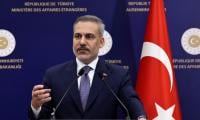
Turkiye’s foreign minister raised concerns about Iran or the United States proposing any new regulations for transiting the Strait of Hormuz, and said he saw difficulties around proposals to re-open the waterway with an international force.
Britain and France will this week co-host talks aimed at restoring freedom of navigation in the Strait of Hormuz, including discussions on what President Emmanuel Macron described as a possible strictly defensive naval mission.
UN Secretary-General Antonio Guterres called on “all parties” to respect freedom of navigation in the Strait of Hormuz, after Iran and subsequently the United States blocked flows through the critical waterway.
The son of Iran’s ousted shah said he is in regular contact with various elements of the highly-divided Iranian opposition in exile, reiterating his desire “to serve as a unifying national figure, not a partisan one.” Reza Pahlavi was speaking during a visit to Stockholm, where he gave a speech on the premises of the country’s parliament, invited by the conservative Christian Democrats and the far-right Sweden Democrats.