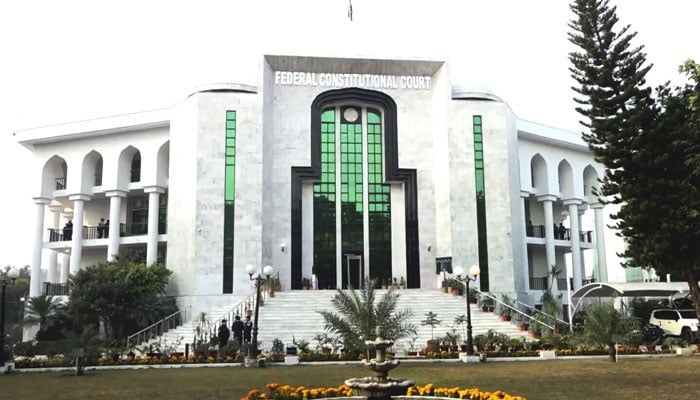
ISLAMABAD: The Federal Constitutional Court (FCC) on Monday adjourned till Tuesday (today) the hearing of scores of petitions regarding the controversial Section 7E of the Income Tax Ordinance, 2001.
A two-member bench headed by Chief Justice Aminuddin Khan heard the petitions transferred to it from various high courts. At the outset of the proceedings, it was pointed out before the bench that all pending cases relating to Section 7E, previously instituted before the Islamabad High Court and other provincial high courts, have now been transferred to the FCC for authoritative adjudication. This consolidation is expected to bring uniformity to a matter that has seen conflicting judicial pronouncements across the country. Representing the Federal Board of Revenue (FBR), Hafiz Ahsaan Ahmad Khokhar, apprised the bench that five different high courts have already rendered judgments on the subject.
He submitted that three of these—namely the Islamabad High Court, Peshawar High Court, and Balochistan High Court—had largely ruled in favour of taxpayers, whereas the Sindh High Court and Lahore High Court had upheld the stance of the Revenue Division.
He further submitted that on the core legal issue—namely the legislative competence of Parliament under Section 77 of the Constitution read with the relevant entry of the Federal Legislative List—the findings had consistently favoured the Revenue Division.
He submitted that Parliament possesses the authority to legislate on taxation matters, and the impugned provision falls within that domain. Meanwhile, the counsel appearing on behalf of the taxpayers commenced their arguments by challenging the vires of the amended provision. They argued that Section 7E, as introduced through subsequent amendments, lacks proper legal foundation and amounts to an impermissible tax on deemed income without constitutional backing.
It was contended that the provision effectively imposes a tax on ownership of immovable property rather than on real income, thereby violating settled principles of taxation law.
After preliminary arguments, the bench adjourned the matter for today (Tuesday), directing the taxpayer-side counsel to continue their submissions. The court indicated that given the multiplicity of judgments and the constitutional questions involved, the matter requires detailed examination.
It is pertinent to mention here that Section 7E was introduced through the Finance Act, 2022 as part of a broader effort to expand the tax base. The provision deems a fixed percentage (typically 5 per cent) of the fair market value of certain immovable properties as taxable income of a resident individual, even if no actual income is derived from such property.
The measure was aimed at bringing into the tax net idle or under-declared real estate assets. The provision was subsequently challenged before various high courts on grounds including lack of legislative competence, double taxation, discrimination, and violation of fundamental rights. Divergent rulings emerged, prompting the need for a final authoritative determination—now entrusted to the FCC.