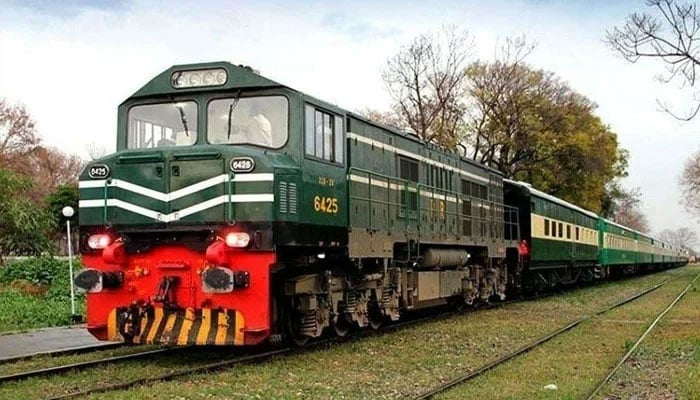
Pakistan Railways, once considered a strength of national integration, is now suffering from a lack of governance, structure, discipline and direction. It is facing a deep cluster of structural failures, ageing and decaying infrastructure, safety crises, obsolete fleet equipment, operational and financial weaknesses, governance and structural confusion and, above all, service quality and public trust.
According to recent government and industry data, the figures reveal both progress and illusion: Pakistan Railways has increased revenues from approximately Rs60 billion in 2021-22 to over Rs93 billion in 2024-25, with 2023-24 already reaching around Rs88 billion. This growth reflects a 50 per cent increase over the last few years, and this is primarily due to improved operations, outsourcing initiatives and partial revival of services. The revenue breakdown in 2024–25 is as follows: passenger revenue Rs47 billion; freight contributed Rs31 billion; and ancillary streams added nearly Rs14 billion.
Revenue is one side of the picture, whereas the expenditures present a different side of the story. According to government budgetary estimates, expenditures are Rs120 billion annually, leaving a deficit of Rs30-35 billion. Although there is a modest surplus of around Rs2 billion in 2024-25, these financials do not include the burden of pensions and long-term infrastructure costs. The federal taxpayer support (direct/indirect) is around Rs40-50 billion annually. Although Pakistan Railways has improved its cash flow, its structural dependence on the state is far from over.
In 1970, Pakistan Railways carried 75 per cent of the country’s freight transportation, and that share today is well below 5.0 per cent. In Pakistan, the logistics costs are around 14-18 per cent of the GDP, whereas in efficient economies, it is around 8-10 per cent. Globally, freight forwarding is the primary profit source of railway systems, whereas in Pakistan, the rail freight income is Rs30 billion, and this is due to over-reliance on road transport- another macroeconomic inefficiency.
Operational constraints are another major factor, as passenger trains average 50-65 km/h due to outdated infrastructure. The cargo trains move even more slowly as the network still relies heavily on manual signalling and ageing tracks. Recurring safety incidents (95 in 2025) are another concern, as we have 7,000 level crossings, of which over 3,000 are unmanned. The railway demands a modern ecosystem which can transform its stations into platforms of progress. The analysis of what railways are and what they can become is the centre point of the debate.
The Lahore Railway Station was built in the aftermath of the 1857 war of independence. Primarily, it was designed to secure territory, move troops and facilitate trade. In 1947, Partition witnessed human migration on an exceptional scale, carrying millions across the border. With such an enriched history and function, today Pakistan RailwayS is struggling to redefine itself. Contrast this with London’s King’s Cross railway station, once a deserted industrial hub, now transformed into a multi-billion-pound economic ecosystem where transportation anchors real estate, retail, technology and culture. The divergence happened because of the institutional choice of regeneration and leadership vision. The same goes for Pakistan Railways, whether it continues to operate its infrastructure or begins to build ecosystems around it.
But all of this will depend on the system’s purpose and philosophy. The British system treats King’s Cross railway station as a regulated marketplace: here, rail infrastructure is developed by the state, but operations are commercially driven by multiple train operating companies, based on efficiency and service quality. Whereas Indian Railways operates as a unified public system but has developed into a capacity-optimising network, investing in electrification and freight corridors to serve the state’s economic and social objectives. Pakistan Railways, however, is neither fully commercial nor fully optimised as a public utility, thus resulting in inefficiency and policy drift. Perhaps we can separate infrastructure from operations, as the UK has done, while preserving India’s focus on scale and integration for optimal outcomes.
There are many global examples, as we are not reinventing the wheel. The Japanese, famous for their punctuality, operate the bullet train, the Shinkansen, at speeds exceeding 300 km/h. More recently, the Saudi Railways Organisation has developed high-speed intercity corridors linking major cities, while in Dubai, the Dubai Metro demonstrates how rail infrastructure, when commercially structured and professionally managed, can generate sustainable growth and returns through integrated real estate and service ecosystems.
Pakistan has also initiated its flagship modernisation effort through the Main Line-1 (ML-1) Upgrade under the China-Pakistan Economic Corridor (CPEC). Under this project, the Karachi to Peshawar corridor will be modernised, aiming for speeds of up to 160 km/h. This $10 billion project will certainly transform the entire backbone of Pakistan Railways, but the delays in execution and financial complexities reflect the critical truth about our governance and institutional inefficiency.
Pakistan Railways can be modernised as it requires a structural reset. It must be divided into two new bodies: first, the New Rail Track Authority (RTA) must be established, which retains the ownership of the rail track, treating it as a public utility, responsible for infrastructure, safety, and capacity management, funded through public investment and transparent access charges. The RTA will permit multiple train operating companies to run trains under regulated access.
Second, we need to create a corporatised Platform and Services Authority (PSA). This will open the market for the commercial potential of stations, including retail, logistics, advertising and real-estate development. At King’s Cross station, non-fare revenues account for 40 per cent of total railway income, yet in Pakistan this untapped source remains underexploited. Third, to corporatise further, a partial listing, floating 10 per cent equity of the services arm, would introduce market discipline, improve governance and attract investment.
Beyond its operations, Pakistan Railways can also explore a revenue stream from cultural and economic capital through heritage tourism. The Lahore Railway Station is a historical landmark with colonial architecture and deep emotional resonance. With new heritage-train services, tourism routes and event spaces, the railway will not only monetise itself but also enhance its national identity and brand. Branded premium trains like the ‘Royal Punjab Line’ or the ‘Indus Heritage Express’ could sell both experience and history, while station zones generate revenue through retail, museums, and cultural programming. This is where integration with private-sector partnerships becomes very important. This is how King’s Cross transformed from a mere railway station into a multi-billion-dollar ecosystem.
Competition is always healthy; therefore, train operations, both passenger and freight, must be opened to competition. Under strict regulations and a level playing field, train operating companies must be invited to operate trains. The focus must be on freight trains, which must be prioritised, as they can become the most powerful lever for transformation. Modern freight terminals, integrated with ports and dry ports, can further improve efficiency through containerisation and cold-chain logistics.
Rail cargo cost is 50 per cent lower than road over long distances. This is also reflected in recent government initiatives, especially outsourcing, service expansion and digitisation, which have delivered measurable gains. According to official reporting, outsourcing has significantly increased earnings, contributing to the sharp rise in revenues.
Pakistan Railways employs approximately 60,000 to 70,000 people. This is where the political economy of reforms cannot be ignored. Any restructuring will certainly face resistance; therefore, a viable transition must be planned, where reforms must align incentives rather than simply imposing change. Pension liabilities must be ring-fenced, employees retrained, redeployed where feasible and given a stake in the restructured entities.
We certainly do not need 300 km/h trains, but a safe and reliable system operating at 120-160 km/h for passengers and 80-100 km/h for freight would be transformative. The objective is not speed for prestige, but efficiency for growth and safety for commuters. To regain credibility, Pakistan Railways must prioritise safety before speed.
The writer is a political economist, public policy commentator and advocate for principled leadership and regional cooperation across the Muslim world.