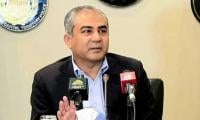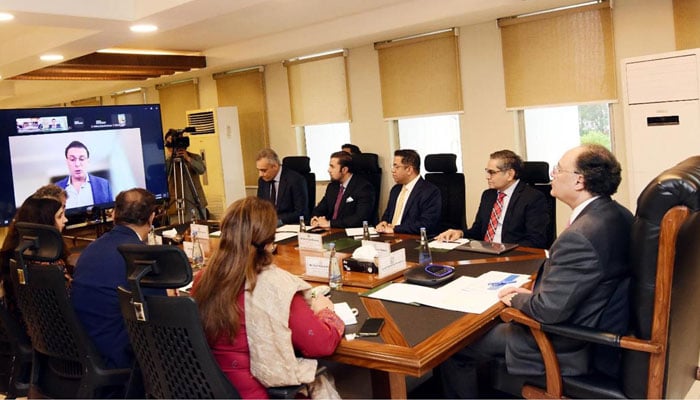
ISLAMABAD: Minister for Finance Muhammad Aurangzeb told the National Assembly on Tuesday that austerity measures were being properly enforced to provide financial relief to the public amid the current situation arising from the Middle East tensions.
Speaking in the House during a discussion on the recent increase in petroleum products, he said the prices had not been increased for three weeks and the public was given a blanket subsidy of Rs129 billion.
He said the government was now providing targeted subsidy to the deserving segments of the society, including motorcyclists, truckers and public transporters. He said small farmers were also getting subsidy.
“The provinces already have data of farmers in the form of Kisan Card, and the disbursement has already started Saturday last,” he said.
Aurangzeb said the prices of diesel and petrol were frozen from March 14 to April 4 while taking various austerity measures and imposing Rs100 billion cut in the Public Sector Development Programme (PSDP).
“We have to plan as to what would be the impact on economy and what is intensity and duration of the conflict and its impact on the global economy,” he said. So far, there has been no impact on remittances coming from the Gulf countries, he added.
Aurangzeb said people also criticise the government for approaching the IMF but as a matter of fact, Pakistan has to make Euro Bond payment of 1.4 billion dollars this week besides other payments.
“As we talk about external financing, we do not want to be dependent, but we have to make these payments,” he said.
Talking about structural reforms, the minister said 26 SOEs had been handed over to the Privatization Commission, while others were in the process of privatization.
Taking part in the discussion, PPP parliamentarian Dr. Sharmila Farooqui disagreed with the increase in the fuel prices and asked the government to opt for long-term planning to provide relief to the masses.
She said following the start of the Middle East conflict, Pakistan recorded the highest increase in the prices of petroleum products in the world.
She suggested that the government still had a window to reduce petrol price, which included Rs131 as taxes and commission of oil companies.
“You are giving subsidy to motor bikes but how people owning small cars will get relief?” she asked.
JUIF’s Noor Alam Khan said the increase in the prices of petroleum products would result in the hike of prices of essential commodities and medicines. He said the incumbent finance minister was a banker and a banker could not be a good economist, as his objective was to collect money and increase accounts.
The PTI supported MNA Muhammad Aslam Ghuman, who said the Parliament should be strengthened by taking all the important decisions and discussing people-related problems.
He questioned as to why the prices of petroleum products were increased when the country had old stocks available. Minister for Defence Khawaja Asif said the government’s hands had been tied because of agreements made with the IPPs in 1990 and then after the year 2000 leading to the payment of capacity charges. He said some of agreements would expire in the next two to three years, while others would continue in 2030s. He added that capacity payments remain a major financial burden, as the government was required to pay power producers under the existing contracts even if electricity was not used.
He said although efforts had been made to renegotiate these agreements, the relief achieved so far was limited and not enough compared to the scale of the obligations.
Despite these challenges, he said the government would continue to explore options to reduce costs and gradually shift towards more affordable and sustainable energy solutions.
In her response, Minister of State for Climate Change Shezra Mansab Ali Khan Kharal said the government was encouraging clean energy including solar power. She said changes to the net metering policy were for new prosumers, while the existing agreements will be honoured till the expiry of original terms.
“We are no longer importing coal for power generation, as local coal is being used for this purpose,” she said.
She further said a proposal for 18 percent tax on solar was considered which was later reduced to 10 percent at the time of passage of the last federal budget.
PPP parliamentarians Syed Naveed Qamar, Sehar Kamran and others raised the issue of a drastic change in the net metering policy for solar prosumers and the decision to propose 18 percent tax on solar panels. Responding to another calling attention notice, Minister of State for Finance Bilal Azhar Kayani said growth had been witnessed in tax revenue collection during the first eight months of the current fiscal year.
He said the government was taking measures to improve the tax net and mitigate the impact of US-Iran war on the people.