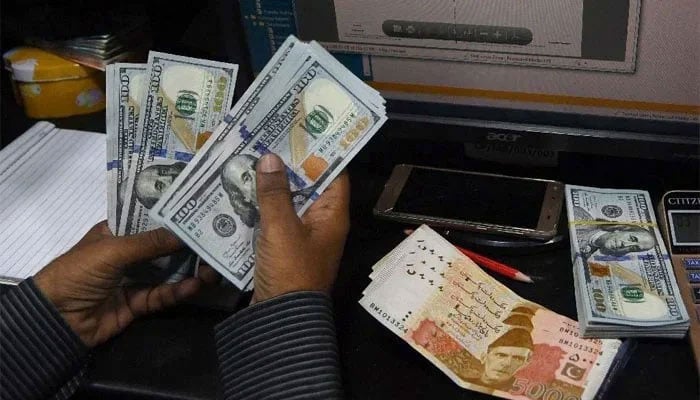
KARACHI: The Pakistani rupee is likely to remain stable in the coming sessions, but traders gauge whether the local currency can sustain this trend as the country prepares to repay two significant external loans in April.
According to reports, the government plans to repay a total of $3.5 billion in external loans this month. This includes a repayment of $2 billion to the United Arab Emirates (UAE), due on April 17, and $1.3 billion upon the maturity of Eurobond on April 8.
Traders and analysts said that although Pakistan is facing considerable outflows, there is a strong likelihood that the country will meet these repayment obligations on time. This is largely due to the country’s relatively stable external account position, despite geopolitical tensions in the Middle East. Pakistan also recently signed a staff-level agreement with the International Monetary Fund for a $1.2 billion loan tranche, which supports the view that the rupee will remain range-bound, at least in the near term.
In the interbank market, the rupee closed at 279.16 against the dollar on Monday but ended at 279.1 on Friday.
No sharp currency depreciation on the card; the rupee is expected to weaken to 282-284 per dollar by end-June
A weekly report from Tresmark, published on Saturday, says the upcoming loan repayment to the UAE and the Eurobond maturity are unsettling, as they could absorb a meaningful portion of SBP reserves (almost one third). These payments come at a time when reserves have been built piece by piece over the past few months. However, the key question is whether this situation changes policy direction. Analysts at Tresmark believe it will not. With the IMF staff-level agreement of over $1 billion in place and continued focus on managing the external account, this is a tough but manageable outflow and does not jeopardise policy continuity.
The second development relates to reports around IMF conditions on interest rates and currency controls. While rate expectations have already adjusted, the interpretation around currency control appears overstated, according to the Tresmark report.
“From a flow perspective, the SBP has been buying surplus dollars from the interbank market, as inflows are exceeding outflows,” the report said. “This indicates that if SBP didn’t buy those dollars, Rupee would actually be stronger than what it is today,” it added. “This suggests that the exchange rate is not being artificially held but rather managed to maintain stability.”
“The more accurate reading is that adjustment is taking place through import compression, with tools including interest rates, letter of credit margins, and other fiscal and administrative controls, rather than through burning reserves or verbal intervention,” the report noted. “There is indeed talk about deregulating the forex market, but this is far more complex and time-consuming than on paper.”
The report predicts that the rupee will experience gradual and controlled movement, with a likely range of 282-284 against the dollar by the end of June, avoiding any steep devaluation.