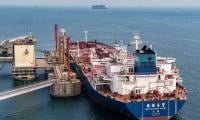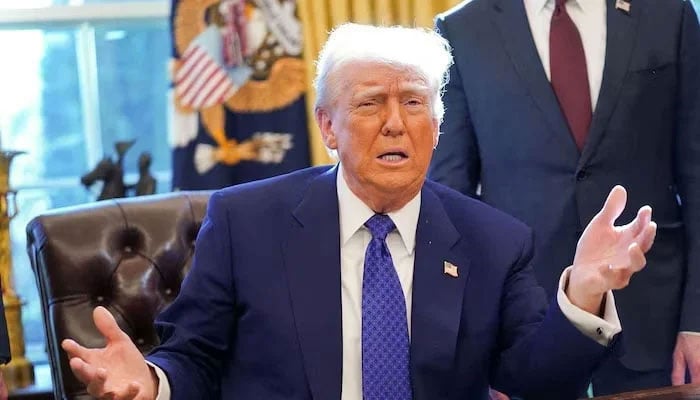
WASHINGTON: US President Donald Trump threatened Monday to destroy Iran’s oil export hub of Kharg Island, oil wells, power plants and other civilian infrastructure if it does not soon agree to a deal to end the war.
A day after sounding conciliatory and suggesting a deal could be reached this week, Trump wrote on his Truth Social network that the United States is in “serious discussions” with “a more reasonable regime” in Tehran. But he added an ominous warning.
“If for any reason a deal is not shortly reached, which it probably will be, and if the Hormuz Strait is not immediately ‘Open for Business,’ we will conclude our lovely ‘stay’ in Iran by blowing up and completely obliterating all of their Electric Generating Plants, Oil Wells and Kharg Island (and possibly all desalinization plants!),” Trump said.
Trump said that negotiations with Tehran were going well and suggested that “regime change” in Iran is complete. “We’ve had regime change, if you look, already, because the one regime was decimated, destroyed, they’re all dead. The next regime is mostly dead. And the third regime, we’re dealing with different people than anybody’s dealt with before. It’s a whole different group of people,” Trump told reporters. “So I would consider that regime change, and frankly, they’ve been very reasonable.”
White House Press Secretary Karoline Leavitt repeated the administration’s insistence that the US war against Iran should be over within another two weeks.
Trump “has always stated four to six weeks, estimated timeline,” Leavitt told reporters. “We’re on day 30 today. So again, you do the math.””He wants to see a deal over the next 10 days,” she said.
Asked whether Trump’s threat to devastate Iranian civilian infrastructure would not risk committing war crimes, Leavitt said the US armed forces would always act within the law.However, she warned Iran that the US military “has capabilities beyond their wildest imagination and the president is not afraid to use them.”
On Sunday night, Trump told reporters on Air Force One that the United States had achieved “regime change” in Iran through the war launched a month ago with Israel, citing the number of Iranian leaders who have been killed. He called the new leadership “much more reasonable”.
”We’re dealing with different people than anybody’s dealt with before. It’s a whole different group of people. So I would consider that regime change.”There could be a deal “soon,” Trump said when asked if an agreement could come this week.
Meanwhile, when asked if US allies in the Gulf—like Kuwait, Saudi Arabia and United Arab Emirates—should help pay for the costs incurred by the war, Leavitt said Monday it was something Trump was “quite interested in doing.”
“It’s an idea that I know he has,” she said without further detail.US Secretary of State Marco Rubio said that Washington is close to achieving its objectives in Iran “in a matter of weeks,” adding that President Donald Trump has “a number of options available” to prevent Iran from controlling the Strait of Hormuz.
During an interview with ABC News, Rubio said that the US is focused on the “destruction” of Iran’s air force, navy, and factories where they make all their weapons, as well as the substantial reduction in the number of missiles they possess. “All of those objectives are being met, on or ahead of schedule and should be able to achieve in a matter of weeks,” he said.
On the closure of the Strait of Hormuz, Rubio said Trump has “a number of options available” to prevent Iran from imposing control or a tolling system on the vital waterway. “The president has a number of options available to him if he so chooses to prevent that from happening. … Obviously, I’m not going to discuss what those options are, and we’re not going to discuss military tactics,” he added.
Rubio voiced hope for working with elements within Iran’s government, saying the United States privately had received positive messages.He said there were internal “fractures” inside the Islamic republic and that the United States hopes figures with “power to deliver” take charge.
Rubio nonetheless also denounced the Islamic republic in broad strokes, insisting that the war aimed to end its nuclear weapons building capacity, which President Donald Trump said he accomplished during an attack last year.In a separate interview with Al Jazeera, Rubio said there were “messages and some direct talks going on between some inside of Iran and the United States.”
The communication is “primarily through intermediaries, but there’s been some conversation,” he told the Qatar-based news channel.”I think the president always prefers diplomacy.”
Iran denies seeking a nuclear weapon and the UN nuclear watchdog has said no bomb was imminent.Iran said on Monday it was not seeking nuclear weapons but the issue of whether to remain part of the non-proliferation treaty was under review in parliament.
”The Islamic Republic of Iran has never sought and does not seek nuclear weapons,” said foreign ministry spokesman Esmaeil Baqaei in a weekly press briefing.”Regarding membership in this treaty, regardless of our clear position on the prohibition of all weapons of mass destruction, this is genuinely a debate taking place within public opinion and at the parliamentary level.”
Despite the Trump administration’s public talk of diplomacy, the United States has been reinforcing its military presence in the region.Thousands of soldiers from the US Army’s elite 82nd Airborne Division have started arriving in the Middle East, two US officials told Reuters on Monday, as President Donald Trump weighs his next steps in the war against Iran.
Reuters first reported on March 18 that Trump’s administration was considering deploying thousands of additional US troops to the Middle East, a move that would expand options to include the deployment of forces inside Iranian territory.
The paratroopers, based out of Fort Bragg, North Carolina, add to the thousands of additional sailors, Marines and Special Operations forces sent to the region. Over the weekend, about 2,500 Marines arrived in the Middle East. The officials, speaking on the condition of anonymity, did not say specifically where the soldiers were deploying to, but the move was expected. The additional Army soldiers include elements of the 82nd Airborne Division headquarters, some logistics and other support, and one brigade combat team. No decision has been made to send troops into Iran, but they will build up capacity for potential future operations in the region, one of the sources said.
On the ground on Monday, there was no let-up in hostilities.
Israel said its air defence batteries responded to “missiles launched from Iran” after earlier announcing it was striking “terror regime military infrastructure across Tehran.”Israel’s fire and rescue services reported a fire at an oil refinery in the northern port city of Haifa, which also suffered a blaze on March 19.
Kuwait reported strikes on a power station and a desalination plant.Israel confirmed that in recent days it had hit the Imam Hossein University in Tehran, which it says is used by Iran’s Islamic Revolutionary Guards Corps (IRGC) for advanced weapons research.
In keeping with its tit-for-tat targeting, Tehran has warned it could strike US universities across the Middle East.Iran launched new strikes on a water desalination plant in Kuwait, after its own electrical facilities came under attack at the weekend, cutting power to parts of Tehran. Saudi Arabia said it had intercepted five ballistic missiles.
The war has inflicted havoc on the global economy, with fuel shortages across much of Asia, stock markets in turmoil, and oil prices soaring—the main US benchmark rising past $100 a barrel and UK-traded Brent up sharply and trading close to $117.
With economies already reeling from recent energy price rises, and US President Donald Trump openly mulling a military operation to seize Iran’s main export terminal, market experts warned that any US ground operation or wider Iranian retaliation could send oil prices to historic highs.
G7 economy and finance ministers said they stood ready to take “all necessary measures” to ensure the stability of the energy market as they tackled the economic consequences of war in the Middle East.
”We stand ready to take all necessary measures in close coordination with our partners, including to preserve the stability and security of the energy market,” G7 energy and finance ministers, as well as central bank governors, said in a joint statement.
”We recognise the importance of coordinated international action to mitigate spillovers and safeguard macroeconomic stability.”They said they continued to monitor developments and their potential impact on global growth, and financial market conditions.
The G7 ministers also called on all countries to refrain from imposing unjustified export restrictions on hydrocarbons and related products.The Gulf Cooperation Council bloc’s Secretary-General Jasem Mohamed Albudaiwi urged the international community to protect vital maritime corridors, condemning Iran’s closure of the Strait of Hormuz and its attacks on regional energy infrastructure.
Addressing the conference virtually, he said Iranian aggression was a threat to the world. “The brutal Iranian threats against energy facilities and the closure of the Strait of Hormuz constitute not only a blatant violation of international law but also a direct threat to global energy,” he said.
The commander of the foreign operations branch of Iran’s Revolutionary Guards issued a rare message on Monday hailing Iranian proxy groups for helping create a “new regional order”.Esmail Qaani became head of the Guards’ Quds Force after the killing of Qassem Soleimani in a US strike in Iraq in 2020.
His message, just the second attributed to him since the US-Israeli war against the Islamic republic began on February 28, was posted on X under the handle @general_Qaani, although the social media giant then rapidly suspended the account with a note that “X suspends accounts which violate the X Rules.”
The message was also widely published by Iranian news agencies and state television.
Qaani said that Israeli Prime Minister Benjamin Netanyahu wanted to create a “security belt across the region” but the actions of Tehran-backed militant groups including Hezbollah in Lebanon and the Houthis in Yemen had “exposed the regime’s false promises”.
”Get used to the new regional order,” he said.Qaani was reported to have been killed in the 12-day war between Israel and Iran last June, but re-emerged in public.
Turkiye’s Defence Ministry said that NATO forces had intercepted a new missile fired from Iran—the fourth since the start of the Middle East war. None of the four projectiles managed to hit Turkish soil, according to the authorities.
Kuwait said an Iranian attack on a desalination and electricity plant killed one worker and caused damage to a building as the Islamic republic pressed its aerial campaign against its Gulf neighbours.
”A service building at a power and water desalination plant was attacked as part of the Iranian aggression against the State of Kuwait,” the Gulf state’s electricity ministry said.The attack caused “the death of an Indian worker and significant material damage to the building,” the statement added, without elaborating on the location of the facility.
Kuwait’s military said later on Monday that it had intercepted 13 hostile drones in the past 24 hours, with “major damage” caused to the building at the power and water plant.Iran’s military said that Israel was behind an attack on a desalination plant in Kuwait.
”The brutal aggression by the Israeli regime against Kuwait’s desalination plant, carried out in recent hours under the pretext of accusing the Islamic Republic of Iran, is a sign of the vileness and depravity of the Zionist occupiers,” said the military’s operational command Khatam Al-Anbiya in a statement carried by state TV.
Iran confirmed on Monday that an Israeli strike had killed the commander of the naval force of the Revolutionary Guards, who Israel had said was responsible for the blocking of the Strait of Hormuz.
A statement carried by the Guards’ Sepah News website said Alireza Tangsiri “succumbed to severe injuries” from the attack last week.Rockets fired overnight targeted an Iraqi military base inside the Baghdad airport complex, which also houses a support centre for the US embassy, Iraq’s defence ministry said Monday.
The base is near a US diplomatic and logistics hub in the airport complex, which has been repeatedly targeted since the start of the war in the Middle East on February 28.German inflation in March jumped to its highest level since January 2024 on the back of rocketing energy prices due to the Middle East war, official data showed Monday.
Consumer prices rose by 2.7 percent compared with the same month a year earlier, according to preliminary data from the federal statistics agency Destatis.
French police on Monday arrested two more people over an apparent bid to set off a homemade explosive device outside a Bank of America branch in Paris, bringing the total in custody to five, prosecutors said.The arrests follow an incident early Saturday morning when police arrested a first suspect after he placed a device outside the US financial institution near the Champs-Elysees.
The two individuals detained on Monday are adults, according to a source following the case, who spoke on condition of anonymity.
Sri Lanka announced on Monday a nearly 40 percent increase in electricity prices from Wednesday as it battles an energy shortage caused by the war in the Middle East.German inflation in March jumped to its highest level since January 2024 on the back of rocketing energy prices due to the Middle East war, official data showed Monday.
Consumer prices rose by 2.7 percent compared with the same month a year earlier, according to preliminary data from the federal statistics agency Destatis.Energy prices alone rose by 7.2 percent from a year earlier—the first time they had risen since December 2023, the agency said.
South Korea’s energy minister sought Monday to ease fears over shortages of plastic rubbish bags after sales in Seoul jumped nearly fivefold due to energy supply concerns sparked by the Middle East war.
Israel’s military said Monday that it had struck a university in Tehran run by Iran’s Revolutionary Guards, claiming the institution was used for advanced weapons research.Israel’s military said it had struck dozens of weapons production sites including a long-range surface-to-air missiles manufacturing line in Iran’s capital Tehran.
”During waves of airstrikes over the past two days in Tehran, approximately 40 weapons production and research facilities were struck,” the military said.
The targets, it said, included “a facility used for assembling long-range surface-to-air missiles”, a site assembling components for “anti-tank missiles and small anti-aircraft missiles”, and a facility that produced and researched “ballistic missile engines.”
Iran has restored electricity in parts of the capital and nearby areas after strikes damaged power grids and briefly disrupted supply, the deputy energy minister said on Monday.
”Following last night’s enemy attack, the power grid in the provinces of Alborz and Tehran sustained damage and was affected,” said Mostafa Rajabi-Mashhadi in an interview with state television.
“The power network across Iran’s national electricity grid is stable; in Tehran and Alborz the problems have also been resolved,” he added.Israel’s fire and rescue service said its crews were working to extinguish a large blaze at the Haifa oil refinery after it was hit by debris from the interception of a projectile Monday.
Aluminium prices climbed around six percent in early trading on Monday after Iran attacked two major plants in the Gulf that produce the widely used metal, raising concerns over supply disruptions.
The Israeli military on Monday said a soldier was killed a day earlier in combat in southern Lebanon, bringing to six the number of troops killed since fighting with Hezbollah started earlier in March.”Sergeant Liran Ben Zion, aged 19, from Holon... fell during combat in southern Lebanon,” the military said.
The American University of Armenia said on Monday it was moving all classes online over Iranian threats to target US universities in West Asia.Several US universities have campuses scattered throughout the Middle East, including Texas A&M University in Qatar and New York University in the United Arab Emirates.
Iran threatened to target US universities in the Middle East after saying US-Israeli strikes had destroyed two Iranian universities.
More than 1,000 people of Iranian descent gathered in the US capital on Sunday to voice support for the war, riding on calls to bring back Iran’s exiled crown prince who has emerged as a figure of intense interest.
The rally on the lawn of the National Mall, not far from the White House, was a sea of Iranian and American flags, with chants of “USA! USA!” and “Javid shah” (“Long live the shah”) bolstering the crowd, along with songs in Persian.
United Nations peacekeepers, who for decades have served as a buffer between Israel and Lebanon, have seen three of their comrades killed and several others wounded since the latest war erupted between Israel and Hezbollah. On Monday, two peacekeepers were killed when “an explosion of unknown origin destroyed their vehicle”, wounding at least two others, the force said.
Dubai will provide support worth over $270 million to help businesses and families, authorities announced Monday, with the Gulf states facing economic disruption from Iran´s aerial attacks and closure of the Strait of Hormuz.
“Today, we approved support measures worth AED 1 billion ($272 million) for the economic sector, aimed at assisting individuals, families, and businesses in navigating these exceptional circumstances,” Dubai´s media office said in a statement.
It added: “Long-term government planning reflects Dubai´s unwavering commitment to its citizens, residents.”The United Arab Emirates and other Gulf countries have faced waves of drone and missile salvos from Iran after Tehran unleashed a retaliatory aerial campaign on its neighbours in response to US and Israeli strikes beginning on February 28.