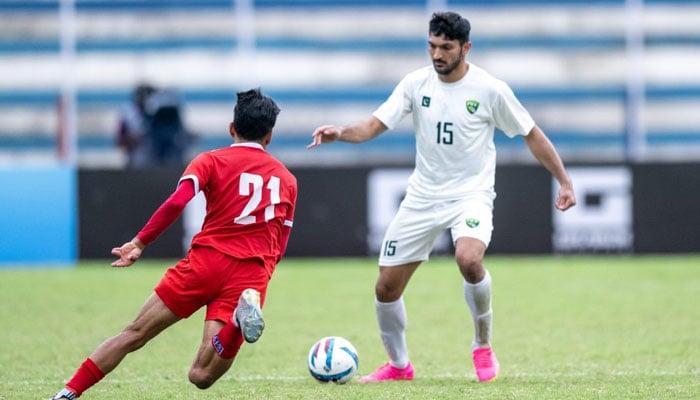
ISLAMABAD: Promising footballer Abdullah Shah has called for the launch of a Pakistan Football League, stressing that a structured domestic competition is vital to sharpen local talent and build a competitive national side.
Speaking to the media ahead of Pakistan’s crucial Asia Cup Qualifier against Myanmar, Abdullah underlined the urgent need to provide consistent exposure to emerging players, noting that opportunities at home remain limited.
“Budding players in Pakistan need regular exposure at a competitive level. A domestic league can play a key role in improving skills and confidence,” he said.
Sharing his recent experience abroad, Abdullah revealed that he had the opportunity to feature in the Bangladesh Football League, where he played three matches, a stint he described as instrumental in enhancing his game.
“Playing in Bangladesh helped me gain valuable experience and improve my understanding of the game. Such opportunities are crucial for player development,” he added, while appreciating the improving sporting ties between Pakistan and Bangladesh.
He noted that several Pakistani footballers are currently plying their trade in regional competitions, particularly in South Asia, but emphasized that the absence of a domestic league continues to hinder long-term growth.
“Pakistani players want a league of their own, on the pattern of international competitions. The sooner we establish one, the better it will be. Regular interaction with foreign players will significantly raise our standards and prepare us better for international fixtures,” he said.
Abdullah expressed regret over the prolonged stagnation of football in the country, which, according to him, cost an entire generation of players valuable years.
“I represented Pakistan at the U-14 level in 2014, but after that, there was virtually no football activity in the country for nearly a decade. A major part of my career was lost due to this inactivity,” he lamented.
Reflecting on recent progress, Abdullah acknowledged that Pakistan’s performances in international competitions have helped revive interest in the sport. He pointed out that the national team’s participation in the FIFA World Cup Qualifiers and a commendable draw against Afghanistan in the Asian Cup qualifiers have played a key role in bringing football back into the spotlight.
“Before 2022, there was hardly any scope for football in Pakistan. But now, things are improving. The team’s recent performances have reignited public interest, and we are seeing encouraging support from fans in stadiums,” he concluded.
With voices like Abdullah’s growing stronger, the demand for a structured domestic league appears to be gaining momentum, a move many believe could mark a turning point for football in Pakistan.
Footballer Alamgir Ghazi strongly advocated the introduction of a structured domestic league in Pakistan, stressing that regular competitive football is essential to prepare players for international challenges.
Talking to the media, Ghazi highlighted that Pakistani players seldom get the opportunity to participate in league matches, which affects their ability to cope with high-pressure situations at the international level.
“A league is a must. Regular league matches help players manage pressure better, and that ultimately improves performance in international games,” he said.
He pointed out that some Pakistani players have recently benefited from opportunities in the Bangladesh Football League under the SAFF quota, where teams are allowed to field three foreign players.
“Our players got a chance to play in Bangladesh, which is a positive sign. Their league is among the top in the region, second only to India’s. Such exposure helps in improving skills and confidence,” he added.
Ghazi emphasized that a strong domestic structure is directly linked to the success of the national team.
“If Pakistan develops a proper domestic system, the national team will automatically become stronger,” he maintained.
Calling for more domestic competitions, Ghazi said that local players should be provided maximum opportunities to play and grow within the country.
“Domestic tournaments are very important. Our players need consistent chances to perform and improve,” he said.
Referring to the upcoming Asia Cup Qualifier against Myanmar, Ghazi welcomed the decision to rely on local players, terming it a positive move for nurturing homegrown talent. “It is good to see local players getting a chance against Myanmar. This will allow them to prove their abilities at the international level,” he said.