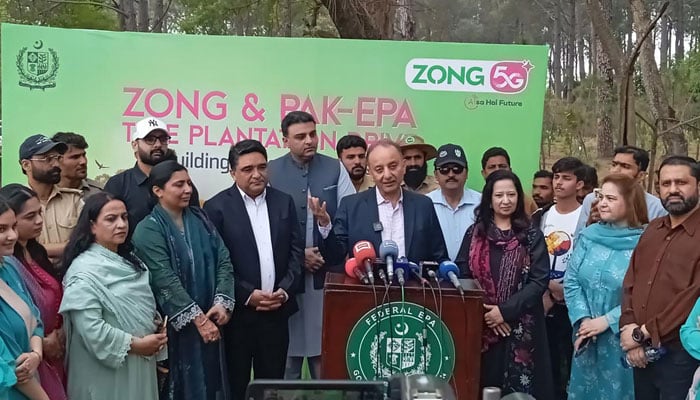
Islamabad:Minister for Climate Change Dr Musadik Masood Thursday announced that weekly plantation drives would commence across Islamabad after March 31, marking a renewed push to enhance environmental protection, urban livability and climate resilience in the capital.
During a plantation ceremony in Shakarparian, he said the campaign would run for one to two months, covering multiple locations across the city. “The initiative forms part of the government’s broader strategy to expand green cover and mitigate the effects of climate change."
The minister reiterated the government’s commitment to planting 10 trees for every one cut in Islamabad, noting that practical implementation of the pledge has already begun. He invited media and the public to monitor the activities and independently assess progress on the government’s promises.
Linking afforestation to broader climate challenges, Dr Musadik said that rising temperatures and greenhouse gas emissions were intensifying extreme weather events, including floods and accelerated glacier melt.
“Trees are essential for maintaining ecological balance as they absorb carbon dioxide and release oxygen,” he said. The minister said that forests acted as natural carbon sinks, helping slow climate change while mitigating its environmental, social and economic impacts.
He added that trees reduced flood intensity by enhancing water absorption, stabilise soil, prevent erosion and lessen damage from strong winds during storms. Also, increasing urban tree cover improves city livability by lowering temperatures, reducing air pollution and creating healthier environments.
“Urban forestry is not just an environmental priority but a public health and quality-of-life imperative,” he said. Dr Musadik also said fuel conservation under the government’s austerity policy contributed to lowering carbon dioxide emissions, reinforcing the link between economic discipline and environmental benefits.
Calling for a whole-of-society approach, he underscored the need for active participation from communities, schools, civil society and the corporate sector in tree-planting campaigns and forest conservation.