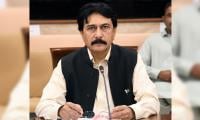
ISLAMABAD: Khyber Pakhtunkhwa Chief Minister Sohail Afridi Wednesday raised an alarm over what he called the “abrupt cancellation” of a high-level meeting, convened by the federal government to hold deliberations on the prevailing national and regional issues.
Speaking to a news conference here, he pointed out that despite profound political differences and sustained political victimisation faced by the Pakistan Tehreek-e-Insaf over the past three years, the KP provincial government had taken a principled decision to participate in the meeting in the larger national interest.
He underscored that this decision was made notwithstanding the treatment meted out to former PM Imran Khan, his spouse Bushra Bibi, his family members, party leadership and workers, which has few parallels in the country’s political history.
Highlighting the evolving regional situation, particularly the war involving Iran, Israel, and the United States, the CM stressed that implications for Pakistan are significant and far-reaching. Afridi expressed concern that despite the gravity of the situation, the federal government had not meaningfully engaged the public or parliament, nor provided a transparent policy direction. He regretted that critical national decisions were being taken without adequate consultation, limiting public awareness and institutional alignment.
The CM reiterated that decisions of national consequence extend beyond any single family or institution and have implications for the entire country. In this context, he stressed the importance of inclusive governance and the need to take all stakeholders into confidence.
Turning to intergovernmental fiscal relations, he raised serious concern that a scheduled meeting of the committee on the Accelerated Implementation Programme (AIP) will not proceed, as the federal side has conveyed its inability to attend which, he said, reflects a lack of seriousness in addressing the province’s financial concerns.
Under the AIP for the merged districts, he explained the federal government had committed Rs100 billion annually for 10 years. However, he noted that only Rs168 billion out of the committed Rs700 billion had been released to date, leaving Rs532 billion outstanding, with no allocation made in the current fiscal year.
He added that the provincial government extended bridge financing amounting to Rs26 billion from its own resources to sustain development activities in the merged areas. He said the share of merged districts has not been adequately incorporated into the NFC framework, which he termed inconsistent with constitutional provisions.
The chief minister observed that key economic indicators reflect a challenging outlook; a decline in GDP growth from 6.1 per cent prior to the change in government in 2022 to below 3 per cent now, contraction in industrial activity, closures within the textile sector, a widening trade deficit exceeding USD 20 billion, decreasing exports, increasing outward migration of youth due to limited economic opportunities and stress within the agricultural sector affecting farmers’ livelihoods.
He highlighted the rising cost of living and noted that fuel prices have increased sharply, with petrol reaching approximately Rs321 per litre, significantly increasing the financial burden on people. He contrasted this with the previous (PTI) government period, when petrol prices were around Rs150 per litre despite higher global oil prices in the range of US$117 to 120 per barrel, compared to roughly $85 per barrel currently.
This disparity, he noted, underscores the need for more effective economic management and targeted relief measures to protect the public from inflationary pressures. Afridi reaffirmed that despite challenges, the KP government remains committed to national stability and is prepared to contribute constructively at times of crisis.
He stated, however, that the burden of sacrifice must be shared equitably across all federating units, particularly in financial terms. He urged the federal government and relevant institutions to adopt a more transparent, consultative and inclusive approach by engaging parliament and the public in decision-making processes, and to take timely and coordinated measures to address the country’s evolving challenges.
Replying to a question about telephonic contact between Prime Minister Shehbaz Sharif and US President Donald Trump, he said: “Israel and America will never want Pakistan to develop. Will Zionists like an Islamic nuclear power to develop?”
PTI MNA Junaid Akbar, who is the party’s provincial president KP, alleged that unfortunately, ‘incompetent leadership’ has been imposed on the country and the state’s behaviour makes it seem that Khyber-Pakhtunkhwa was not being given its equal share.
He alleged that after the merger of FATA, responsibilities were given to the province but resources were not provided. “Our rightful share in NFC award and other financial resources are not being given, due to which the province is facing severe financial difficulties,” he complained.
Junaid Akbar charged that due to the federal government’s policies, investment in the country has decreased and the economic situation is deteriorating day by day. He demanded parliament be empowered and taken into confidence on all important decisions.