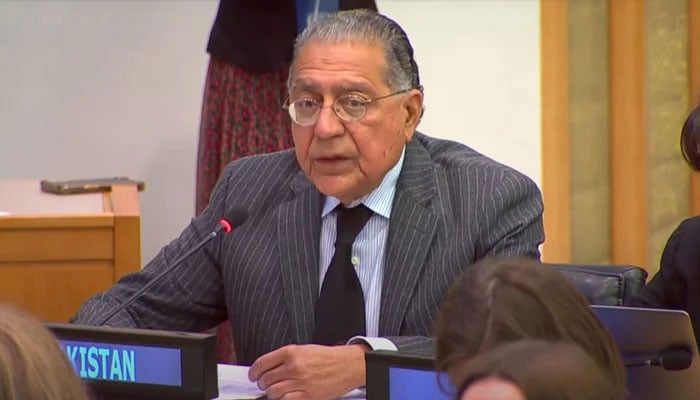
ISLAMABAD: Former Pakistan envoy to UN Munir Akram has said Pakistan is making efforts to facilitate negotiations between Iran and the United States, but prospects of an agreement remain low as both sides hold maximalist positions with little flexibility.
Speaking in Geo News programme “Capital Talk” hosted by Hamid Mir, he said the recent statements by Pete Hegseth carry limited weight in Washington, adding US lacks a strong justification to frame an end to the conflict. He noted Iran’s stance is understandable given it was attacked twice during negotiations, while reports of paratroopers deployment signal increased US pressure.
Akram warned any US ground deployment could result in heavy casualties. He also stressed Pakistan should ensure the Gulf states stay out of the conflict. Former foreign secretary Aizaz Ahmad Chaudhry said a possible compromise could emerge if Iran ensures opening of Strait of Hormuz and US eases economic sanctions. He added Donald Trump miscalculated Iran and is now seeking time.
Chaudhry pointed to contradictions between US officials’ statements and warned any attack via Chabahar or elsewhere would be a serious mistake with grave consequences. He said the Gulf countries are unlikely to join the war due to risks to their own territories and reputations, urging Pakistan to advise Saudi Arabia to stay out, while persuading Iran not to target it.
Meanwhile, speaking to Geo News in Lahore, former defence attaché Faisal Shah said Iran’s latest conditions reflect its long-standing stance on sovereignty, adding Tehran is now in a position to assert its terms and stand by them. He said Iran has challenged perceptions of US military superiority, prompting greater global attention to its position.
Shah noted US demands remain stringent and have consistently been rejected by Iran, which deeply distrusts Washington and is unlikely to accept any proposal without critical scrutiny. He added Iran is pursuing a calculated diplomatic strategy that is widely regarded as effective.
Middle East expert Mansoor Jaffar said Iran’s demonstrated military capability is now reflected in its diplomacy, stressing Tehran has the right to accept, reject or modify any proposal. He said Iran’s five-point plan is grounded in realities, while pressure tactics by the US cannot ensure lasting peace. He emphasised halting attacks is essential before meaningful ceasefire talks can begin, urging mediating countries — particularly Turkiye, Pakistan and Egypt — to press the US and Israel to stop strikes on Iran.
Former foreign secretary Jalil Abbas Jilani said Pakistan is playing a positive and active role in de-escalation, maintaining communication between Iran and the United States despite absence of formal talks. He highlighted contacts involving Asim Munir, Donald Trump, Shehbaz Sharif and Iran President as key to ongoing efforts, expressing hope for positive outcomes once negotiations begin.
Jilani said Iran seeks assurances against future attacks by the US and Israel, adding while both Tehran and Washington appear interested in ending the conflict, Israel’s role could hinder progress. He noted the Gulf countries also favour a swift resolution and expect flexibility from both sides.
Former ambassador Asif Ali Durrani warned Israel could act as a “spoiler” to ceasefire efforts, questioning who would guarantee against further strikes. He said Iran has capacity for prolonged conflict, while Pakistan’s role remains that of a mediator, with final decisions resting with Tehran and Washington.