CNN has Islamabad. The Financial Times has Islamabad. Bloomberg has Islamabad.Axios has Islamabad. Reuters, the Associated Press, the BBC -- all of them have Islamabad. They cannot all be wrong.
Tehran is 2,841 kilometres from Islamabad and that’s where the world’s most consequential war is being fought. The war has rattled governments from Riyah to Beijing, reshaped energy markets and produced the gravest nuclear anxiety since the cold war. And at the centre of every diplomatic effort to stop it -- quietly, carefully, deliberately -- sits Islamabad. Chief of Defence Forces Field Marshal Asim Munir’s trips to Riyadh and Oman and Deputy Prime Minister Ishaq Dar’s back-channels weren’t just damage limitation. They were positioning. Pakistan has been building towards this mediation role deliberately. Islamabad has more assets than any other capital on the face of the planet. Islamabad has the SMDA with Riyadh, giving it Saudi trust. Pakistan has a 900-kilometre border and deep ties with Iran, giving it Tehran’s ear. FM Munir has a direct line to Trump -- which is extraordinary and deserves more scrutiny on its own. Pakistan is Muslim, non-Arab, non-Western, and nuclear -- that combination is rare. It is also, at this moment, nearly irreplaceable.
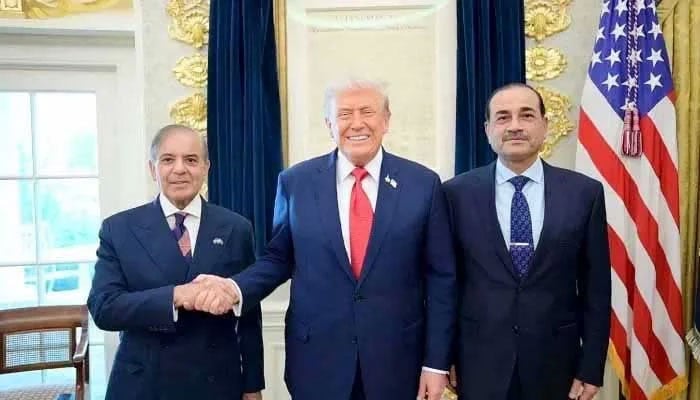
Remember what Mojtaba Khamenei stated in his Nowruz address: “For a long time, I have known Pakistan to be a country that was especially beloved by our martyred Leader.” Islamabad’s position at the centre of this crisis is not an accident. On June 18, 2025, Field Marshal Munir was hosted at the White House -- a private lunch with President Trump. The visit was unprecedented: a serving Pakistani army chief, not a head of state, received at that level. Trump said publicly that Pakistan “knows Iran very well, better than most.”
That relationship, built quietly over months, is now paying visible diplomatic dividends. Pakistan has not picked a side in this war -- and that neutrality is itself an asset. Islamabad condemned the US-Israeli strikes on Iran, satisfying Tehran. Yet its army chief speaks directly to Trump, satisfying Washington. In diplomacy, the most valuable real estate is the middle ground. Islamabad occupies it.
Islamabad’s positioning is not hypothetical. Multiple US and Israeli media outlets have reported that Pakistan, Egypt and Turkey have already been serving as messengers between Washington and Tehran -- carrying signals, testing red lines and gauging flexibility. The mediation infrastructure is not being built. It is already operating.
According to Axios, two possible formats are under discussion for a meeting in Islamabad -- one involving Iranian Foreign Minister Abbas Araghchi alongside US envoy Steve Witkoff and Jared Kushner, another envisioning US Vice President JD Vance meeting Iran’s parliament speaker Mohammad Bagher Ghalibaf. These are not rumours. These are named principals and named formats. The diplomatic architecture is specific.
For the record, wars end in one of two ways: exhaustion or diplomacy. The exhaustion route means more bombs, more oil shocks, more bodies. The diplomacy route needs a room, a table, and someone both sides will walk toward. Islamabad may be that room. FM Munir may be that someone. If this works -- if Pakistan brings Washington and Tehran to the table and they stay there -- it will be the most consequential act of Pakistani statecraft since independence.
The world has already datelined Islamabad. Now Islamabad must deliver.Right now, the world’s most powerful newsrooms have their eyes on Islamabad. That is a rare thing. That is not sentiment. That is a signal. It is also a test. Mediation at this level demands credibility, consistency, and the courage to tell both sides what they do not want to hear. Pakistan has the assets. The question -- the only question that history will remember -- is whether it has the will to use them.
The writer is an Islamabad-based columnist.