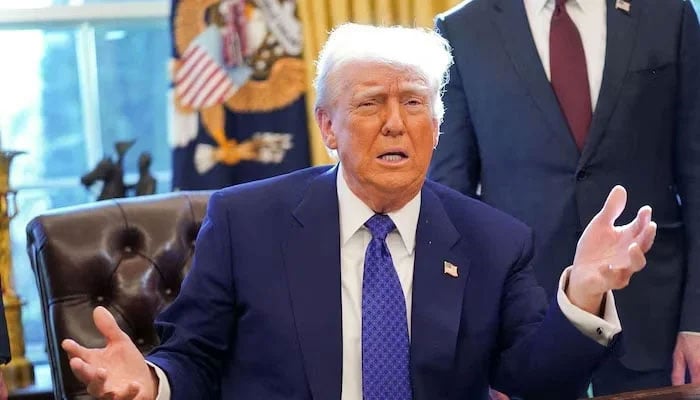
WASHINGTON/TEHRAN: President Donald Trump said on Tuesday that Iran had made a major energy-related concession to the United States, describing it as a positive development, although he did not give details. He also claimed that Iran has agreed they will never have nuclear weapon.
The statement came as Iran and Israel traded fresh strikes. The White House said Donald Trump is pressing on with military operations against Iran even as he examines “newfound” diplomatic options, while the US media reported that Washington is planning to send some 3,000 soldiers from the elite 82nd Airborne Division to the Middle East to support operations against Iran.
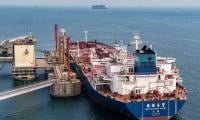
Trump suggested the gift was related to the Strait of Hormuz, the oil transit waterway that the United States has struggled to keep open. “They gave us a present and the present arrived today, and it was a very big present, worth a tremendous amount of money,” Trump told reporters in the Oval Office.
“It wasn’t nuclear, it was oil-and gas-related, and it was a very nice thing they did.”
Trump, reiterating that he felt the United States had already won the war, indicated that Defence Secretary Pete Hegseth was disappointed as how quickly the campaign had gone. “Pete didn’t want it to be settled,” he said, but did not give details.
Trump said the United States was talking to “the right people” in Iran in order to reach a deal to end hostilities, adding the Iranians wanted to reach a deal very badly. “We’re in negotiations right now” over Iran, he said, but would not provide details, particularly on whether U.S. envoys Steve Witkoff and Jared Kushner planned talks this week. He said Witkoff, Kushner, Vice President JD Vance and Secretary of State Marco Rubio were involved in negotiations.
The White House said President Donald Trump is pressing on with military operations against Iran even as he examines “newfound” diplomatic options.
“As President Trump and his negotiators explore this newfound possibility of diplomacy, Operation Epic Fury continues unabated to achieve the military objectives laid out by the Commander in Chief and the Pentagon,” Press Secretary Karoline Leavitt said in a statement to AFP.
On the ground hostilities continued, with Israel’s army saying it had conducted a “large wave” of airstrikes across several areas of Iran including the central city of Isfahan.
In Tel Aviv, Israel reported four people wounded after missile fire from Iran, with AFP images showing rubble-strewn streets and the side of a three-storey building in ruins.
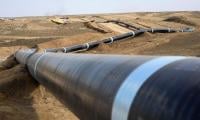
Earlier, Iranian media reported enemy warplanes had struck two gas facilities and a pipeline, hours after Trump stepped back from his weekend threat to attack energy sites, citing the attempts at diplomacy.
Bahrain, Kuwait, the United Arab Emirates and Saudi Arabia all said they had intercepted renewed drone and missile attacks, as Iran kept up retaliatory strikes on US-allied Gulf states.
Trump on Monday said his administration was speaking with an unidentified “top person” in Iran, and extended by five days an ultimatum for the Islamic republic to reopen the Strait of Hormuz or see its power plants obliterated.
But Tehran’s parliamentary speaker, Mohammad Bagher Ghalibaf, said “no negotiations” were underway, accusing Trump of seeking “to manipulate the financial and oil markets”.
Washington and Tehran do not have formal diplomatic relations, but Iran’s foreign ministry on Monday acknowledged messages had been relayed by “friendly countries” indicating a “US request for negotiations”.
China’s Foreign Minister Wang Yi told his Iranian counterpart in a phone call that “talking is always better” than fighting. And the US State Department announced that Secretary of State Marco Rubio would meet G7 counterparts in France on Friday to discuss Iran.
Israel, meanwhile, stepped up its campaign against the Iran-backed Hezbollah militant group in Lebanon, saying its military would take control of south Lebanon up to the Litani river, around 30 kilometres from the border.
Israel pounded Beirut’s southern suburbs throughout the night, while a strike on Bshamoun, south of the capital, killed two people on Tuesday, according to Lebanon’s health ministry.
Whereas Israeli emergency services said a woman was killed in the north of the country on Tuesday following rocket fire from Lebanon, where Israeli forces are fighting Iran-backed Hezbollah. The Israeli military told AFP that dozens of rockets from Lebanon were fired at the area at the time the incident occurred.
Oil prices, which had tumbled after Trump’s comments, rebounded slightly in Tuesday trade, with Brent back above $100 a barrel. Although Iran’s chokehold on the strait gives it leverage in potential negotiations, analysts remained doubtful of any breakthroughs.
Iran named on Tuesday a former Revolutionary Guards commander to succeed Ali Larijani as head of Iran’s Supreme National Security Council after the veteran insider of the Islamic system was killed in an Israeli strike.
Mohammad Bagher Zolghadr, whose appointment was confirmed by state TV, is a former deputy commander-in-chief of Iran’s ideological army who has also held senior posts in the interior and justice ministries.
After serving in the 1980s war against Saddam Hussein’s Iraq, Zolghadr was the head of the Guards joint staff for eight years, and then as the deputy commander-in-chief of the Guards for another eight years.
In 2005, he was named deputy interior minister for security and police in the government of then president Mahmoud Ahmadinejad, a move that was seen at the time as bolstering the Guards’ influence in politics.
Since 2023, he had been the secretary of the Expediency Council, a powerful body which plays both an advisory and mediating role between Iran’s various power structures and the supreme leader.
His new post should give Zolghadr a major role in the Iranian war effort against the United States and Israeli strikes after the killing of over dozen key Iranian security figures in the war.
Zolghadr is formally appointed by President Masoud Pezeshkian but the president’s deputy communications director Mehdi Tabatabaei wrote on X that the nomination had been approved by Mojtaba Khamenei.
Iranian authorities announced on Tuesday the arrest of 466 people accused of seeking to destabilise the country through their online activity, state media reported, as the war with the US and Israel ground on.
“These individuals sought to sow confusion in public opinion, create fear and anxiety in society, promote insecurity and spread propaganda in favour of the enemy” online, state news agency IRNA said, citing Iranian police.
The news agency did not specify the exact nature of the online activity nor the dates of the arrests.
Iranian authorities have completely cut off the internet since war erupted on February 28 with US-Israeli strikes on the country which killed the supreme leader. Internet monitor Netblocks on Tuesday wrote on X that “Iran’s internet blackout has entered its 25th day after 576 hours”. For nearly a month, only a handful of authorised people have had access to the worldwide internet in Iran.
Others have sought to overcome the blackout by connecting sporadically via VPNs or Starlink—a jailable offence in Iran. Iranians can nonetheless access the local internet to communicate or make online orders.
Iranian media reported that Israeli-US strikes targeted two gas facilities and a pipeline. “As part of the ongoing attacks carried out by the Zionist and American enemy, the gas administration building and the gas pressure regulation station on Kaveh Street in Isfahan were targeted,” said the Fars news agency. The facilities in central Iran were “partially damaged”, added Fars. It said an attack also targeted the gas pipeline of the Khorramshahr power plant, in the country’s southwest. “A projectile hit the area outside the Khorramshahr gas pipeline processing station,” Fars reported, quoting the governor of the city bordering Iraq. The governor said the infrastructure was operating normally and there was no disruption to the gas supply.
Qatar said the Middle East war had stretched the Gulf states’ security system beyond breaking point as Iran presses its aerial campaign against neighbouring countries. “The most important outcome of this war is the breakdown of the security system in the Gulf region,” Qatar’s foreign ministry spokesman Majed al-Ansari said. “The Gulf states—which have been working closely and in parallel to ensure their security—are in need of a post-war re-evaluation of what a shared regional security framework truly entails,” he added.
Qatar said that it supports all diplomatic efforts to end the war with Iran after US president Donald Trump announced there had been communication between Washington and Tehran. “We support all diplomatic efforts within this framework, whether through official or unofficial channels and contacts,” Qatar’s foreign ministry spokesman Majed al-Ansari said. “I wish to emphasise here that there are currently no direct Qatari efforts underway regarding mediation between the two parties,” he added.
Iran fired a fresh broadside of missiles at Israel Tuesday, causing damage and injuries in Tel Aviv. Tel Aviv mayor Ron Huldai told reporters a “direct strike” had damaged a building in the upscale neighbourhood, with AFP video showing the facade of the three-storey block torn open.
According to several Israeli media outlets, police believe the damage was caused by a cluster munition missile equipped with three to four warheads, each carrying around 100 kilograms of explosives.
While Israeli first responders said three people were injured during Iranian missile fire targeting the south of the country, including an infant.
China’s top diplomat urged his Iranian counterpart in a phone call that “talking is always better” than fighting. According to China’s foreign ministry, Wang Yi told Abbas Araghchi he hoped “all parties can seize every opportunity and window for peace and start the peace talks process as quickly as possible”.
The Iranian foreign minister said vessels could “safely pass through” the strait, except those belonging to “countries currently engaging in conflict”, the statement added.
He also told Wang that “the Iranian side is committed to achieving a comprehensive end to the conflict, not just a temporary ceasefire”, and thanked China for its humanitarian assistance. The call was held “at the request” of the Iranian side, according to the ministry.
Indian Prime Minister Narendra Modi said that US President Donald Trump had called him to discuss the Middle East war—and the importance of the Strait of Hormuz.
Modi said it was a “useful exchange of views”, adding that India “supports de-escalation and restoration of peace at the earliest”, he wrote on social media. “Ensuring that the Strait of Hormuz remains open, secure and accessible is essential for the whole world,” Modi said.
US Ambassador Sergio Gor also said on social media that the leaders had discussed the war, “including the importance of keeping the Strait of Hormuz open”.
The UAE defence ministry said that a Moroccan contractor with the Emirati military was killed in Bahrain in an Iranian attack, with Manama saying the man had been assisting the local armed forces. “The Ministry of Defence mourns the loss of a Moroccan civilian contractor serving with the UAE Armed Forces, who was martyred during a routine mission in the Kingdom of Bahrain following an Iranian missile attack,” the UAE ministry said in a statement on X.
Five UAE ministry of defence personnel were also injured in the attack, the statement added.
Germany’s fragile recovery is being threatened by the fallout from the Middle East war, the economy minister said Tuesday, warning that the country could see fuel shortages within weeks. Katherina Reiche cited estimates from economic institutes of around $40 billion (34.5 billion euros) worth of damage to Europe’s top economy “due to high energy prices, and, of course, inflation” if the war were to continue.
US oil giant ConocoPhillips has been urging President Donald Trump’s administration to provide extra protection around assets in Qatar where the company has invested significantly, its chief executive said Tuesday. CEO Ryan Lance’s comments at the CERAWeek energy conference in Houston come as war rages on in the Middle East.
Hezbollah has called the decision by Lebanon’s foreign ministry to expel the newly appointed Iranian ambassador a “sin”, and demanded the authorities “immediately reverse” the move.
Israel announced that a strike it carried out near Beirut the day before killed a member of Iran’s Quds Force, who a Lebanese security source said had survived a previous attack in the same area. In a statement Tuesday, the Israeli army said it had killed Mohammed Ali Kurani.
Israel said that its military would take control of south Lebanon up to the Litani River, around 30 kilometres (20 miles) from the border, as deadly strikes pounded the country.
Kenya’s national carrier has seen passenger numbers jump by nearly a third and cargo up more than 250 percent during the Mideast war, its CEO said Tuesday.
Amazon’s cloud arm told AFP on Tuesday that its service in Bahrain had been disrupted, after drone attacks hit the region.
An air strike in Iraq killed 15 members of a former paramilitary coalition, the deadliest attack on the group since the Middle East war began, as missile fire elsewhere killed six Kurdish security personnel.
The Hashed al-Shaabi coalition, part of Iraq’s regular armed forces but which also includes brigades belonging to Iran-backed groups, blamed the strike that killed a commander and 14 other fighters on the United States.
US Secretary of State Marco Rubio will meet G7 counterparts in France on Friday on the war in Iran, the State Department announced.
Sri Lanka ordered street lights, neon signs and billboard lighting to be switched off from Tuesday as part of measures to cut energy consumption by 25 percent to tackle supply shortages.
The UN Human Rights Council said it will hold an urgent debate on Wednesday on Iran’s strikes on countries across the Gulf region and their impact on civilians. The session was called following an official request submitted by Bahrain on behalf of the six Gulf Cooperation Council countries and Jordan.
Human Rights Council spokesman Pascal Sim told a press conference on Tuesday that the countries will present a draft resolution to UN’s top rights body.
The council will “discuss the recent military aggression launched by Iran against Bahrain, Jordan, Kuwait, Oman, Qatar, Saudi Arabia and the United Arab Emirates... targeting civilians and civilian infrastructure, which has resulted in the loss of innocent lives”, according to the request.
German aviation giant Lufthansa and Hong Kong carrier Cathay Pacific have extended flight suspensions to destinations across the Middle East due to the war.
Business activity in the eurozone slowed in March after the war in the Middle East drove energy prices higher and disrupted global supply chains, a closely watched survey showed Tuesday.
Iran’s Revolutionary Guards threatened to conduct “heavy” missile and drone attacks on Israel in what it described as support for Lebanese and Palestinian civilians.
Iraq’s autonomous Kurdistan region accused Iran of launching an attack against its peshmerga armed forces, following the deaths of six fighters.
Iran’s energy minister said he believed the country was less vulnerable than others in the region to any attacks on its energy infrastructure, in an interview with state TV broadcast on Tuesday. “We produce electricity in a spread out way in several places, unlike the countries of the Persian Gulf or the Zionist regime, where production is centralised and very vulnerable,” Energy Minister Abbas Aliabadi said, referring to Iran’s Gulf neighbours and Israel. “We have more than 150 power plants across the country,” he added.
American conservatives converge on Texas this week for what organizers bill as their largest and most influential gathering, with the Iran war and fears of a punishing midterm election cycle heightening the stakes.
Iran has told International Maritime Organization member states that “non-hostile vessels” may transit the Strait of Hormuz if they coordinate with Iranian authorities, the Financial Times reported on Tuesday, citing a letter. Reuters could not immediately verify the report.
The United States is planning to send some 3,000 soldiers from the elite 82nd Airborne Division to the Middle East to support operations against Iran, US media reported Tuesday.
They would join thousands of Marines due to arrive in the Middle East by Friday, the latest deadline set by President Donald Trump for Iran to open the Strait of Hormuz, according to the Wall Street Journal.
No decision has been made to put troops on the ground, the Journal reported, citing two US officials who said a written order on the deployment was expected in coming hours. However, the deployments mean units of the most battle-ready US ground troops will soon be in the region.
The 82nd Airborne Division can deploy anywhere in the world within 18 hours and specializes in “forcible entry parachute assaults” that clear the way for follow-on military action, according to its website.
The New York Times was the first to report on Monday that senior military officials were weighing a possible deployment of a combat brigade from the 82nd Airborne and some of its planning and logistics staff to the ongoing US-Israel war against Iran.
Those soldiers or members of the 31st Marine Expeditionary Unit already en route “could be used to seize Kharg Island,” Iran´s oil export hub, the Times said.
“The movement of the 82nd opens the door for President Trump to try to reopen the Strait of Hormuz by force, seize Iran´s strategic islands or coastline or launch a mission to capture the regime´s highly enriched uranium should he choose to do so,” the Journal reported.
Meanwhile, Saudi Arabia and the United Arab Emirates have taken steps towards joining the Iran war, the Wall Street Journal reported, potentially signaling an escalation of the fighting, the Wall Street Journal reported.
Saudi Arabia agreed to give the US military access to King Fahd Air Base, the WSJ reported, citing people familiar with the matter, an apparent reversal after saying its bases couldn’t be used to attack its longtime rival. The newspaper also cited people familiar as saying the United Arab Emirates closed an Iranian-owned hospital and club — undercutting a key source of support for Tehran.
Videos apparently showed that some missiles used in attacks on Iran were launched from Bahrain, the WSJ said. The US military declined to say if it was getting help from countries in the region, the newspaper reported.
Saudi Arabia recently agreed to let American forces use its King Fahd air base on the western side of the Arabian Peninsula, people familiar with the decision said. Crown Prince Mohammed bin Salman is now eager to re-establish deterrence and is close to a decision to join the attacks, the people said. It is only a matter of time before the kingdom enters the war, one of the people said.
Iranian President Masoud Pezeshkian said on Tuesday that the people of Pakistan and Arab countries are “loudly abhorring America, Israel, and their crimes”. “Today, we are witnessing the awakening of people in many countries around the world. The people of Pakistan, Turkey, Iraq, Lebanon, Egypt, and Arab countries are loudly abhorring America, Israel, and their crimes. The hearts of the free people of the world are not with the Zionists. Stability in the region is possible with support and respect for the will of the nations,” he wrote on social media platform, X.
Iran’s Atomic Energy Organization said that US and Israel attacked the vicinity of Iran’s Bushehr nuclear power plant on Tuesday evening, IRNA reported. It said the attack caused no technical damage or human casualties based on initial reports.
The United States has sent Iran a 15-point plan to end the war in the Middle East, the New York Times reported on Tuesday citing two officials.