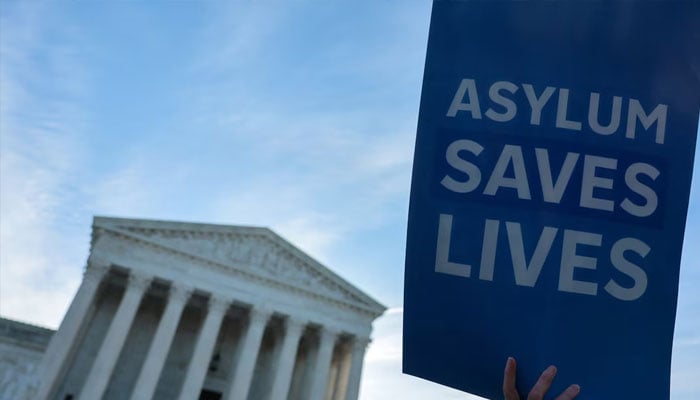
WASHINGTON: The US Supreme Court on Tuesday appeared likely to rule in favor of President Donald Trump’s administration in its defense of the government’s authority to turn away asylum seekers when officials deem U.S.-Mexico border crossings too overburdened to handle additional claims.
The justices heard arguments in a legal dispute involving a policy called “metering” that the Republican president’s administration may seek to revive after it was dropped by Trump’s Democratic predecessor Joe Biden in 2021. The policy let U.S. immigration officials stop asylum seekers at the border and indefinitely decline to process their claims.
The Trump administration has appealed a lower court’s finding that the policy violated federal law. The metering policy is separate from the sweeping ban on asylum at the border that Trump announced after returning to the presidency last year. That policy also faces an ongoing legal challenge.
Under U.S. law, a migrant who “arrives in the United States” may apply for asylum and must be inspected by a federal immigration official. The narrow legal issue in the current case is whether asylum seekers who are stopped on the Mexican side of the border have arrived in the United States.
The Supreme Court has a 6-3 conservative majority. Most of the conservative justices and one of the liberal justices appeared sympathetic toward the administration’s position.
Conservative Justice Amy Coney Barrett pressed Kelsi Corkran, the lawyer who argued on behalf of the immigrant advocacy group Al Otro Lado that challenged the metering policy, on what it means to arrive in the United States. “How close do you have to be to the border?” Barrett asked. “Could you say that someone arrives in the United States if they’re at a portion of the border that does not have a port of entry? Like, what is it, if it’s not crossing the physical border? What is the magic thing, or the dispositive thing, that we’re looking for where we say, ‘Ah, now that person, we can say, arrives in the United States?”
‘KNOCKING AT THE DOOR’
Corkran asserted that under the statute, people arrive in the United States when they are at the “threshold of the port’s entrance about to step over.”
Under the metering policy, Corkran said, “that process of arriving is interrupted by the border officer physically blocking them from completing the arrival.”
Some of the court’s conservatives and liberal Justice Elena Kagan pushed back on Corkran’s suggestion that, prior to the metering policy, arriving in the United States had long been understood as analogous to knocking on a front door.
“There’s been talk about knocking at the door,” conservative Justice Samuel Alito said. “Does a person ‘arrive in’ the house when a person is not in the house and is knocking at the door asking to be admitted to the house?”
Conservative Justice Neil Gorsuch asked: “So anybody at the water’s edge of the Rio Grande on the Mexican side has ‘arrived in’ ... but somebody who’s on the water’s edge has not arrived?” Vivek Suri, the Justice Department lawyer who argued on behalf of the Trump administration, said, “You can’t ‘arrive in the United States’ while you’re still standing in Mexico. That should be the end of this case.”