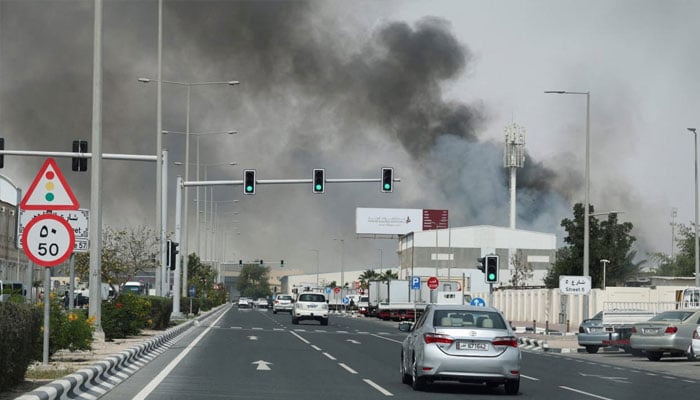
TEHRAN/DOHA: Iran’s Media Operations Centre late on Sunday issued urgent warning to civilians in specific areas of Dubai and Doha, saying that US military personnel are hiding in those locations and that they may be targeted in the coming hours, Iran’s Press TV reported.
The warning came hours after Iran’s Foreign Minister Abbas Araghchi said in an interview that Tehran has “ample evidence” US bases in the Middle East have been used to target the Islamic republic. “We have ample evidence of this: satellite imagery and electronic surveillance demonstrate that US bases in this region are being used for attacks,” Araghchi told Arabic-language news outlet Al-Araby Al-Jadeed, claiming that missiles had been launched from the UAE to attack Kharg Island, a vital Iranian oil hub.
Tehran warned countries against getting involved in its war with the United States and Israel, after President Donald Trump urged world powers to escort oil tankers through the Strait of Hormuz chokepoint in the Gulf.
Araghchi said Iran was not interested in talks with the United States, pushing back on President Donald Trump’s stance that Tehran wants a deal to end the war. “We are stable and strong enough. We are only defending our people,” Araghchi told CBS’s “Face The Nation,” in an interview aired Sunday.
“We don’t see any reason why we should talk with Americans, because we were talking with them when they decided to attack us. “There is no good experience talking with Americans.”
Trump on Saturday said Iran wanted a deal, but that he was not prepared to make one on current terms, without giving further details. “We never asked for a ceasefire, and we have never asked even for negotiation,” Araghchi said.
He added that Iran was ready to talk to countries who want to negotiate for selected oil tankers to pass through the key Strait of Hormuz export route.
“I cannot mention any country in particular, but we have been approached by a number of countries who want to have a safe passage for their vessels,” he said.
Araghchi said the war pitting his country against the United States and Israel will only end when Tehran can be certain it will not be restarted. “This war will end when we are certain it will not be repeated and that reparations will be paid. We experienced this last year: Israel attacked, then the United States... they regrouped and attacked us again,” he said.
Iran’s foreign minister denied that Iran has targeted civilian or residential areas in the Middle East and said Tehran is ready to form a committee with its neighbours to investigate the responsibility for such strikes.
Gulf countries have called upon Iran to cease its attacks on their territories, which have not only sustained strikes on US military bases but also damage to energy facilities and residential areas.
Abbas Araqchi’s Telegram channel quoted him as saying in an interview with Al-Araby al-Jadeed website that Tehran was in communication with various Gulf capitals and would welcome any initiative that could guarantee a complete end to the U.S.-Israeli war on Iran.
Egyptian Foreign Minister Badr Abdelatty and Qatari Emir Sheikh Tamim bin Hamad al-Thani on Sunday discussed regional de-escalation and ending the ongoing war between Israel, the US and Iran, the Egyptian foreign ministry said. Abdelatty had travelled to Qatar as part of a Gulf tour to discuss regional developments.
Italy’s military said Sunday that a drone attacked the Ali Al Salem airbase in Kuwait hosting Italian and US forces, but stressed that all its personnel were safe.
Foreign Minister Antonio Tajani sought to play down the attack—the second on an Italian base in the Middle East this week—saying he did not believe his country was being targeted. “This morning, Ali Al Salem base in Kuwait, which hosts American and Italian personnel and capabilities, was the target of a drone attack,” the chief of Italy’s defence general staff, General Luciano Portolano, said in a statement posted by the military on X. It “hit a shelter housing a remotely piloted aircraft of the Italian Task Force Air (TFA), which was destroyed”. “At the time of the attack, all personnel were safe and uninjured.”
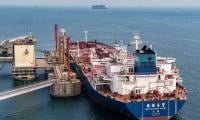
Energy prices have soared across the world since Iran responded to the new US-Israeli campaign by threatening shipping sailing though the Strait of Hormuz, which usually sees passage of 20 percent of global oil and gas exports to the global market.
Trump responded on Saturday by urging “China, France, Japan, South Korea, the UK and others” to send ships to escort tankers, while the US military will continue to pound drone, boat and missile launch sites in Iranian territory north of the strait.
But the countries he listed have given only guarded responses, and Araghchi, in a call with French counterpart Jean-Noel Barrot, warned them to “refrain from any action that could lead to escalation and expansion of the conflict”.
While Iranian President Masoud Pezeshkian discussed regional developments with his French counterpart Emmanuel Macron in a phone call, Iran’s Tasnim news agency said on Sunday.
Indian foreign minister Subrahmanyam Jaishankar hailed direct talks with Iran as the most effective way to restart shipping through the Strait of Hormuz, in an interview published on Sunday. “I am at the moment engaged in talking to them and my talking has yielded some results,” Jaishankar told the Financial Times, adding that talks are ongoing. “If it is yielding results for me, I would naturally continue to look at it.”
Global oil prices have surged by 40 percent as Iran has choked off the vital sea passage and attacked energy and shipping industry targets in its Gulf neighbours.
As global markets reel, Trump has doubled down, telling NBC News in a weekend interview that he thought Tehran was keen to come to the table but that the US fight on to force better terms.
He said he might, again, bomb targets on Iran’s oil hub, Kharg Island, “just for fun”. “Iran wants to make a deal, and I don’t want to make it because the terms aren’t good enough yet,” Trump told NBC News.
Iran’s new supreme leader, Ayatollah Mojtaba Khamenei, has—in a written statement—vowed to keep Hormuz closed. But Trump dismissed this and suggested his foe might not even be in control, saying: “I don’t know if he’s even alive. So far, nobody has been able to show him.”
Despite the hardline talk from all sides, residents of Tehran were able to go about their work week in the most normal atmosphere since the start of the war on February 28.
Traffic was busier than last week and some cafes and restaurants had reopened.
One resident whizzed down the street on an electric hoverboard, and more than a third of stalls in the Tajrish bazaar, a popular shopping hub in the north of the capital, had reopened, five days before Nowruz, the Persian New Year.
Some shoppers queued at ATMs to withdraw cash. Online operations at Bank Melli, one of the country’s largest, had been paralysed in recent days.
The captain of the Iranian women’s football team, which played in the Asian Cup in Australia, has withdrawn her bid for asylum, state media said Sunday. That made her the fifth member of the delegation to change her mind, leaving just two seeking sanctuary.
More than 1,200 people have been killed by US and Israeli strikes, according to Iranian health ministry figures that could not be independently verified.
At least eight people were injured in Israel Sunday following repeated missile launches from Iran, at least two of which contained cluster munitions according to Israeli authorities.
Israeli police released footage from a CCTV camera in the Tel Aviv area showing an impact on a road, saying that it was from “cluster munitions” that caused “damage at several locations”.
Iran’s relations with Arab Gulf states will require a “serious review” in light of the US-Israeli war on Iran, limiting the power of external actors so the region can become prosperous, Tehran’s ambassador to Saudi Arabia told Reuters on Sunday.
Asked if he was concerned that relations would be harmed by the war, Ambassador Alireza Enayati said: “It’s a valid question, and the answer may be simple. We are neighbors and we cannot do without each other; we will need a serious review.”
“What the region has witnessed over the past five decades is the result of an exclusionary approach [within the region] and an excessive reliance on external powers,” he said in a written response to questions, calling for deeper ties between the Gulf Cooperation Council’s six members, along with Iraq and Iran.
Behind the scenes, analysts and regional sources say there is also growing frustration at the U.S., long their security guarantor, at dragging them into a war they did not endorse but for which they are paying a hefty price.
In Saudi Arabia, attacks have been concentrated on the eastern region where most of the kingdom’s oil is produced, as well as the Prince Sultan Airbase hosting U.S. forces east of Riyadh, and the Diplomatic Quarter on the Saudi capital’s western edge, according to Saudi defense ministry statements.
Saudi Arabia and Iran re-established full diplomatic relations in 2023 after years of enmity that saw them back rival political and military factions across the region.
Enayati denied that Iran was responsible for the attacks on Saudi Arabia’s oil infrastructure, including the Ras Tanura refinery on the east coast and dozens of attempted drone attacks on the Shaybah oil field in the desert near the UAE border. “Iran is not the party responsible for these attacks, and if Iran had carried them out, it would have announced it,” he said. He did not say who had carried out the attacks.
Saudi Defense Ministry statements have not assigned blame for individual incidents. Enayati said Iran was only attacking US and Israeli targets and interests.
Enayati said he personally was in ongoing contact with Saudi officials, with relations “progressing naturally” in many areas. He highlighted Saudi cooperation regarding the departure of Iranians who were in the kingdom for religious pilgrimage and the provision of medical assistance to others.
He said Tehran was in contact with Riyadh regarding Saudi Arabia’s publicly stated position that its land, sea and air would not be used to attack Iran, without elaborating on the discussions. His message to Gulf states was that the war “has been imposed on us and the region.”
To resolve the conflict, the US and Israel must halt their attacks and regional countries should not be involved, while international guarantees must be secured to prevent their recurrence, he said. “Only then can we focus on building a prosperous region,” he said.
The ongoing Iran war appears to be escalating, Norway’s Prime Minister Jonas Gahr Stoere said on Sunday, adding that the plan for the military campaign seemed unclear.
Iran-backed militant group Hezbollah said its fighters targeted an Israeli air base south of Tel Aviv on Sunday, as Israel has kept up strikes on Lebanon.
In a statement, Hezbollah said it targeted the Palmachim air base, around 140 kilometres (85 miles) from the Lebanese-Israeli border, with “an advanced missile”, after claiming several other attacks on sites in northern Israel and on Israeli troops in Lebanon near the frontier.
Iran has arrested 500 people accused of sharing information with enemies, the Islamic Republic’s police chief said on Sunday.
Half of those cases had involved serious incidents “including people who provided information for hitting targets and individuals who took footage of strike locations and sent them,” Ahmadreza Radan said, without going into detail on when the arrests took place.
Earlier, Iranian media reported dozens of arrests in several regions on Sunday.
In northwestern Iran, the semi-official Tasnim news agency said 20 people were arrested on accusations by the provincial prosecutor’s office of sending location details on Iran’s military and security assets to Israel.
A fragment of an Iranian missile struck a residential building used by the U.S. consul in Israel, Israeli media reported on Sunday. The reports did not immediately provide further details on the incident.
The Pentagon on Saturday released the identities of six US crew members killed during the crash of a refueling aircraft in western Iraq earlier this week, which authorities said was not caused by “hostile fire.”
The KC-135 aerial refueling aircraft crashed in western Iraq on Thursday, bringing the number of US troops killed in operations against Iran to at least 13. A second aircraft involved in the operation landed safely.
The Pentagon said the six members killed in the crash were: John Klinner, 33, of Auburn, Alabama; Ariana Savino, 31, of Covington, Washington; Ashley Pruitt, 34, of Bardstown, Kentucky; Seth Koval, 38, of Mooresville, Indiana; Curtis Angst, 30, of Wilmington, Ohio; and Tyler Simmons, 28, of Columbus, Ohio.
Israeli Foreign Minister Gideon Saar on Sunday denied a report that Israel was facing a shortage of ballistic missile interceptors after more than two weeks of war that has seen repeated attacks from Iran and Iran-backed Hezbollah in Lebanon. American news website Semafor on Saturday cited an unnamed U.S. official as saying that Israel had told Washington it was running critically low on ballistic missile interceptors.
Asked whether the report was accurate, along with an Israeli media report that Israel was set to hold direct talks with Lebanon, Saar responded: “For both questions, the answer is no.” An Israeli military source also denied any shortage, saying that the armed forces were prepared for a prolonged campaign.
The Israeli military said it still has thousands of targets to hit across Iran, with new ones identified every day, as the war entered its third week on Sunday. “We have a precise plan. We still have thousands of targets in Iran, and we are identifying new targets every day,” military spokesman Brigadier General Effie Defrin said in a televised briefing.
A rocket attack on Baghdad International Airport, which houses a US diplomatic facility, wounded five people on Sunday, Iraqi authorities said.
The Iraqi government´s security media cell said “five rockets targeted Baghdad International Airport and its surrounding area, injuring four airport employees and security personnel, and an engineer”.
It added that rockets struck the airport and a water desalination plant, while others crashed near a prison where Islamic State group (IS) suspects are detained and an Iraqi airbase next to the US diplomatic facility.
Security forces seized the launchpad used for the attack in the al-Radwaniya area southwest of Baghdad, the authorities added.
Security sources told AFP that three drones were also downed near the airport.
British Prime Minister Keir Starmer discussed the need to reopen the Strait of Hormuz to end disruption to global shipping with US President Donald Trump, a Downing Street spokeswoman said on Sunday.
Starmer also spoke with Canadian Prime Minister Mark Carney, with the leaders discussing the impact of the strait’s continued closure on international shipping, the spokeswoman said.
Starmer and Carney agreed to continue talks on the Middle East conflict at a meeting on Monday, the spokeswoman added.