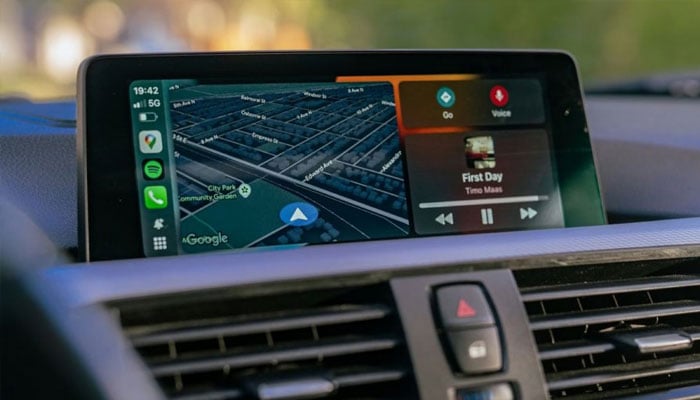
DUBAI: Accurate GPS is a mainstay of modern life, but because of the Iran war, people in the UAE are finding that their phones think they are out at sea or in cities hundreds of kilometres away.
Jamming and spoofing, used as a defensive tactic against missiles and drones, are to blame, experts say, but it’s not just enemy projectiles finding themselves lost in the United Arab Emirates. “I was using the maps while driving until it started taking me through weird roads,” said Hind, a French resident of Dubai who gave only her first name. Instead, she was forced to head back to a main road and “relied on the road signs to figure out where I was”. Despite the occasional inconvenience, the bizarre information given by GPS services, such as delivery drivers floating somewhere in the middle of the Gulf, has become the subject of jokes on social media. Clayton Swope, an aerospace security expert at the Centre for Strategic and International Studies (CSIS), said the disruption was “probably a response to defeat Iranian drones and missiles”, which may be relying on GPS to find their targets. Two options are used, he said. Jamming, which “makes it hard to receive a GPS signal”, and spoofing in which “someone is sending out a false signal broadcasting the wrong location”. Doing this can disrupt GPS-guided munitions. GPS and other satellite navigation systems are passive, meaning they function by receiving timing signals from multiple satellites orbiting the Earth and using them to calculate their locations. These signals are weak, however, making it relatively simple to block them with more powerful, locally broadcast signals.