MITHI: Partab Shivani, a Hindu, has been fasting occasionally during Ramazan for years, but this time it is different: he is observing the fast for the entire holy month.
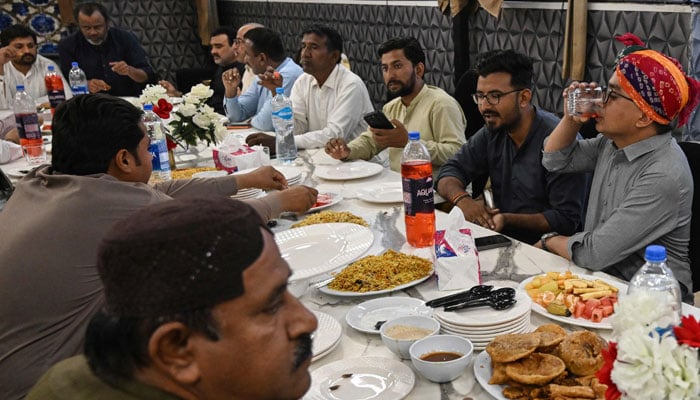
Every year, he and his friends in Mithi organize iftar to promote peace and solidarity between the followers of the two religions.
“I believe we need to promote interfaith harmony. First, we are humans — religions came later,” said Shivani, a 48-year-old social activist, in an interview with AFP. He added that he also reads the teachings of Buddha.
“His message is about peace and ending war. Peace can spread through solidarity and by standing with one another. Distance only widens the gap between people,” he said.
Ninety-six percent of Pakistan’s population of about 240 million is Muslim. Only around two percent are Hindu, most of whom live in rural areas of Sindh province, where Mithi is located.
In Mithi itself, however, most of the city’s 60,000 residents are Hindu.
Many Hindus in the city also observe Ramazan, and iftar has become a social gathering where people from both faiths happily take part.
“This has been a wonderful tradition of ours for a very long time,” said Mir Muhammad Buledi, a 51-year-old Muslim friend who attended Shivani’s iftar gathering.
“It is a beautiful example of harmony between the two communities.”
According to the Human Rights Commission of Pakistan, religiously-motivated violence and discrimination exists in the country. However, such tensions are largely absent in Mithi.
“I am a Hindu, but I observe all the fasts during this month”, said Sushil Malani, a local politician. “I feel happy standing with my Muslim brothers”.
“We also celebrate Eid together. This tradition in the region is very old”.
Ramesh Kumar, a 52-year-old Hindu man who sells sweets and savory snacks outside a Muslim shrine, keeps his pushcart covered and closed until iftar.
“There is no discrimination among us whether someone is Muslim or Hindu. Since my childhood, I have seen that we all live together like brothers,” he said.
Residents say Mithi’s peaceful religious coexistence may be linked to its remote location in the Tharparkar desert, near the border with India’s Rajasthan state.
Cows — considered sacred in Hinduism — roam freely in Mithi, much like they do in neighboring India.
At two Sufi shrines in the centre of the city, Hindu families prepare meals and bring fruit, food, and juice so their Muslim neighbours can break their fasts.
“We respect Muslims,” said Mohan Lal Malhi, a Hindu caretaker of one of the shrines.
Local residents say that both communities value their social relationships more than their religious identities.
“Here you will see a Sikh gurdwara, a mosque, and a shrine standing side by side”, Mohan said. “The atmosphere of this area teaches humanity”.