DUBAI/JERUSALEM: Iran on Sunday indicated it had chosen Ayatollah Ali Khamenei’s son Mojtaba as his successor, after Israel struck fuel depots in Tehran overnight and the conflict widened after Bahrain said an Iranian attack had damaged one of its desalination plants. “The name of Khamenei will continue,” said Ayatollah Hosseinali Eshkevari, a member of the clerical council charged with electing a new leader, in a video published in Iranian media. “The vote has been cast and will be announced soon,” Eshkevari said, without providing further details.
The council’s secretary, Hosseini Bushehri, would announce the successor to Ayatollah Ali Khamenei—who was killed earlier in the conflict - Ahmad Alamolhoda, another cleric, told state media.
US President Donald Trump said on Sunday Washington should have a say in the selection. “If he doesn’t get approval from us he’s not going to last long,” he told ABC News. Israel said it continued to target senior Iranian figures, including Abolqasem Babaian, the recently appointed head of the military office of the supreme leader, killed in a Saturday strike.
As fighting escalated on day nine of the US-Israeli campaign against Iran, thick black smoke hung over Tehran on Sunday, residents said, after strikes on oil storage facilities had lit up the night sky with plumes of orange flame.
Iran’s foreign ministry spokesperson Esmaeil Baghaei said the large-scale attack marked a “dangerous new phase” of the conflict and amounted to a war crime.
“By targeting fuel depots, the aggressors are releasing hazardous materials and toxic substances into the air,” he wrote on X.
Israeli military spokesman Lieutenant Colonel Nadav Shoshani told reporters the depots were used to fuel Iran’s war effort, including producing or storing propellant for ballistic missiles. “They are a legal military target,” he said. US Energy Secretary Chris Wright said the United States will spare Iran´s energy infrastructure, With oil prices rising dramatically, he told CNN that disruptions to the petroleum and gas industry will be short lived—“worst case, that´s a few weeks. That´s not months.”
Israeli Prime Minister Benjamin Netanyahu said his government would press on with the assault and strike Iran’s rulers “without mercy”. “We have an organised plan with many surprises to destabilise the regime and enable change,” he said in a video statement.
Trump told reporters on Air Force One that he was not seeking negotiations to end the conflict, which has driven up global energy prices, disrupted business and snarled air travel. “At some point, I don’t think there will be anybody left maybe to say, ‘We surrender’,” he said.
Saudi Arabia, Kuwait, the United Arab Emirates and Bahrain reported Iranian drone attacks on Saturday and early Sunday, including a huge fire that engulfed a government office block in Kuwait. Kuwait’s interior ministry said two officers were killed, while the UAE said four migrant workers had died in Iranian attacks there so far. Iran hit fuel tanks at Kuwait´s airport and a desalination plant in Bahrain.
The UAE said air defence teams had knocked out 16 ballistic missiles and 113 drones fired towards the Gulf state on Sunday. One missile fell in the sea and four drones hit the country’s territories. Bahrain said on Sunday that an Iranian drone attack had caused “material damage” to a desalination plant, though water supplies were not disrupted. It was the first time an Arab country has said Iran targeted a desalination facility during the conflict.
On Saturday, Iran accused the United States of striking a desalination plant on Qeshm Island, disrupting water supplies to 30 villages and calling it “a dangerous move with grave consequences.”
In Saudi Arabia, two people an Indian and a Bangladeshi national were killed and 12 injured after a projectile hit a residential area in Al-Kharj city, the Civil Defence agency said. Riyadh has told Tehran that continued Iranian attacks on the kingdom and its energy sector could push Riyadh to retaliate, people familiar with the matter told Reuters.
Lebanon has also been pulled into the conflict after the Iran-backed militant group Hezbollah launched rockets and drones into Israel last week, with nearly 400 people killed by Israel over the past week, the health ministry said. Israel killed at least four people when it struck a hotel in central Beirut on Sunday, saying it had targeted Iranian commanders operating in the city — the first such strike on the heart of the Lebanese capital — amid heavy bombardment of the southern suburbs and the country’s south and east.
Two Iranian sources told Reuters last week that Mojtaba Khamenei, who built influence inside Iran’s security forces and vast business networks under his father, remained the clear favourite. Choosing him would signal that hardliners remain firmly in charge.
Trump has justified the biggest US military operation in the Middle East since the 2003 invasion of Iraq by saying Tehran posed an imminent threat to the United States, without providing evidence. He has also said Iran was too close to being able to build a nuclear weapon. The US and Israel have discussed sending special forces into Iran to secure its stockpile of highly enriched uranium at a later stage of the war, Axios reported, citing sources. Asked on Saturday about sending ground troops to secure nuclear sites, Trump said it was something they would only do if the Iranians were “so decimated that they wouldn’t be able to fight at the ground level.”
The US-Israeli attacks have killed at least 1,332 Iranian civilians and wounded thousands, according to Iran’s UN ambassador. Iranian attacks have killed 10 people in Israel. At least six US service members have been killed, with Iran saying on Sunday it had struck US bases in Kuwait. Israel said on Sunday that two of its soldiers were killed in southern Lebanon.
Guards spokesman Ali Mohammad Naini said Iran had so far used only first- and second-generation missiles, but would use “advanced and less-used long-range missiles” in the coming days.
Prime Minister Keir Starmer and President Donald Trump held a call Sunday about the Middle East war, the UK government said, after fierce criticism of the British premier by the US leader.
”The leaders began by discussing the latest situation in the Middle East and the military cooperation between the UK and US through the use of RAF bases in support of the collective self-defence of partners in the region,” Starmer´s office said in a statement.
Israel struck a hotel in central Beirut on Sunday, the first attack on the city centre since the start of the new war with Hezbollah, as Lebanon said nearly 400 people were killed over the past week.
Lebanon was drawn into the Middle East war on Monday, when Iran-backed militant group Hezbollah attacked Israel in response to the killing of Iranian supreme leader Ayatollah Ali Khamenei during US-Israeli strikes.
Israel, which has kept up strikes targeting Hezbollah despite a 2024 ceasefire, launched multiple waves of strikes this week across Lebanon and sent ground troops into border areas.
Hezbollah said on Sunday that it repeatedly targeted northern Israel, including attacking a naval base in Haifa and sending a swarm of drones towards the city of Nahariya.
Israel´s military, meanwhile, said that two of its soldiers were killed in combat in southern Lebanon, the first of its troops to have died since the latest offensive began on March 2. Iran´s foreign minister said Sunday that its missiles cannot reach the United States as he defended strikes that have hit Gulf neighbours.
”It is Americans who started this war against us, attacking us, and we are defending ourselves. So it is obvious that our missiles cannot reach the US soil,” Foreign Minister Abbas Araghchi told NBC´s “Meet the Press.”
”What we can do is to attack American bases and American installations around us, which are unfortunately in the soil of our, you know, neighbor countries.”
The Israeli military said on Sunday it had struck what it described as the “space force headquarters” of Iran´s Revolutionary Guards in Tehran.
”As part of the strikes, the IDF targeted and dismantled the Iranian terror regime´s IRGC Space Force headquarters,” the military said.
”The headquarters served as a reception, transmission and research centre for the Iranian Space Agency, which is affiliated with the regime´s military,” it said.
More than 100 Iranians, including some diplomats, were evacuated from Beirut overnight on a Russian plane, a Lebanese official told AFP.
Three Indonesian crew members are missing after a UAE-flagged tugboat was hit by a blast and sank in the Strait of Hormuz on Friday, Jakarta´s foreign ministry said.
Of the ship´s seven crew members, one survivor was receiving burn treatment in Oman, and search missions continue for the missing three.
Israel´s military said two of its soldiers were killed in combat in southern Lebanon—the first Israeli troops to have died since fighting flared with Iran´s Lebanese proxy Hezbollah.
- Six wounded in Israel -
Six people were wounded, some by shrapnel, at blast sites in central Israel, first responders said.
Iranian President Masoud Pezeshkian said his country “will be forced to respond” to any attack or invasion attempt from a neighbouring country.
”Responding does not mean we have disputes with that country or wish to harm its people—we would be responding out of necessity,” he said in remarks broadcast on state TV. A day earlier, Pezeshkian apologised to neighbouring countries hosting US military bases for attacks on their territory.
The Arab League´s secretary-general said Sunday that Iranian attacks on several member states were “reckless”, urging Tehran to reverse what he called a “massive strategic mistake”.
In response to a US-Israeli air campaign that began on February 28, Iran has launched retaliatory strikes on Israel and Gulf states, which house American bases.
Addressing an emergency videoconference of Arab foreign ministers from Cairo, Ahmed Aboul Gheit said the strikes “cannot be justified under any pretext or excuse”, accusing Tehran of responding to Gulf peace efforts with “treacherous rockets and drone attacks”.
He said Arab states were “not parties to the ongoing war” and had made it clear they would not allow “their territory or airspace to be used” to launch attacks.
Several Arab countries, including Oman—until recently the mediator of US-Iran nuclear talks—as well as Qatar and Egypt, had put in “earnest, sincere and serious efforts to spare the entire region, including Iran, the ravages of war”, Aboul Gheit added.
Residents of Tehran woke up on Sunday morning to find it was still dark outside, an apocalyptic sight created by thick black smoke billowing from oil depots hit by Israeli strikes.
With the Sun blotted out, disoriented people in the Iranian capital had to turn on their lights to see through the gloom.
”I thought my alarm clock was broken,” a driver in his fifties told AFP on condition of anonymity.
By 10:30 am local time (0700 GMT), cars still needed their headlights to drive along Valiasr Street, a main thoroughfare that runs north-south through the city.
Black smoke from the burning fuel depots mingled in the sky with heavy grey rain clouds, compounding the murky atmosphere.
The smoke spread across the sprawling city, normally home to more than 10 million people.
The fuel depot strikes are the first time Iranian oil infrastructure has been targeted during the nine-day war.
On the streets of Tehran, security forces directed traffic while wearing special coats and masks to protect themselves.
Authorities warned that the noxious fumes can cause breathing problems and irritate eyes, urging residents to stay indoors.
The Iranian Red Crescent Society said that “significant quantities of toxic hydrocarbons, sulfur and nitrogen oxides” were released into the air.
The windows of nearby buildings were blown out by the force of the explosions.
On Sunday morning, there were long lines at petrol stations, with AFP counting around 40 cars queuing at one.
Iran´s Revolutionary Guards said Sunday that the country´s forces could fight an intense war for six months against the United States and Israel, which said it struck Tehran´s commanders at a seaside hotel in the heart of Beirut.
Revolutionary Guards official said if attacks on Iranian energy infrastructure do not stop, “we will respond with similar actions in the region”, state media reported.
While Iraq has warned against danger of Strait of Hormuz closure and its impact on Iraq’s interests, crises in energy sources, prices, the Iraqi foreign ministry said.
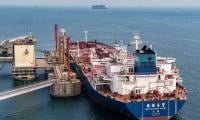
Iraqi oil production from its main southern oilfields has fallen by 70 per cent to just 1.3 million barrels per day as the country is unable to export oil via the Strait of Hormuz due to the Iran war, 3 industry sources said on Sunday. Production from the fields stood at around 4.3 million bpd before the war.
Irradiation facility in Isfahan had been damaged on Saturday in Israeli-US strikes, no radiation pollution reported, ISNA citing nuclear security centre said.
US military said Iranian forces are using crowded areas to launch attack drones and ballistic missiles.
While the UAE foreign ministry said it does not seek to be drawn into any conflicts or escalation, but affirms full right to protect its sovereignty and national security, a statement said. Meanwhile, a Pakistani driver was killed in Dubai’s Al Barsha area on Saturday evening after debris from an aerial interception struck his vehicle shortly after Iftar, authorities confirmed, Geo News reported. The incident occurred near Sheikh Zayed Road behind the Mall of the Emirates. Officials said the impact sparked a brief fire, but no other injuries were reported.
Authorities have launched an investigation to determine whether the driver received an emergency alert on his mobile phone and if safety instructions were followed. The Al Barsha area is located along Sheikh Zayed Road, one of Dubai’s busiest highways. The fatality raises the toll from the recent attacks to four people, including two Pakistani nationals.
Prime Minister Shehbaz Sharif has expressed deep sorrow over the deaths of Pakistani nationals, saying: “I am deeply saddened by the tragic death of two Pakistani nationals in Dubai caused by missile debris.” Previously, a Pakistani national, Murid Zaman, hailing from Khyber Pakhtunkhwa, was killed in Abu Dhabi’s Madinat Zayed area. Zaman, as per diplomatic officials, was killed in an Iranian missile strike after being struck by missile fragments.
The Iranian army said on Sunday that at least 104 people were killed and 32 were wounded in an attack by the U.S. on an Iranian warship off Sri Lanka’s coast last week.
A U.S. submarine sank the frigate Dena in the Indian Ocean about 19 nautical miles off Sri Lanka’s southern port city of Galle on Wednesday, killing dozens of sailors and dramatically widening Washington’s pursuit of the Iranian navy.
President Donald Trump on Saturday joined the families of six US soldiers killed in the war in the Middle East during a dignified transfer ritual at Dover air force base. A “dignified transfer” is when the remains of US service members killed in action are returned to the US. The soldiers were killed in a drone strike in Kuwait earlier this week.
The US military on Sunday announced that a service member in Saudi Arabia had died after being wounded in an Iranian attack, the seventh American combat death since the war began.
US Central Command, which oversees American military forces in the Middle East, said in a statement that the service member died Saturday “from injuries received during the Iranian regime´s initial attacks across the Middle East.”
It said the service member’s identity will be withheld until 24 hours after next of kin notification.