BEIRUT/WASHINGTON/TEL AVIV: Amid war continuing to rage across the Gulf region, Iran’s Foreign Minister Abbas Araghchi said on Saturday that if Trump seeks escalation, it is what he will get, saying that President Pezeshkian’s openness to regional de-escalation was “almost immediately killed by president Trump’s misinterpretation of our capabilities”.
The Iranian foreign minister’s statement came after Trump called Iranian president’s apology to Gulf countries as a surrender, while saying the country would be “hit very hard” and warned the US could widen its attacks to areas and groups of people that were not previously designated targets.
Iranian President Pezeshkian while urging Gulf countries not to join US-Israeli attacks on Iran, stated, “I personally apologise to neighbouring countries that were affected by Iran’s actions.”
However, Pezeshkian’s comments caused a political stir in Iran, prompting his office to reiterate Iran’s military would respond firmly to attacks from US bases in the region. In his statement on social media platform X, Araghchi also warned Trump’s envoys that war will not improve bargaining position.
Araghchi further said Saudi officials have assured him they are fully committed to not allowing their soil, waters, airspace to be used against Iran. He said he was in constant contact with Saudi counterpart, officials said.
Iranian President Pezeshkian dismissed President Trump’s demand for the Islamic Republic’s unconditional surrender as “a dream”, but said its temporary leadership council had agreed to suspend attacks on nearby states unless strikes on Iran originated from their territory.
Pezeshkian’s comments caused a political stir in Iran. Hamid Rasai, a hardline cleric and lawmaker, wrote on X, “Mr Pezeshkian, your stance was unprofessional, weak and unacceptable”.
Hours after Pezeshkian’s announcement, Iran’s Revolutionary Guards said their drones struck a US air combat centre at Al Dhafra Air Base, near Abu Dhabi, capital of the United Arab Emirates. Reuters could not independently verify that report.
The Revolutionary Guards also targeted US forces at a base in Bahrain, the Iranian state media said. Blasts were also heard in Doha, a Reuters witness said.
Gholamhossein Mohseni-Ejei, Iran’s judiciary chief, said evidence from Iran’s armed forces indicates that the territory of some regional countries was being used to carry out attacks against Iran.
Heavy strikes on those targets will continue, said Mohseni-Ejei, who is also a member of the interim leadership council set up after Supreme Leader Ayatollah Ali Khamenei was killed in an airstrike on his compound at the start of the conflict.
Huge explosions were heard in several parts of the Iranian capital, state media reported. The US-Israeli war on Iran has already spilled beyond Iran’s borders, as Tehran has responded by hitting Israel and Gulf Arab states hosting US military installations and Israel has launched fresh attacks in Lebanon after the Iran-aligned militia Hezbollah fired across the border.
Gulf states voiced outrage that their civilian infrastructure—hotels, ports and oil facilities—was struck despite their having had no part in the US-Israeli attacks.
The UAE, Kuwait, Qatar, Bahrain, Oman, Saudi Arabia and Iraq have all reported drone or missile attacks over the past week.
An Emirati official said the United Arab Emirates wanted the Iranian aggression against the Gulf states to end immediately. With the conflict spreading, Israel warned Lebanon of a “very heavy price” if it did not rein in Hezbollah, as it pounded the group’s strongholds with airstrikes and mounted a deadly airborne raid in the east. Heavy Israeli bombardment had followed an evacuation order for civilians. The total death toll from Israel’s attacks on Lebanon since Monday has risen to 294, the health ministry said. The US-Israeli attacks have killed at least 1,332 Iranian civilians and wounded thousands, according to Iran’s UN ambassador, Amir Saeid Iravani.
Iranian attacks have killed 10 people in Israel, and at least six US service members have been killed.
Iran’s apparent strategy of maximum chaos has driven up the costs of the conflict by raising energy prices, hurting global business and logistics links and shaking trust in the stability of a critical region for the world’s economy.
Early on Saturday, the Iranian army said its navy had carried out drone strikes against targets in Israel as well as US gathering points and bases in Abu Dhabi and Kuwait.
Speaking at an event hosting Latin American leaders in Miami, Florida, Trump said on Saturday the US had knocked out 42 Iranian navy ships in three days.
Israel launched what its military described as a new wave of strikes on Tehran and Isfahan, while overnight, the Israeli military said it had carried out strikes on neighbouring Lebanon that it said were aimed at Hezbollah military sites.
The Israeli military reported identifying missiles fired from Iran at Israel on eight different occasions on Saturday, setting off air raid sirens in parts of the country and prompting Israeli air defences to intercept incoming fire. The war has roiled global markets and oil prices have hit multi-year highs with the Strait of Hormuz effectively shut. About one-fifth of global oil moves daily through the strait.
Iran’s army said Saturday its navy had launched a wave of drone attacks targeting Israel as well as US bases in the United Arab Emirates and Kuwait, as the regional war raged into its second week.
“The Iranian Navy targeted American bases and occupied territories with a massive wave of drone attacks,” the army said in a statement carried by the official IRNA news agency.
It said the targets included the UAE’s Al-Minhad base and another in Kuwait, as well as a “strategic facility” in Israel.
Later, the Revolutionary Guards said their forces also targeted Al-Dhafra air base in the UAE.
”In this attack, the American terrorists’ air warfare centre, satellite communication centre, early warning radars, and fire control radars were hit,” the Guards said in a statement, according to Tasnim news agency.
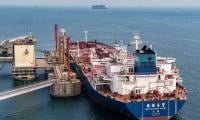
Iran’s Revolutionary Guards hit a Marshall Islands-flagged tanker in Hormuz, Iranian state media reported on Saturday.
Dubai’s main airport, a key global transport hub, was forced to briefly close on Saturday as Iran launched missiles and drones at targets across the Gulf. The Emirates said it was targeted with 16 ballistic missiles and more than 120 drones.
One unidentified object was intercepted near Dubai airport, the world’s busiest for international traffic, forcing it to briefly suspend operations.
A witness told AFP of a loud explosion in the area followed by a cloud of smoke, while footage authenticated by AFP recorded the sound of a drone followed by a loud explosion and plumes of smoke close to an airport concourse.
In a statement since deleted from X, Emirates, the largest airline in the Middle East, had announced it was suspending all flights to and from Dubai until further notice, but later said it had resumed operations.
The United Arab Emirates will emerge “stronger” after the Middle East war, the president told Abu Dhabi TV in a rare address on Saturday, as Iran continued its retaliatory strikes across the Gulf.
The UAE “is in a period of war”, Sheikh Mohammed bin Zayed Al Nahyan told the TV channel, but “we will emerge stronger”.
On the other hand, Israel’s military said on Saturday it had struck 16 Iranian aircraft at Tehran’s Mehrabad International Airport, which it said was a key hub for the Islamic republic’s Revolutionary Guards. Other targets included an underground command centre and missile storage facility as well as launch sites, “in order to reduce the scope of fire directed at the territory of the State of Israel”, the statement said.
Iran’s Revolutionary Guards said they targeted Haifa refinery after targeting of Tehran refinery, state media reported.
The United States has started using British bases for certain operations against Iran during the Middle East war, the UK government announced on Saturday.
Britain’s defence ministry said the US had begun using the military sites for “specific defensive operations to prevent Iran firing missiles into the region”.
Iran’s Revolutionary Guards said Saturday they have targeted “separatist groups” in Iraq’s Kurdistan region.
An official from an exiled opposition group in Kurdistan told AFP that drones struck positions belonging to three Iranian Kurdish parties without causing casualties.
Turkiye is considering the possibility of sending F-16 fighter jets to Northern Cyprus as a security measure, a Turkish defence ministry source said Saturday, days after the island was targeted by a drone attack.
Iran’s Foreign Minister Abbas Araghchi accused the United States on Saturday of attacking a desalination plant on a Gulf island, saying it had set a precedent.
Iran’s parliament speaker said that the attack on a freshwater desalination plant on Qeshm island was carried out with support from one of the airbases in a southern neighboring country. He did not name the country. “The crime will receive a proportionate response,” he said.
While Kuwait’s national oil company announced a cut to its production of crude due to Iranian attacks and threats to the Strait of Hormuz.
”In light of the ongoing aggression by the Islamic Republic of Iran against the State of Kuwait, including Iranian threats against safe passage of ships through the Strait of Hormuz, KPC (Kuwait Petroleum Corporation) has implemented a precautionary reduction in crude oil production and refining throughput as part of its risk management and business continuity strategy,” it said, adding that it would be “reviewed as the situation develops”. The Israeli military warned the remaining residents of Beirut’s southern suburbs, where Hezbollah holds sway, to evacuate immediately. Qatar said it had intercepted a missile, shortly after AFP journalists heard explosions and sirens sounding in central Doha. “Armed forces intercepted (a) missile attack which targeted (the) State of Qatar,” the defence ministry said.
Lebanon’s health ministry on Saturday said Israeli attacks on the country had killed almost 300 people since the start of the war with Hezbollah this week. In a statement, the ministry said that “the death toll from the Israeli aggression, from dawn on Monday... has risen to 294 martyrs and 1,023 wounded”.
Jordan accused Iran on Saturday of directly targeting sites in the kingdom, firing 119 missiles and drones in the week since US-Israeli strikes triggered a regional war.
Jordanian military spokesman Brigadier General Mustafa Hayari told a news conference that 108 of the projectiles had been intercepted.
”These missiles and drones were targeting vital installations inside Jordan and were not passing through our territories,” he said.
Saudi defence ministry said ballistic missile fell in uninhabited area towards Prince Sultan Airbase, in a post on X
Foreign ministers of the Arab League will hold an emergency meeting on Sunday (today) to discuss “Iranian attacks on the territories of several Arab countries”, the bloc’s assistant secretary-general told AFP. The meeting, which will be held via videoconference, was requested by Kuwait, Saudi Arabia, Qatar, Oman, Jordan and Egypt, Hossam Zaki said.
Iran’s assembly of experts to meet within one day to chose new supreme leader, said assembly member Ayatollah Mozafari cited by Iranian media
Meanwhile, A classified US report doubts that Iran’s opposition would take power following either a short or extended U.S. military campaign. A classified report by the National Intelligence Council found that even a large-scale assault on Iran launched by the United States would be unlikely to oust the Islamic republic’s entrenched military and clerical establishment, a sobering assessment as the Trump administration raises the specter of an extended military campaign that officials say has “only just begun,” Washington Post reported. As the first explosions from Iran’s retaliatory attack sounded across the United Arab Emirates last Saturday, the State Department was still scrambling to finalise a key bureaucratic task -- securing approvals for at least three US embassies in the region to evacuate non-essential personnel.
Memos asking State Department leadership to approve evacuations for US missions in Bahrain, Kuwait and Qatar, all of which were already coming under fire from Tehran on Saturday, were not sent up for clearance and approved until hours after the United States and Israel launched their war on Iran, and in several cases not until the following day, according to two sources familiar with the matter and half a dozen internal State Department cables seen by Reuters.
Iran’s security chief Ali Larijani while calling for unity insisted that there is no rift among Iranian officials about responding to US and Israeli aggressions.
He said Tehran has no problem with regional countries, adding that why the US bases in the region are being used by enemies. He said Tehran has the right to defend itself.
Larijani emphasised they “do not welcome the war, but aggressors should be punished”, adding that Iran has not closed down the Strait of Hormuz, it is closed because of the war. He said the US is stuck in the quagmire of its own miscalculations.