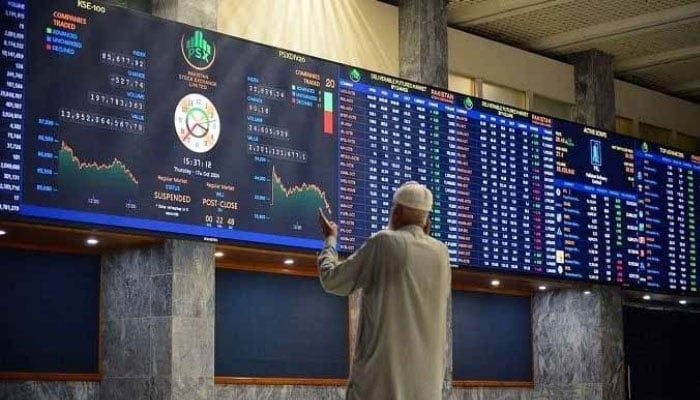
KARACHI: The stock market may remain under pressure next week as investors track developments on the geopolitical front and await the upcoming monetary policy decision.
Analysts expect cautious trading as markets assess the impact of regional tensions, inflation trends and interest rate direction. The index currently trades at a price-to-earnings ratio of about 8.1 times and offers a dividend yield of around 6.3 per cent, which analysts view as attractive at current levels.
According to AHL Research, the KSE-100 index performance over the coming week will depend largely on geopolitical developments and the outcome of the Monetary Policy Committee (MPC) meeting expected on Monday. The research house noted that the market trades at relatively attractive valuations compared with its historical levels. It identified several sectors where fundamentals remain supportive despite recent volatility.
The market ended the week on a weak note. The benchmark index closed at 157,496 points. It fell by 10,566 points during the week, marking a decline of 6.3 per cent week-on-week (WoW). Persistent geopolitical tensions linked to the conflict involving the US and Iran weighed heavily on investor sentiment. Selling pressure intensified as investors reduced exposure to equities and moved to safer assets.
Macro-economic indicators also shaped market direction. Data released by the Pakistan Bureau of Statistics (PBS) showed that consumer inflation reached 7.0 per cent year-on-year (YoY) in February 2026. This was the highest reading since October 2024 and higher than 5.8 per cent recorded in January. The increase raised concerns about possible inflationary pressures in the months ahead.
Trade data showed continued external pressure. Pakistan recorded a trade deficit of about $3 billion in February 2026. Exports stood at $2.3 billion, down 8.0 per cent YoY. Imports were recorded at $5.3 billion, showing a decline of 1.6 per cent year on year.
Sector-specific indicators showed mixed trends. Cement dispatches rose 12.53 per cent YoY to 4.19 million tonnes in February compared with 3.73 million tonnes in the same month last year. However, provisional urea offtake declined sharply. Sales dropped 28 per cent year on year to about 251,000 tonnes, the lowest monthly level in recent months.
Energy sector data also remained soft. Gas production fell 0.1 per cent WoW to 2,687 million cubic feet per day in the fourth week of February. Oil production declined 2.9 per cent week on week to 59,103 barrels per day during the same period.
Meanwhile, the government raised Rs581.7 billion in the Treasury bill auction held during the week. Yields increased across all tenors by 21.5-39.3 basis points (bps). Public debt continued to rise as well. Government debt increased by 1.0 per cent month-on-month (MoM) to Rs79.3 trillion in February 2026.
Foreign exchange reserves remained broadly stable. Pakistan’s total liquid reserves stood at 21.4 billion dollars, including 16.3 billion dollars held by the State Bank of Pakistan (SBP). The Pakistani rupee showed marginal strength and appreciated slightly to 279.411 per dollar during the week.
Muhammad Waqas Ghani, head of research at JS Global Capital, said the index extended its decline due to heightened geopolitical tensions and cautious investor sentiment. He noted that the market has now fallen nearly 17 per cent from its January 2026 peak of 189,167 points.
Nabeel Haroon, vice president of international equity sales at Topline Securities, said the decline mainly reflected investor concerns about the Middle East conflict and risks to global energy supply routes. He added that foreign corporates remained net sellers, offloading equities worth $25.5 million during the week, while mutual funds sold shares worth $54.5 million due to investor redemptions. Banks, insurance companies and local corporates provided some support by buying equities worth $36 million, $15.7 million and $14.3 million, respectively.
Market activity remained active despite the decline. Average daily trading volume stood at about 658 million shares, while the average daily traded value reached around 36.2 billion rupees. Analysts expect volatility to continue in the coming week as investors monitor geopolitical developments and the central bank’s policy decision.