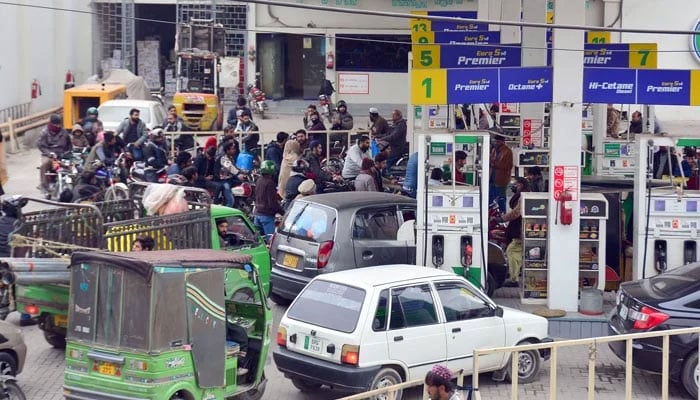
ISLAMABAD: The federal government is preparing a comprehensive fuel conservation strategy amid rising global oil prices triggered by the recent US-Israel attack on Iran, as concerns grow over mounting pressure on Pakistan’s foreign exchange reserves.
International crude prices have already climbed to $84.14 per barrel on March 5 following the escalation in tensions. Energy market analysts warn that if the conflict widens or prolongs, prices could rise further, deepening economic challenges for oil-importing countries like Pakistan.
Senior officials told this correspondent that an important meeting will be held today (Friday) to finalise immediate and medium-term measures aimed at reducing petroleum consumption and containing the import bill. The measures are expected to be finalised and announced on Monday.
Officials clarified that the issue is not one of fuel shortage but of affordability and macroeconomic stability. Pakistan imports the bulk of its petroleum requirements, and any sustained spike in oil prices directly inflates the country’s import bill, widens the current account deficit and puts pressure on the rupee.
With foreign exchange reserves already under strain, policymakers are keen to prevent a fresh external sector shock.
Among the measures under consideration are encouraging work-from-home arrangements in both public and private sectors, promoting carpooling, restricting non-essential official travel and reviewing government fuel usage. Energy conservation steps, including reduced working hours for certain departments and awareness campaigns for the public, are also being examined.
Officials said provinces may also be consulted to ensure coordinated implementation of conservation measures nationwide. Sources caution that higher oil prices not only increase the petroleum import bill but also fuel domestic inflation through higher transport and electricity costs. This, in turn, complicates fiscal management and may require adjustments in fuel prices or additional subsidies -- both politically and economically sensitive options.
Pakistan has previously adopted similar fuel-saving measures during periods of external shocks, including reduced government working days and limits on official fuel consumption.
Today’s meeting is expected to finalise a clear roadmap balancing economic prudence with public convenience. The government is likely to appeal to citizens to voluntarily reduce fuel consumption in the national interest as global uncertainty persists.
While authorities emphasise that there is no immediate supply disruption, they acknowledge that the real challenge lies in managing the ballooning petroleum bill -- a burden that ultimately affects both the government’s finances and consumers’ pockets.
Under the new mechanism, petroleum prices will be adjusted weekly, official meetings will be held virtually and the number of public holidays will be increased—similar to the pattern observed during the Covid-19 pandemic in the first phase.
Authorities are also considering reintroducing online education to reduce daily commuting by students and staff.
The government has finalised a three-phase approach and prepared nearly three to four dozen proposals, which will be presented to Prime Minister Shehbaz Sharif on Friday (today) for final approval. The implementation of approved measures will be enforced on an immediate basis.
Top official sources confirmed to The News on Thursday that the government would enforce measures in the public sector during the first stage. In the second phase, private schools, universities and hospitals will be required to shift to online assignments.
According to an official statement issued by the Ministry of Finance, a meeting of the Committee to Monitor Petrol Prices in the Wake of Emerging Situation in the Region—constituted by the prime minister—was held on Thursday under the chairmanship of Finance Minister Muhammad Aurangzeb at the Finance Division. The meeting reviewed developments in the energy sector and assessed national preparedness measures.
The panel continued its deliberations on the evolving regional and global energy situation and undertook a detailed review of petroleum product stock positions across the country. Members were briefed that national reserves remain at comfortable levels, with sufficient cover available for key products, and that there is no immediate cause for concern regarding the availability of petroleum products. The committee, however, noted that the situation remains fluid and uncertain, requiring sustained vigilance and prudent planning as global supply chains and shipping routes face heightened risk and cost pressures.
A comprehensive briefing was also given on international oil market conditions, including movements in global benchmarks, freight and insurance costs, maritime and routing dynamics, and the risk of supply congestion at key chokepoints. The committee reviewed multiple supply and pricing scenarios to ensure preparedness under different contingencies and to maintain stability in domestic energy supplies. In this context, the forum noted that “war premium” dynamics and intensified competition for energy cargoes, particularly in Asian markets, could increase external account pressures if volatility persists.
The panel reviewed ongoing efforts to strengthen supply assurance through diversified sourcing and logistics arrangements. Updates were shared on diplomatic and commercial engagements being pursued with friendly countries and partner suppliers to secure additional crude and refined product volumes through alternate routes and ports, including options outside high-risk corridors.
The committee also considered shipping and operational measures to reduce time lags, including facilitation of timely berthing and use of available national shipping capacity where feasible.
To safeguard orderly market conditions, the committee discussed measures to deter hoarding, illegal storage and diversion, including coordinated enforcement actions by provincial administrations in close collaboration with Ogra and relevant agencies. It emphasised that preventing outward smuggling and ensuring uninterrupted domestic distribution will remain a top operational priority, and that real-time field intelligence and strict action against violations will be maintained.
In his remarks, the finance minister emphasised that the government’s foremost objective is to ensure uninterrupted availability of petroleum products across the country, and that availability will remain the primary driver of all policy and operational decisions. He stressed that the government is managing the situation responsibly through a structured governance mechanism, with daily monitoring, scenario planning and coordinated decision-making. He further noted that where international price movements create unavoidable pressures, the government will respond through established and predictable mechanisms, with the aim of avoiding distortions and preserving market stability.
The committee also reviewed the LNG and LPG situation, including supply chain risks, shipment schedules and terminal operations. The members discussed contingency options to manage demand efficiently if disruptions linger, while protecting priority sectors and maintaining orderly conditions.
In line with broader preparedness planning, the committee examined a phased menu of fuel conservation measures drawing on institutional protocols implemented during prior national emergencies to support demand management if needed, while carefully calibrating communications to avoid any perception of undue alarm.
It was further decided that the committee will finalise its recommendations by Friday and submit them to the prime minister, together with a comprehensive implementation plan covering supply assurance, enforcement, pricing and governance mechanisms and conservation measures, as appropriate.
The panel would continue to meet on a daily basis to monitor developments, review stock positions and supply chain movements and ensure timely execution across all stakeholders.
For refined petroleum products, Pakistan State Oil (PSO) will continue importing fuel from Singapore. However, due to the disruption in traditional supply routes, the company may procure diesel through competitive tenders instead of from its usual supplier in Kuwait.
Authorities said import costs have already surged due to higher premiums, war-risk charges and insurance costs, further increasing pressure on the country’s energy import bill.
On the gas front, the government has activated a nationwide gas load management plan and sharply reduced LNG regasification rates to stretch available supplies. Regasification of two LNG cargoes — one docked at the Pakistan GasPort Consortium Limited (PGPL) terminal and the other at the Engro Elengy Terminal Limited (EETL) terminal — has been cut to around 100 million cubic feet per day (mmcfd) from normal levels of about 500 mmcfd. Each LNG cargo carries roughly three billion cubic feet (bcf) of gas, and officials said the reduced regasification rate would help stretch supplies until March 25. As part of the conservation strategy, the government has suspended about 78mmcfd of imported LNG supply to the fertiliser sector to prioritise essential consumption. Officials said Sui Northern Gas Pipelines Limited (SNGPL) has also proposed cutting around 45mmcfd of gas supply to the CNG sector, although a final decision has yet to be taken.
Authorities maintained that domestic consumers will remain protected under the load management plan, ensuring uninterrupted gas supply to households while sectoral adjustments are made to balance demand and supply.
Sources said the government had already arranged two LNG cargoes before the Hormuz situation deteriorated but has now decided not to import additional LNG during March, even under its flexible agreement with Socar, which allows Pakistan to skip monthly cargo purchases.
Officials warned that imported LNG prices have already jumped by nearly 50 percent and could rise further if regional instability continues.
Meanwhile, the government dismissed as fake a notification circulating on social media claiming a temporary suspension of all port entries in Pakistan due to the security situation until March 10.
In a statement posted on its official ‘X’ account, the minister of information’s fact-checking team clarified that no such notification had been issued by either the Cabinet Division or the Ministry of Maritime Affairs, terming the circulating document fabricated.
Meanwhile, Pakistanis fleeing Iran described explosions and missile strikes across Tehran shaking the ground under their feet and engulfing buildings in fire and smoke in a city emptied of many of its residents.
“I was in the classroom when a powerful explosion rocked our university building,” Hareem Zahra, 23, a student at the Tehran University of Engineering, told Reuters after crossing Pakistan’s land border with Iran. “We saw thick smoke coming from many buildings on fire,” she said, adding Tehran was under attack until the moment she left.
Nearly 1,000 students, businessmen and pilgrims have fled Iran since the war started out of a total 35,000 Pakistanis in the country, Mudassir Tipu, Pakistan’s ambassador to Tehran, said. “There are now serious challenges. As you know there is no internet in most parts of Iran,” he said.
Tehran has looked deserted since the conflict began, said Nadir Abbas, 25, a student of Persian literature at a university in the Iranian capital. “I saw a drone hit a basketball court where six girl players lost their lives.” Reuters could not verify his account.
Islamabad is walking a diplomatic tightrope as it attempts to maintain warming ties with Washington while expressing solidarity with Iran.
Pakistan is home to the second-largest Shia population in the world after Iran and being drawn into the conflict could lead to instability at home as well as complications evacuating its citizens.
“The first attack happened right next to my hospital,” said Sakhi Aun Mohammad, a student at the Tehran University of Medical Sciences.
After he reached the border, an Iranian friend called to check if he was safe, saying: “’Thank God, you have gone to Pakistan, all of you are safe, but your hostel has been attacked’.”
A Pakistani diplomat who is still in Tehran said attacks took place every four or five hours, adding one missile struck a building next to his office. “At times you will feel as if something exploded right at your feet,” he said. “The last time I got out was at night. Buildings had collapsed, some others were on fire. There is destruction everywhere.” He added: “It is almost like a ghost town.”
Separately, the US Mission in Pakistan has issued a security alert, limiting the movement of all US personnel and citizens in light of possible countrywide protests today (Friday) against US-Israeli airstrikes in Iran.
In an advisory issued on Thursday night, the mission urged American citizens in the country to avoid areas of large public gatherings, keep a low profile, review personal security plans, monitor local media and email updates, ensure Smart Traveler Enrollment Programme registration is up to date, and cooperate with local authorities while carrying valid identification to ensure their safety.
The Jamaat-e-Islami has called for nationwide protests on Friday against the United States and Israel over their joint airstrikes on Iran that assassinated Iranian Supreme Leader Ayatollah Ali Khamenei and other senior figures, drawing widespread condemnation across the region.
The US Mission also highlighted multiple threats to American citizens, including potential Iranian drone and missile strikes following the outbreak of conflict on February 28, 2026, as well as ongoing terrorist risks from violent extremist groups targeting transportation hubs, markets, hotels, airports, schools, hospitals, military sites and government buildings across Balochistan, Khyber Pakhtunkhwa, Karachi and Islamabad. It warned Americans against traveling to Balochistan, Khyber Pakhtunkhwa and areas near the Line of Control. Other foreign missions have also issued safety advisories for their nationals in the country.