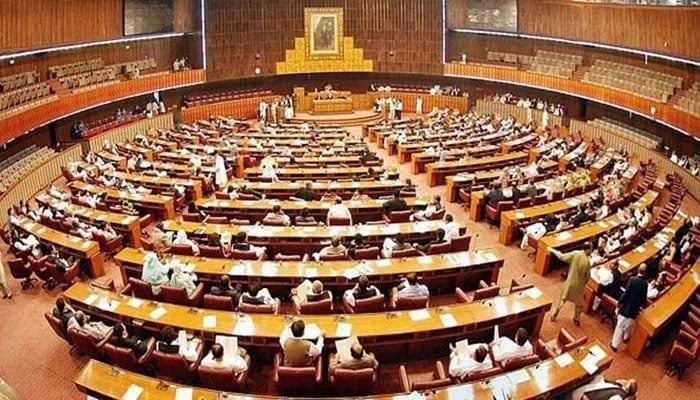
ISLAMABAD: In a matter of hours, the National Accountability (Amendment) Bill, 2026 sailed through both houses of parliament on Thursday in the teeth of opposition, paving the way for an extension in the NAB chairman’s tenure for another three years.
Mah Jabeen Khan moved the bill in the National Assembly, seeking amendments to certain provisions of the National Accountability Ordinance, 1999 (XVIII of 1999) to strengthen accountability mechanisms, and introducing additional safeguards in the appellate and administrative framework of the National Accountability Bureau (NAB). The bill proposes amendments relating to the jurisdiction, financial thresholds, tenure of the NAB chairman, bail powers of courts and introduction of a second appellate forum.
Following its passage from the National Assembly, the bill was moved in the Senate from where also it successfully sailed through amid severe criticism by the opposition, which claimed that the extension was against the public interest. The sudden legislation has been carried out just a day before the expiry of three-year term of the incumbent National Accountability Bureau Chairman Lt. Gen. (retired) Nazir Ahmed. Nazir served a non-extendable term of three years and is not eligible for reappointment.
The amendment to Section 6 of the NAB Ordinance envisages the chairman to serve a three year term, which may be extended once to another three years by the federal government. As per the statement of objects and reasons of the private member bill moved by independent senator from Balochistan Muhammad Abdul Qadir, the amendment would provide administrative continuity and flexibility in leadership.
The opposition benches protested strongly against the bill that was moved as supplementary agenda on a non-private members day. Monday remains the private members day in the Senate. Expressing his views, PTI parliamentary leader Barrister Syed Ali Zafar claimed the controversial bill had come from “somewhere else”. He said shifting criminal cases to the constitutional courts would amount to compromising the dignity of the judiciary.
He said changing the forum of NAB cases from High Court was a blot on parliament’s reputation. The NAB amendments were being made only to politically target the PTI founder Imran Khan, he noted.
Barrister Zafar said cases were being transferred to the constitutional courts because the Supreme Court was not under control. “Lawmakers elected through Form-47 are legislating against the will of the people. Citing past mistakes to bulldoze legislation today is dangerous for democracy,” he remarked. He observed that ignoring the opposition in legislation was diminishing the parliament’s credibility.
The statement of objects and reasons of the bill says the National Accountability (Amendment) Bill, 2026 seeks to amend certain provisions of the National Accountability Ordinance, 1999 with the objective of improving procedural clarity, strengthening accountability mechanisms, and introducing additional safeguards in the appellate and administrative framework of the National Accountability Bureau (NAB).
It proposed amendments relating to jurisdiction, financial thresholds, tenure of the NAB chairman, bail powers of courts and introduction of a second appellate forum. The bill proposes an amendment to Section 4 of the NAB Ordinance concerning the jurisdiction and functions of accountability courts. The amendment inserts the word “appeals” after the word “trials” in sub section (6), clause (a). This change clarifies that the relevant procedural provisions apply not only to trials but also to appellate proceedings, thereby, ensuring broader procedural application and reducing ambiguity in the interpretation of law.
It also proposed an amendment to Section 5, which contains definitions used in the ordinance. Under the proposed change, the monetary threshold specified in clause (o) will be adjusted annually in accordance with the inflation index published by the Pakistan Bureau of Statistics. This measure ensures that the financial limits prescribed under the law remain realistic and relevant over time and are not diminished due to inflation.
The bill amends Section 9 by substituting sub section (b) to clearly empower both the accountability courts and the relevant High Courts to grant bail or order release of the accused under Sections 439, 496, 497, and 498 of the Code of Criminal Procedure. The amendment says any person convicted or the prosecutor general accountability, if so directed by the NAB chairman, aggrieved by the decision made by the High Court under Section 32, may prefer a second appeal to the Federal Constitutional Court within a period of 30 days.
According to the law, the NAB chief is appointed through consultations between the prime minister and the opposition leader, which is supposed to start two months before the expiry of the term and be completed within 45 days. If there is no consensus, the names proposed by the PM and the opposition leader are to be forwarded to the parliamentary committee for the final decision. “Provided that the leader of the house and leader of the opposition shall propose two names each for consideration of the parliamentary committee,” a proviso to the law reads. “The parliamentary committee under clause (ii) shall be constituted by the speaker, National Assembly, comprising fifty percent members from the treasury benches and fifty percent from the opposition benches, based on their strength in Majlis e Shoora (parliament), to be nominated by the respective parliamentary leaders,” the law reads. The committee, comprising 12 members, including one-third from the Senate, has to propose the name not later than 30 days.
In a later development, President Asif Ali Zardari assented to a number of bills passed by parliament and approved several related summaries, including the one related to NAB. They include The Virtual Assets Bill, 2026; The Islamabad Capital Territory Senior Citizens (Amendment) Bill, 2026; The Privatisation Commission (Amendment) Bill, 2026; The Cannabis Control and Regulatory Authority (Amendment) Bill, 2026 and the NAB (Amendment) Bill, 2026.
The president also approved amendments to the Federal Constitutional Court Judges (Leave, Pension & Privileges) Order, 2025. In addition, he also approved the re-constitution of the Islamabad Subordinate Judiciary Service Tribunal. He further approved the establishment of branch registries of the Federal Constitutional Court at Lahore, Karachi, Peshawar and Quetta.