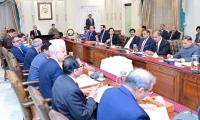
ISLAMABAD: Pakistan on Monday said that the present developments in the Middle East were indeed very worrisome and in this regard Islamabad was making full diplomatic efforts and was in touch with the United States and Iran at the leadership level, while calling for an immediate halt to escalation through diplomacy and dialogue.
“Pakistan is making full diplomatic efforts for de-escalation in the Middle East. The situation is extremely delicate. This recent escalation has obviously now significantly heightened tensions in an already volatile and fragile environment.
“We are doing our full diplomatic efforts and are requesting all parties to de-escalate and refrain from this process,” said Deputy Prime Minister and Foreign Minister (DPM/FM) Ishaq Dar as he briefed foreign envoys based in Islamabad at the Foreign Office.
The session also included detailed briefing on the present situation with Afghanistan and Pakistan’s military operations under ‘Operation Ghazab Lil Haq.’ Foreign Secretary Amina Baloch, and several senior officials were also present.
Dar said that Pakistan found the development in the last 72 hours “really very very worrisome.” “In our outreach, at the leadership level, we have called for an immediate halt to escalation through urgent resumption of diplomacy to achieve a peaceful, negotiated resolution to the crisis. Pakistan stands ready to extend support towards peaceful resolution of outstanding issues,” he said.
Speaking on Oman’s mediation efforts, Dar said that in his reach out the Omani foreign minister was “absolutely satisfied” with the US-Iran talks, as well as the IAEA authorities whom the Pakistani leadership met 10 days ago in Austria.
“So it is puzzling that what necessitated all of a sudden the decision to attack,” Dar said as the US and Israel attacked Iran. The response from Iran saw a Pakistani national killed in Abi Dhabi. “Our missions in the region remain fully engaged with the diaspora, and remain in close contact with local authorities for facilitation,” he said.
Pakistan’s efforts, he pointed out, has been to encourage both the US and Iran to get engaged in dialogue and diplomacy, and resolve the issue. “We are privy to the demands and the responses. We have been encouraging to make it viable, win-win for both the United States and Iran, and I think we are very close in counselling both countries on this subject,” he added.
Pakistan stands for global peace and security and the DPM/FM reminded the envoys it has been elected as a non-permanent member of the United Nations Security Council for the term 2025-26.
“We will remain committed to fostering peace, promoting security, and ensuring justice on the world stage,” he added. Dar said Pakistan acknowledged that the main target of Iran’s retaliatory strikes were in self-defence.
“But Pakistan deeply regrets and condemns the strikes on brotherly countries, including Saudi Arabia, Bahrain, Jordan, Kuwait, Qatar, the UAE and Oman.” “We can’t have double standards. Pakistan was one of the first to condemn the attacks on Iran, but the self-defence actions “compounded and complicated the situation on the ground. They are a sovereign state and it’s their decision, they say ‘we have not attacked those countries, we attacked the American base there or their installation there’.
“But there is still no justification because of the panic, see what’s the turmoil in the entire region. I myself had to find ways to get back to the country and the entire airspace was closed,” he added.
While he spoke to all his counterparts since the past week, “I think I have not talked to anyone who disagrees that dialogue and diplomacy is the only way forward, not only for this region but wherever there is any conflict. There are forums available, there are systems in place post-World War-II, so it seems to be a very turbulent time in the diplomatic space and the diplomatic world, which we all need to work together to bring it back to the original agreed principles,” he said.
FM Dar noted that Pakistan’s position had been clear and persistent that “all countries must abide by the principles of the UN Charter and international law, including respect for the sovereignty and territorial integrity of other states, as well as international humanitarian law”.
The minister recalled that he had conveyed Pakistan’s “condemnation of the attacks” to Iran FM Abbas Araghchi in a phone call with him on February 28.
He noted that his Iranian counterpart had responded “positively” to his call for restraint and dialogue, adding: “But on ground, we are that things are not settling or easing out. But what triggered all of a sudden this action, which has now engulfed almost all countries. As late as this morning, we understand that Saudi Arabia has also now, in self-defence, responded to Iran, though there is no reported casualties.”
“Things are on the ground moving very differently, which obviously is worrisome because we believe that the international law must prevail and the conventions must be respected,” he noted.
“We had consistently urged that the door to dialogue and diplomacy must not be closed,” the foreign minister stressed. Dar also mentioned the Gaza conflict and the Board of Peace membership.
“All the efforts aimed to bring peace in the Middle East, particularly in Gaza, Pakistan has been a contributor in all those efforts, together with the eight Islamic states since September 2025.
“We don’t mince words; we call a spade a spade. Wherever you know principle demands, we do act accordingly,” he said. Later, the Foreign Office said that the DPM/FM spoke with European Union High Representative and Vice President (HRVP) Kaja Kallas.
According to FO, the two sides expressed “deep concern on the recent regional developments in Iran and the wider Middle East”. During the call, Dar underscored the need for dialogue, diplomacy and de-escalation, it said.
He also briefed the Kallas on Pakistan-Afghanistan tensions and appreciated the EU’s constructive engagement. “Both sides agreed to maintain close contact on the evolving regional situation,” it added.
The foreign minister also spoke to his counterpart in Bahrain, Dr Abdullatif bin Rashid Al Zayani, where they discussed the regional situation with Dar emphasising efforts towards de-escalation, and advancing peace and stability in the region.
Meanwhile, Chinese Ambassador Jiang Zaidong called on the foreign minister who reaffirmed Pakistan’s commitment to peace and stability in the region and beyond.
Meanwhile, Prime Minister Shehbaz Sharif held a telephone conversation with Sultan of Oman Haitham bin Tariq and discussed the prevailing regional situation that had aggravated following Israel’s attack on Iran as well as subsequent hostilities that endangered peace and security of entire region.
The prime minister said that the escalation had taken place at a time when diplomatic efforts were underway to reduce US-Iran tensions, facilitated by Oman. The attacks had not only derailed the delicate diplomatic process, but had also undermined efforts to promote dialogue and de-escalation in the region.
He stressed upon the urgent need to prevent further escalation and to create space for resumption of diplomatic initiatives. While conveying his deep appreciation for Oman’s mediatory role, the prime minister commended Sultan Haitham bin Tariq for Muscat’s constructive efforts in facilitating dialogue and building trust among regional and international stakeholders.
He acknowledged that Oman’s balanced and forward-looking diplomacy was a stabilising force in the region. Both the leaders agreed to remain in close contact and to continue supporting diplomatic initiatives aimed at restoring calm and ensuring lasting regional stability.
PM Shehbaz spoke with Kuwait Crown Prince Sheikh Sabah Al-Khaled Al-Sabah. During their conversation, the prime minister expressed condolences over the loss of lives as a result of the attacks on Kuwait during the ongoing crisis in the Middle East.
He affirmed Pakistan’s solidarity and support for the leadership and people of Kuwait at this critical time. The two leaders stressed on the urgent need for de-escalation amid heightened tensions that had been aggravated following Israel’s attack on Iran and Iran’s retaliatory strikes against various brotherly Gulf nations, including Kuwait.
While condemning the violation of sovereignty and territorial integrity of these brotherly countries, as well as the loss of valuable lives in the ongoing conflict, the prime minister reiterated that Pakistan continued to call for diplomacy and urged all parties to refrain from any further actions that could exacerbate tensions and undermine the peace and security of the region.
Meanwhile, the US Mission in Pakistan Monday announced an immediate halt to operations at its Peshawar consulate and cancellation of visa appointments at its Karachi and Lahore missions amid countrywide street protests against deadly US Israeli airstrikes on Iran.
The other foreign missions also issued safety advisories for their nationals in the country. According to the US Mission, the US Consulate General in Peshawar has “temporarily” suspended routine operations, while all consular services, including US visas and American Citizen Services, have been cancelled at the US Consulates General in Karachi and Lahore for today (Tuesday).
However, the US Embassy in Islamabad will resume normal consular operations on Tuesday after a one-day suspension. Amid unrest, the US Mission has issued an alert urging American citizens in Pakistan to remain vigilant, avoid large gatherings, stay aware of their surroundings, monitor local news and ensure their Smart Traveler Enrollment Programme registration is up to date. They’re also advised to carry identification and cooperate with local authorities if approached.
Also, the Australian High Commission in Pakistan has advised Australians to stay alert to protests and avoid large crowds, rallies and demonstrations, following local authority guidance.
Likewise, the French Embassy reminded its citizens in the country to exercise utmost caution in light of regional tensions and ongoing unrest, urging them to stay informed, avoid public gatherings and steer clear of crowded places such as malls, restaurants and hotels.
The German Embassy in Islamabad said it would remain closed to the public due to mobility restrictions, with affected applicants to be formally contacted about rescheduled appointments.
Meanwhile, the federal government sent the military to Gilgit-Baltistan region and banned large gatherings nationwide after deadly protests against US and Israeli strikes on Iran spread, with 26 dead so far.
In Skardu normally a tourist hotspot, protesters set fire to a UN office on Sunday with 14 people, including a soldier, killed in the ensuing clashes, local officials said. The funeral processions for those killed in Gilgit-Baltistan, Karachi and Islamabad were announced for Monday.
Ghulam Abbas, the Gilgit-Baltistan information minister, said authorities were calling in the military for three days and imposing “a three-day curfew in Gilgit and Skardu to maintain law and order”.