WASHINGTON: President Donald Trump signaled on Monday that US strikes on Iran could go much longer than originally predicted as he refused to rule out sUS troops into Iran.
Iran launched waves of missile and drone attacks against a range of US military installations, allied bases and infrastructure across the Persian Gulf. The war between Iran and US-Israeli coalition has rapidly expanded into a broader regional conflagration, drawing in multiple countries across the Middle East and beyond, as retaliatory attacks and military operations escalate just days after Iranian Supreme Leader Ayatollah Ali Khamenei was martyred in a joint US-Israeli strike.
In his first public comments since launching the military operation, the president who long campaigned for “no new wars” laid out what he said were four key objectives for hitting Iran.
Trump also said that the timeframe he initially gave could drag out, raising fears among right-wing supporters in particular of a return the Middle Eastern entanglements he once opposed.
“From the beginning we projected four to five weeks, but we have capability to go far longer than that,” Trump said at the start of a medal presentation event at the White House.
Trump however said that the United States was “substantially ahead of our time projections”, citing the killing of Iran’s top leadership in the initial wave of strikes on Saturday.
The US president for the first time clearly laid out four explicit goals for Operation Epic Fury, saying it was the “last, best chance” to hit Washington’s decades-long arch-foe.
“First, we’re destroying Iran’s missile capabilities... Second, we’re annihilating their navy... Third, we’re ensuring that the world’s number-one sponsor of terror can never obtain a nuclear weapon.
“Finally we are ensuring the Iranian regime can’t continue to arm, fund and direct terrorist armies outside of their borders.”
Trump had previously made different and sometimes contradictory comments on the conflict in a series of telephone interviews since the strikes began on Saturday.
He refused to rule out sending US troops into Iran in an interview with the New York Post on Monday. That could risk far higher casualties than the four service members killed so far. “I don’t have the yips with respect to boots on the ground,” Trump said, using a golf term for anxiety. “Every president says, ‘There will be no boots on the ground.’ I don’t say it.”
Trump also spoke to CNN on Monday, flagging what he said would be an escalation in the assault on Iran. “The big wave hasn’t even happened,” he said. “The big one is coming soon.”
Iran launched waves of missile and drone attacks against a range of US military installations, allied bases and infrastructure across the Persian Gulf. Explosions and impacts have been reported in Kuwait, Qatar, Saudi Arabia, the United Arab Emirates (UAE), Bahrain and other Gulf states, causing significant disruption.
In one of the most dramatic developments, three US F-15E warplanes were shot down over Kuwait after the country’s air defences mistakenly engaged the aircraft amid the chaos of combat operations. All six American aircrew ejected safely and were recovered, the US military confirmed, but the incident underscores how rapidly the fighting is spreading.
Iran’s retaliatory strikes targeted energy infrastructure and critical facilities across the region. State energy companies report Qatar’s LNG export operations at Ras Laffan were halted after drone attacks forced production to stop, affecting roughly 20pc of global liquefied natural gas supplies.
Saudi Arabia’s massive Ras Tanura oil refinery complex was struck by Iranian drones, briefly igniting fires and leading to shutdowns at key oil export terminals.
Officials in the UAE also reported repeated interceptions of missiles and drones, with civilian and industrial areas impacted by debris and explosions.
For the first time in the conflict, a British Royal Air Force base on Cyprus — RAF Akrotiri — was struck by an Iranian-made drone. The attack caused minor damage to a runway and led to heightened security alerts, although no British personnel were reported injured. The United Kingdom has stated it is not formally at war but is stepping up defensive measures in the region.
Meanwhile, financial markets around the world are experiencing significant volatility as the conflict has intensifies and spread across the Middle East, fuelling investor fear and major shifts in asset prices.
The escalating hostilities have had an immediate impact on Gulf stock exchanges, reflecting deep investor uncertainty:
The United Arab Emirates ordered a two-day closure of the Abu Dhabi Securities Exchange (ADX) and the Dubai Financial Market (DFM) on March 2 and March 3 to stem panic selling as missile and drone strikes rocked the region. This suspension leaves billions of dollars in market value temporarily frozen while authorities assess the situation.
Kuwait’s bourse also suspended trading indefinitely amid the heightened risk environment. In markets that remained open, equities fell sharply: Saudi Arabia’s Tadawul All-Share Index initially dropped more than 4pc, while indices in Oman, Bahrain, and Egypt recorded declines across sectors.
In Riyadh, Saudi Aramco shares bucked the trend with gains of over 3pc, driven by rising crude prices as oil producers benefit from supply-risk pricing. The Pakistan Stock Exchange (PSX) also felt the shock of rising geopolitical tensions. Oil prices surged sharply. Safe-haven assets such as gold and government bonds strengthened, reflecting flight-to-safety flows that typically accompany geopolitical shocks.
Separately, Iran’s security chief on Monday said the Islamic republic would defend itself no matter the costs, on the third day of war with the United States and Israel.
“We will fiercely defend ourselves and our six thousand years old civilisation regardless of the costs and will make the enemies sorry for their miscalculation,” Ali Larijani, the powerful head of Iran’s Supreme National Security Council, wrote in English in an X post. Iran “will not negotiate with the United States”, Ali Larijani said, denying media reports that Iranian officials had sought to initiate talks.
Also, Iran’s foreign minister on Monday declared that it bore no ill will towards Gulf countries. “Iran harbours no hostility towards the Persian Gulf countries and is determined to pursue good neighbourly relations with them,” Abbas Araghchi said during a phone call with his Chinese counterpart, Wang Yi.
According to his ministry, Araghchi said Iran’s “defensive response against US military bases... should not be seen as an Iranian attack against these countries”.
The Iranian Red Crescent said Monday that “131 cities have been affected” by US-Israeli strikes “and, regrettably, 555 of our compatriots have been killed”. Iranian officials confirmed the killings of three Guards members and five army personnel.
Also Iran fired a new salvo of missiles at Israel on Monday, state television said. “The 11th wave of Operation Honest Promise 4 is underway with missile and drone strikes on targets in Beersheva,” Iranian state TV said at about 3:30 pm local time, citing a statement from the Revolutionary Guards.
Iran’s new strikes hit a military base in Iraq housing the Iran-backed Kataeb Hezbollah group on Monday, while air defences in the Kurdish city of Erbil intercepted drone attacks.
“One fighter was martyred and another wounded in fresh bombing on the Jurf al-Nasr base,” a Kataeb Hezbollah source told AFP, after several strikes hit the facility earlier in the day.
The base serves as one of the main bastions of the powerful armed group, and has been targeted several times since the start of the Israel-US campaign against Iran.
Separately, US President Donald Trump Monday told the New York Post he would not rule out sending ground troops into Iran if necessary. Trump’s comments came shortly after Defence Secretary Pete Hegseth also signalled that deploying troops inside Iran had not been ruled out. Asked if there were already boots on the ground, Hegseth told a news conference: “No, but we’re not going to go into the exercise of what we will or will not do.” “We’ll go as far as we need to go,” he said.
As for how long the war will last, Hegseth said: “Four weeks, two weeks, six weeks, it could move up. It could move back.”
He sought to differentiate the Iran operation from past long-running US wars in Iraq and Afghanistan, saying the war is not an effort to build democracy in Iran.
“No stupid rules of engagement, no nation building quagmire, no democracy-building exercise. No politically correct wars. We fight to win and we don’t waste time or lives,” the Pentagon chief said.
“This is not Iraq. This is not endless,” Hegseth said. “Our generation knows better and so does this president. He called the last 20 years of nation building wars ‘dumb’ and he’s right.”
General Dan Caine, the top US military officer, spoke alongside Hegseth, saying that air superiority had been achieved over Iran.
Strikes by American forces “resulted in the establishment of local air superiority. This air superiority will not only enhance the protection of our forces, but also allow them to continue the work over Iran,” Caine said.
In a related development, the United Kingdom made it clear that it will not become a direct participant in the expanding conflict between the US, Israel and Iran, even as US President Donald Trump expressed frustration and “disappointment” with London’s stance.
British Prime Minister Keir Starmer reiterated that London would not join US and Israeli offensive strikes on Iran, although the UK has approved limited defensive cooperation. The government emphasised that any British involvement must be compliant with international law and aimed solely at protecting British interests, rather than participating in regime change or direct combat operations.
Starmer’s government has allowed the US to use some British military facilities for defensive actions, primarily to counter Iranian missile threats that have targeted regional bases, but insists Britain is not at war and has no troops engaged in offensive missions against Iran.
President Donald Trump publicly voiced his disappointment with the UK’s initial hesitation to allow full support for US military action against Iranian targets, particularly regarding the use of British airbases for offensive operations. Trump signalled that he expected closer cooperation from long-standing allies, lamenting that British leaders “took far too long” to agree to support measures.
British Prime Minister Keir Starmer said he did not believe that an attempt to remove Iran’s leadership through aerial bombardment without a land invasion would work, which was one reason the UK did not join US-Israeli strikes against Iran.
“This government does not believe in regime change from the skies,” Starmer told lawmakers on Monday, emphasising that military action needed a lawful basis and a “viable thought-through plan, with an objective that can be achieved.”
“They’re the principles that I applied to the decision not to get involved in the offensive strikes of the US and Israel.”
The Israeli military said on Monday it had begun a new “broad strike” in the “heart of Tehran” after generals vowed to step up attacks on “key elements of the regime”.
Loud explosions were heard in several parts of the Iranian capital, AFP journalists said, shaking apartment buildings in the centre.
Iran’s UNESCO-listed Golestan Palace in Tehran has been damaged in US and Israeli strikes, local media reported. “Following the joint US-Israeli attack on Arag square in southern Tehran on Sunday evening, parts of the Golestan Palace... were damaged,” the ISNA news agency reported.
UN nuclear watchdog head Rafael Grossi on Monday said his agency had “no indication” that any nuclear installations in Iran had been damaged or hit in the US-Israeli strikes.
Also, Tehran claimed on Monday that one of its key nuclear sites was struck by US and Israeli forces.
Iran’s ambassador to the International Atomic Energy Agency (IAEA), Reza Najafi, told the agency in Vienna that the Natanz uranium enrichment complex — a central part of Tehran’s nuclear programme — was hit during recent US and Israeli airstrikes. He condemned the alleged attack as unlawful and called on IAEA member states to denounce it.
Tehran vowed to rebuild and reinforce the facility, underscoring its determination to maintain its nuclear infrastructure despite the conflict. The ambassador said the strikes represented a serious escalation with potentially far-reaching consequences.
However, the IAEA’s Director-General, Rafael Grossi, has reported that the agency has “no indication” from satellite imagery or radiation data that any Iranian nuclear facilities — including Natanz — were damaged in the recent strikes. He noted that communication with Iranian authorities has been limited, making assessment difficult.
Grossi warned of the significant risks posed by military operations in proximity to nuclear sites, saying any strike — whether intentional or accidental — could lead to serious radioactive contamination affecting not just Iran but the wider region.
Meanwhile, China called on Monday for a ceasefire and diplomatic talks to end the conflict in the Middle East, as officials in Beijing confirmed one citizen had been killed in Iran.
“The most urgent task is a cessation of military operations and preventing a spillover of conflict,” foreign ministry spokeswoman Mao Ning told a news conference.
Meanwhile, Russian President Vladimir Putin urged a ceasefire in the Middle East during phone calls with Emirati and Qatari leaders on Monday amid the escalating war in the Middle East.
In a call with UAE President Mohamed bin Zayed Al Nahyan, both leaders “emphasised the need for an immediate ceasefire and a return to the political and diplomatic process,” the Kremlin said in a readout.
The Russian leader also said he was ready to convey to Tehran the UAE’s concerns about Iranian retaliation strikes and to provide assistance stabilising the situation in the region.
During the call with Qatari Emir Sheikh Tamim bin Hamad Al Thani, both leaders shared concerns about “the risks of the conflict’s expansion and the danger of third countries being drawn into it,” the Kremlin said.
The Russian Foreign Ministry earlier slammed “any attacks on civilian targets, whether in Iran or Arab countries,” in the conflict.
Also, French President Emmanuel Macron warned Monday that a widening war between the United States, Israel, and Iran risks spilling over to Europe’s borders, as he unveiled a new strategy for France’s nuclear deterrence.
The conflict “brings and will continue to bring instability and a possible conflagration to our borders, with Iran’s nuclear and ballistic capabilities still intact”, he said.
Meanwhile, Egyptian President Abdel Fattah al-Sisi has warned a prolonged war in the Middle East threatens the Suez Canal, the country’s key economic lifeline.
Three major container shipping companies have halted passage this week through two of the region’s vital waterways as US-Israeli strikes on Iran and Tehran’s retaliation disrupt global maritime traffic.
“We are very cautious about the continuation of the war because of developments... in the Strait of Hormuz and its impact... on navigation in the Suez Canal,” Sisi said in a speech broadcast on state television late Sunday.
UN’s climate chief said on Monday the oil and gas price hikes triggered by the war in the Middle East show the importance of renewable energy, which is cheaper and more resilient to global turmoil. “Along with its brutal human costs, this newest upheaval shows yet again that fossil fuel dependence leaves economies, businesses, markets and people at the mercy of each new conflict or trade policy lurch,” said Simon Stiell, the head of the United Nations climate body.
Qatar’s air force shot down two aircraft inbound from Iran on Monday, Doha’s defence ministry said in a statement. “Qatar Emiri Air Force successfully shot down two (SU24) aircraft coming from the Islamic Republic of Iran. They also successfully intercepted seven ballistic missiles through air defences, and intercepted five drones by Qatar Emiri Air Force and Qatar Emiri Navy Forces, which targeted several areas in the state today,” the defence ministry said.
Meanwhile, the United Arab Emirates and Qatar are privately lobbying allies to help them persuade President Donald Trump to reach for an off-ramp that would keep US military operations against Iran short, according to people familiar with the matter, Bloomberg reported.
The countries are seeking to build a wide coalition to advance a swift and diplomatic end to the conflict, the people said, in order to prevent regional escalation and a prolonged energy price shock.
Iran’s Deputy Foreign Minister Majid Takht-Revanchi rejected claims that Iran attacked Saudi oil infrastructure following reports of a fire after shrapnel from two intercepted drones fell on the country’s giant Ras Tanura oil refinery.
Meanwhile, Arab countries slammed Iran’s wave of retaliatory strikes across the Middle East, decrying at the United Nations that Tehran had upended their attempts to avoid a regional escalation.
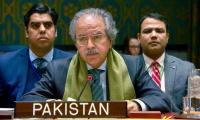
The Group of Arab States told the UN Human Rights Council in Geneva that Iran’s attacks were an “extremely grave” violation of international law that threatened regional stability. The six Gulf Cooperation Council countries—Bahrain, Kuwait, Oman, Qatar, Saudi Arabia and the United Arab Emirates—plus Jordan—all hit by Tehran’s retaliation—also jointly condemned the “Iranian aggressions”, which came “despite our efforts to avoid escalation in the region”.
Qatar halted LNG production over Iran’s latest strikes, sending prices soaring.As attacks widened to energy facilities, QatarEnergy, one of the world’s biggest liquefied natural gas (LNG) exporters, suspended production over drone strikes on two of its sites.
Iran’s retaliatory strikes have so far targeted 500 sites linked to the United States and Israel in the Middle East, the Revolutionary Guards said on the third day of fighting Monday.
Iran’s president appointed on Monday Revolutionary Guards general Majid Ebnelreza as acting defence minister after his predecessor was killed in Israeli-US strikes.
The wife of Iran’s slain supreme leader Ayatollah Ali Khamenei died on Monday after succumbing to wounds sustained during the US-Israeli attack, Iranian media reported. Mansoureh Khojasteh Bagherzadeh, 79, had been in a coma since strikes on Saturday killed Khamenei, the Tasnim news agency said.
The US military on Monday announced that a fourth American service member had been killed in the war on Iran.
Unidentified projectiles hit an oil tanker at a Bahrain port on Monday, causing a fire that was extinguished, local authorities said, with the ship’s owner reporting that one crew member was killed.
While Kuwait’s military said a navy sergeant was killed Monday while on duty, without elaborating further on the circumstances of his death.