LAHORE/WASHINGTON/LONDON: The Government of Punjab’s legislative push to combat bonded labour has received strong international endorsement, with visiting delegations praising the province’s transition from fragmented responses to coordinated, system-level reform.
In a statement issued following consultations with Pakistani officials, the CEOs of Families Set Free (FSF) and the Christian Economic Forum (CEF) praised the establishment of a Provincial Steering Committee and the passage of the Punjab Labour Code 2026 as benchmark achievements aligning the province with global governance and sustainability standards.
FSF CEO Mike Brickley, and CEF Managing Director Grant Webster jointly commend the governments in Punjab and Centre for undertaking substantive reforms to eradicate bonded labour and modernise the brick kiln sector in alignment with international labour, environmental and governance standards.
“The Government of Punjab has demonstrated clear political resolve in addressing a complex and long-standing challenge,” said Mike Brickley. “The establishment of a formal governance framework to eliminate bonded child labour marks a decisive transition from fragmented responses toward coordinated, system-level reform.”
A central component of this effort is the formation of the 15-member Provincial Steering Committee to Eradicate Bonded Child Labor, chaired by Senior Minister Marriyum Aurangzeb. As the first province to implement an integrated cross-sector strategy targeting exploitation in brick kilns and other high-risk industries, Punjab has institutionalised oversight, coordination and accountability within its reform architecture.
“Importantly, the introduction of the Punjab Labour Code 2026 signals a long-anticipated modernisation of the province’s labor governance framework,” Brickley added. “It aligns economic development with strengthened worker protections, sustainability priorities, and rule-of-law principles, reinforcing structural accountability and long-term reform.”
“The coherence between legislative direction, administrative coordination and implementation mechanisms is both credible and encouraging,” said Grant Webster.
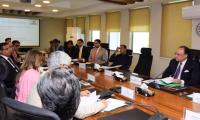
“During our two-week visit to Pakistan with more than 20 CEF members, we engaged at the Prime Minister’s Office, the National Assembly and the Punjab Assembly. These consultations provided substantive insight into the regulatory commitments supporting mechanisation, enhanced labor protection, and environmental compliance. We observed professionalism, transparency and urgency in the province’s response.”
“The establishment of the Steering Committee to Eradicate Bonded Child Labour represents a decisive and commendable institutional step,” said Øystein K. Selbekk, member of the CEF delegation and CEO of Selbekk Invest AS. “From our arrival in Lahore to our departure from Islamabad, we experienced consistent professionalism, transparency and constructive engagement across government institutions. These qualities are essential to building long-term international confidence and sustainable reform.”
International recognition has further reinforced confidence in this trajectory. The Congressional Pakistan Caucus, chaired by Congressman Tom Suozzi and Congressman Jack Bergman, has served as a pivotal catalyst in the fight against bonded labour. Their leadership and relentless efforts over the past year have helped drive measurable progress in Pakistan.
In November 2026, the Co-Chairs of the Congressional Pakistan Caucus issued a formal letter acknowledging Punjab’s progress in eliminating bonded labour and advancing responsible industrial modernisation. In February 2026, the caucus received official communications from Punjab Senior Minister Marriyum Aurangzeb, Chair of the Committee, Mohsin Shanawaz Ranjha, Co-Chair of the Committee; and Malik Muhammad Ahmad Khan, Speaker of the Punjab Assembly, detailing the government’s continued implementation measures.
In response, Congressman Suozzi described the developments as “something to celebrate” and reaffirmed the caucus’s support for sustained US–Pakistan engagement, including collaboration with the American business and nonprofit sectors to promote ethical supply chains, responsible investment and long-term social impact. Congressman Suozzi emphasised that fighting for families trapped in bonded labour is not just a policy priority, but a moral calling and legacy that he will carry with pride.
Collectively, these developments position Punjab’s reform pathway as an emerging benchmark for responsible governance, ethical industrial modernisation, and durable public and private cooperation. The joint statement reaffirmed continued support for high-level dialogue, principled international partnership, and cross-sector collaboration to permanently eradicate bonded labor while advancing inclusive, environmentally responsible, and rules-based economic growth in Pakistan.