After four days in Lahore that straddled the weekend last week, I have a stockpile of memories and impressions, and also anecdotes that just cannot be compressed in the little space that I have. But the idea is to give you the sense of this Lahore experience at a time that was exceptional in some ways.
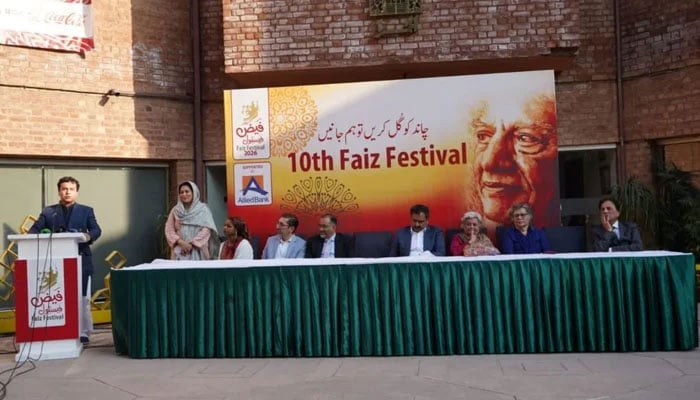
First, I need to report that we – my wife Sadiqa and I – were there for the Faiz Festival. This had to be an exciting encounter with the country's literati, particularly those of Lahore. It began on Friday afternoon and concluded on Sunday evening, leaving the participants breathless with the pace of engagements and the pull of distractions that were, so to say, on the table.
We ran into so many friends and acquaintances and made some new connections at the Faiz Festival that the overall impact could be described as intellectual gratification. We had great fun. And that seemed to be the organisers' intent. In fact, both Salima Hashmi and Moneeza Hashmi, when we first met them, had this simple welcome motif: “Enjoy”.
It was in the same mood that we went into the city of Lahore, as visitors from Karachi. This was a visit after a lapse of some years and we wanted to make good use of the little time we had. I have said that it was an exceptional time. An important aspect of it was the Basant celebration a week earlier. We could feel the hangover that still lingered in the city. At the popular level, it was certainly a kind of intoxication.
My column last week was about Basant, with my long-distance reflections on what its revival after nearly two decades would signify about Lahore’s cultural evolution. Does one Basant make a spring?
In addition, this was the last weekend before the arrival of Ramazan and there was this surge of cultural, literary and social events to beat the deadline. Basant itself had overlapped with Lahore’s literary festival and Karachi Literature Festival was held the same week. It was the first time that the two landmark literary events of the two cities were held on the same dates, making it tricky for a number of writers and intellectuals who were booked for both.
Now, I must resist the temptation of looking at Lahore against the backdrop of Karachi. A comparison should be valid, but this is not the occasion for it. Still, it was such a pleasure to meet people on the streets who seemed to be passionately in love with their city. As a journalist, I have always sought to explore a city by walking its streets and talking to strangers, when language is not a barrier. We did this in Lahore and were delighted by the response we got.
One of my goals this time was to take a ride on the Orange Line, the remarkable world-class public transportation project in the country. In my view, it sets Lahore apart from other cities and Karachi is one city that has desperately needed it for a long time. I am very familiar with the metro bus system that was first introduced in Lahore and was then replicated in Islamabad. Their voices are seldom heard, but the working-class commuters have genuine reasons to celebrate these mass transit initiatives.
Besides this task, which I easily accomplished, there is a certain drill I follow when I am in Lahore. It is a kind of ritual to visit Readings, the bookshop. This I would do with young friend Mahmudul Hasan, a literary journalist and author. And former Geo anchor Abdur Rauf would join us there. This affair began about fifteen years ago when I was doing ‘Geo Kitab’, and Readings had their outlet only in Gulberg.
On my visit to the bookshop this time, I noticed this book prominently displayed. Its title: ‘Lahore in Motion’. One could readily guess that the book is about the Orange Line. Edited by Ammara Maqsood, Chris Moffat and Fizza Sajjad, the book has this sub-heading: ‘Infrastructure, history and belonging in urban Pakistan’.
Browsing through it, I learnt that the book was originally published last year in the UK by the University College, London (UCL). Its Pakistani edition is published by Readings. I liked the format of the book. It has 26 chapters, one each for every station on the Orange Line, written by well-known academics and activists. The book collects stories along its length of 27 kilometres.
It so happened that before we went to Readings, we were sitting with a group on the sidelines of Faiz Festival that included Ali Usman Qasmi and Ali Raza of LUMS’ Department of History, who are highly respected for their academic achievements and I saw their names in the book as writers on the Thokar Niaz Baig and Khatam-e-Nabbuwat/Shahnoor stations. By way of a disclaimer, I should say that Ali Raza is Sadiqa’s nephew. He told us about the controversy that surrounded the renaming of the Shahnoor station as Khatam-e-Nabbuwat.
‘Lahore in Motion’ provides an interesting portrait of Lahore by tracing the path of this first metro rail corridor. Let me quote writer Mohammed Hanif’s blurb: “A lovely, mind-boggling tapestry of a book. ‘Lahore in Motion’ gives us sharp glimpses into how Lahore lives, dies, plays, goes to work, prays, celebrates, resists and surrenders. Intimate forays into how a city reinvents itself, struggles to breathe and remembers that other imagined Lahore of legends”.
We had our return flight to Karachi very late on Monday evening, and Ali Raza invited us to the book launch at LUMS the same evening. We just couldn’t make it. But we had our ride on the Orange Line in the afternoon. We boarded it at Lakshmi Chowk at one end of the line, Dera Gujran, covering 11 stations for Rs35 each. After a stroll in Dera Gujran, we rode back to Lakshmi Chowk.
A motley crowd in a slick, modern metro in Lahore is a reality – and yet, it seemed a bit unreal.
The writer is a senior journalist. He can be reached at: [email protected]