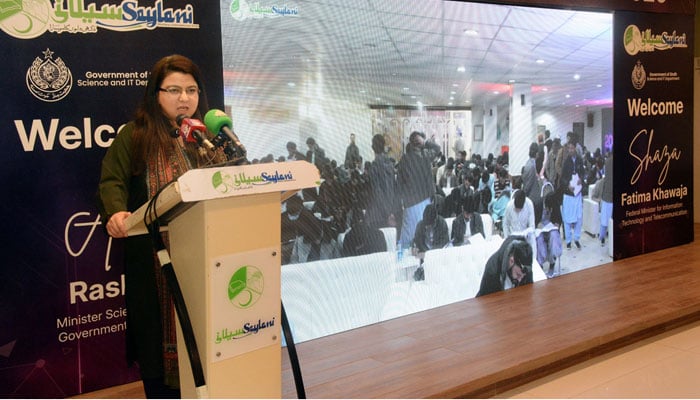
Federal Minister for IT and Telecommunications Shaza Fatima has said the country can transform its economic trajectory in months, not decades, if every youngster is given internet access, smart devices and training in digital skills.
Addressing more than 7,000 students gathered for an AI training entrance test at the Hockey Stadium during ‘Indus AI Week’, she said the government had unveiled an ambitious $1bn artificial intelligence drive as it wanted to ensure that “every youngster becomes part of modern technological training.”
“If we succeed in equipping every youngster with connectivity, modern gadgets and IT skills, Pakistan’s progress would accelerate dramatically, unfolding in months, not decades” she said.
The week-long Indus AI Week initiative has been designed designed to evoke the legacy of the Indus Valley civilization which she described as one of the world’s oldest intelligent civilizations.
According to the minister, more than 100 events were held across cities, towns and villages in Sindh as part of the campaign. She cited encounters with children aged nine to 11 already working with advanced technologies as evidence of growing digital potential among the country’s youth.
Under the government’s ‘Digital Nation Pakistan’ vision led by Prime Minister Shehbaz Sharif, the country had introduced its first national AI policy and begun implementation, she said, adding that the PM announced a $1bn investment at the opening of Indus AI Week, alongside a pledge to train one million youngsters and award 1,000 international PhD scholarships to students in technology-related fields.
“These initiatives aim to strengthen national AI infrastructure and make the best use of our human resource,” Shaza said. She added that the federal government would facilitate international investment through the Special Investment Facilitation Council and support young entrepreneurs seeking to launch technology businesses.
She explained that plans were under way to introduce digital identity systems and a super app to allow citizens to access public services and verify documents through their mobile phones, reducing the need for in-person visits to government offices such as the National Database & Registration Authority (Nadra) and the Higher Education Commission of Pakistan (HEC).
“In developed countries, citizens can access all government services from a mobile phone,” she said.
She emphasised that nearly half of the population of Pakistan was under 30, and it was the country’s most valuable asset. She urged a shift from being consumers of technology to becoming creators, inventors and innovators.
She also highlighted the role of women in economic development, noting that women constituted roughly half the population. Calling for safer public spaces and workplaces, she urged men to help create safe environments in which families felt confident sending women to schools, markets and jobs.
“If half of the population is deprived of education or excluded from work, progress becomes impossible,” she said.
The event was organized in collaboration with the Saylani Welfare Trust, whose IT training programme drew thousands of applicants to the stadium. Sindh Governor Kamran Tessori, Special Assistant to Sindh CM Ali Rashid and the Saylani Trust Chairman Maulana Bashir Farooqui were also present on the occasion.