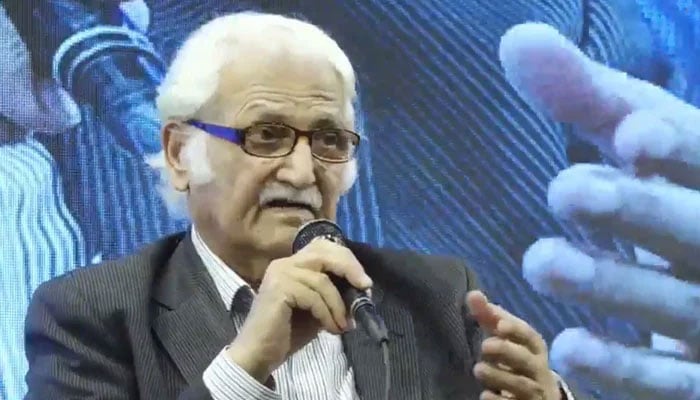
Islamabad : At a ‘Meet the Author/Book Review’ session organised jointly by the Perveen Shakir Trust (PST) and The Islamabad Club the speakers sought to explore a different dimension of Bhutto’s personality: the psychological forces behind his meteoric rise and tragic downfall, says a press release.
Former chairman of the Central Board of Revenue (now Federal Board of Revenue), Shamim Ahmad book ‘Bhutto: The Psychodynamics of His Rise and Fall’ was discussed at length.
The discussion triggered a lively and thought-provoking debate among scholars, writers and former bureaucrats. The gathering was notable for what PST Chairperson Parveen Qadir Agha described as a ‘galaxy’ of Inland Revenue Service (IRS) retired officers. The author Shamim Ahmad, moderator Khawar Ahmed, Mrs. Agha herself, and PST Secretary General Raana Seerat all share backgrounds in the service, adding a distinctive bureaucratic perspective to the literary evening.
Former PPP Senator Farhatullah Babar delivered the keynote address, while Prof. Dr. Nazia Iqbal from the Department of Psychology at the International Islamic University Islamabad (IIUI) critically examined whether the author had successfully done justice to such a complex subject through a psychodynamic lens.
She described the book as a serious attempt at psychoanalyzing Bhutto, beginning with the foundations of his personality - his early heroes, intellectual influences, literary preferences, and formative experiences. She observed that the book reminds readers that leadership is not merely political but deeply psychological.
However, she pointed out that the author identifies several psychological traits that may have contributed to Bhutto’s eventual downfall: flawed judgment, impulsive decision-making, manic and hypermanic tendencies, towering ambition, fragile ego, and occasional recklessness. According to the book, Bhutto may have been vulnerable to extreme mood swings and overwhelming political ambition, with the author even suggesting the possibility of bipolar tendencies.
“The central question this book leaves us with,” Dr Nazia remarked, “is whether our political system is capable of protecting leaders from their own psychological vulnerabilities.”
Farhatullah Babar welcomed the publication, saying that a good book is one that stimulates meaningful dialogue - something this work had clearly achieved. Though originally written in 2019, he noted, the book remains relevant due to its unusual and compelling approach.
Babar appreciated the Perveen Shakir Trust for organizing a thoughtful discussion on one of Pakistan’s most admired and controversial leaders. However, he expressed reservations about attributing Bhutto’s success primarily to internal psychological dynamics. Citing Dr. Mubashar Hassan - a founding member of the Pakistan People’s Party - Babar argued that external political forces and historical circumstances played a decisive role in shaping Bhutto’s ascent.
He nonetheless described the book as informative, rich in detail and intellectually engaging. Babar also suggested that the author clarify a section listing individuals “assassinated during Bhutto’s time,” noting that without explanation it could create unintended impressions.