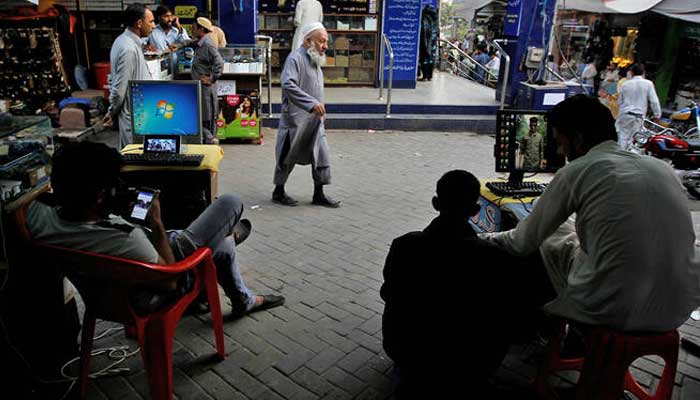
LAHORE: Smartphones, cheap internet and social media platforms have penetrated even the most informal corners of the economy. Today, technology is everywhere. Productivity, however, is not. Widespread technology usage alongside persistently low productivity defines Pakistan’s current economic challenge.
More than a decade ago, technology adoption in Pakistan was largely confined to documented, medium-to-large enterprises. Small and micro businesses, particularly undocumented wholesale, manufacturing and enterprise units (WMEs), operated almost entirely outside the digital ecosystem.
Now across Pakistan, undocumented WMEs now routinely use messaging apps for orders, marketplace on social networking sites for sales, mobile wallets for payments, and video sharing platforms for informal training. Traders track prices on their phones, mechanics diagnose faults using online videos, and small manufacturers coordinate supply chains digitally. Yet these technological tools are largely being used for coordination and survival, not for value creation.
The core reason is that productivity gains do not come from digital access alone. They require capital deepening, skill enhancement, and process modernisation — areas where Pakistan continues to lag.
Most small manufacturing units operate on obsolete machinery, often imported second-hand decades ago. Textile looms, metal workshops, food processing units and light engineering firms rely on equipment that consumes more energy, produces inconsistent quality, and requires intensive manual intervention. Digital tools may help market the output, but they cannot compensate for poor production efficiency. Technology layered on outdated hardware merely digitises inefficiency.
Equally important is the quality of human capital. The SME workforce is predominantly semi-literate and informally trained. While smartphone usage is widespread, functional digital literacy remains low. Workers may know how to operate apps, but not how to interpret data, maintain modern equipment, or optimize production workflows. As a result, technology adoption remains superficial rather than transformative.
This explains why productivity here has stagnated despite visible digital penetration. According to international comparisons, Pakistan’s labour productivity remains significantly below that of regional peers such as Bangladesh, India and Vietnam. Even within Pakistan, productivity differentials between large documented firms and small informal units are stark — often by multiples rather than margins.
Another structural issue is capital starvation. Productivity-enhancing technology — CNC machines, automated looms, ERP systems, quality testing equipment — requires upfront investment. Pakistan’s SMEs face prohibitively high borrowing costs, limited access to long-term credit, and an environment where documentation increases tax exposure without commensurate benefits. Rationally, firms choose to remain small, informal and technologically conservative.
This creates a vicious cycle. Low productivity keeps margins thin, thin margins prevent reinvestment, and lack of reinvestment perpetuates low productivity. Technology, in this environment, becomes a tool for cost-cutting and evasion rather than growth.
There is also a policy blind spot. Public discourse often assumes that digitisation automatically leads to productivity gains. In reality, digitisation without industrial upgrading can even reinforce informality. Mobile payments and online platforms have made it easier for businesses to operate at scale without entering the tax net, while regulators remain focused on documentation rather than competitiveness.
Countries that successfully raised productivity followed a different path. China paired digital adoption with massive investment in skills, machinery, and industrial clustering. Vietnam linked SME upgrading with export orientation and technology transfer. Bangladesh supported productivity in garments by enforcing scale, compliance and standardized processes. Pakistan, by contrast, expects productivity to emerge organically in an environment of policy uncertainty, weak enforcement, and high transaction costs. The result is an economy where millions are busy, connected and entrepreneurial — but not productive.
The policy focus must shift from technology access to technology absorption. This requires affordable long-term credit for machinery upgrades, vocational training aligned with modern production methods, incentives for formalisation that reduce risk rather than increase it, and industrial policies that reward scale and efficiency instead of rent-seeking. Until machines are modern, workers are skilled, and firms are confident enough to invest, digital tools will remain coping mechanisms rather than engines of growth.
Pakistan does not suffer from a lack of innovation at the grassroots. It suffers from an economic structure that prevents that innovation from translating into productivity.