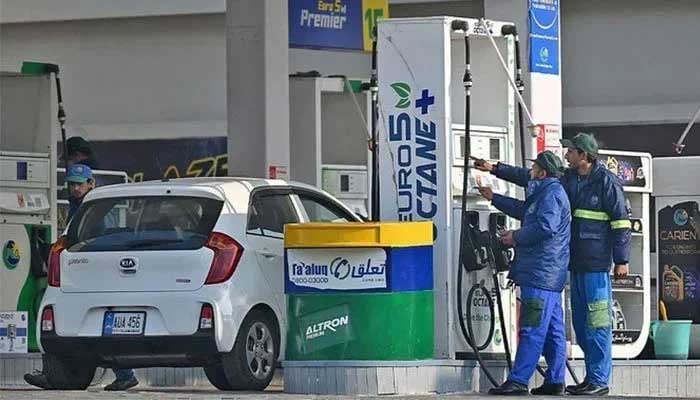
ISLAMABAD: Consumers are likely to receive significant relief at fuel stations from January 1, 2026, as authorities have finalised a sharp reduction in petroleum prices for the next fortnight, driven by a steep decline in international oil prices.
According to official sources, petrol prices are expected to fall by up to Rs10.60 per litre, while high-speed diesel (HSD) may be reduced by Rs8.59 per litre. Kerosene oil is projected to become cheaper by Rs8.92 per litre, and light diesel oil (LDO) by Rs6.62 per litre.
If approved, the price of petrol would decline from Rs263.45 to around Rs252.85 per litre, while HSD would fall from Rs265.65 to Rs257.06 per litre. Kerosene oil is expected to drop to Rs171.62 from Rs180.54 per litre, and LDO to Rs146.64 from Rs153.26 per litre.
Government and industry sources attributed price decline mainly to increased oil production in United States, subdued demand from China, and resumption of full-scale operations at Kuwait’s refineries following completion of annual maintenance.
Despite the anticipated cuts, consumers will continue to bear a heavy tax burden. Currently, petroleum levy stands at Rs79.62 per litre on petrol and HOBC, Rs75.41 on HSD, Rs18.95 on kerosene oil, Rs15.37 on LDO, and Rs77 per litre on furnace oil. In addition, a Rs2.50 per litre carbon levy is charged on petrol, HSD and HOBC.
However, the expected relief may be partially offset by higher margins for oil marketing companies (OMCs) and petroleum dealers. On December 9, 2025, the Economic Coordination Committee (ECC) approved an increase of Re0.61 per litre for OMCs and Re0.67 per litre for dealers on petrol and diesel.
This decision is awaiting federal cabinet’s approval and is expected to be notified at the beginning of next fortnight. Once implemented, margin increase will add Rs1.28 per litre to petrol and diesel prices, reducing net benefit for consumers even as global oil prices continue to decline.