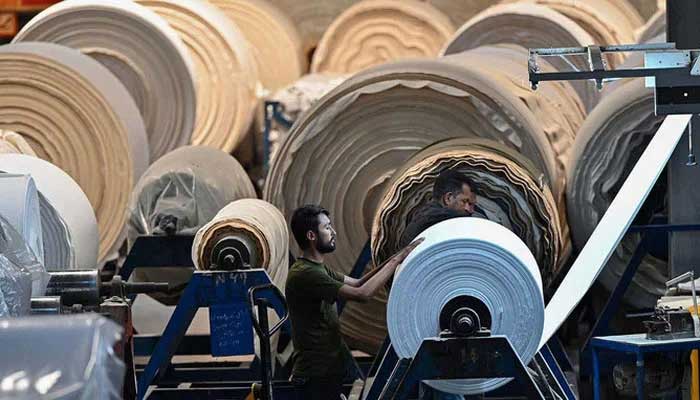
LAHORE: Pakistan’s textile industry entered 2025 with cautious optimism. But as the calendar year draws to a close, the sector’s performance tells a story of modest gains, deep structural weaknesses, and worrying signs of stagnation that deserve urgent attention.
The year 2025 for Pakistan’s textile exports is best understood in two distinct halves. Official data from the Pakistan Bureau of Statistics (PBS) shows that textile and apparel exports grew modestly in the first half of 2025 compared to the same period in the previous fiscal cycle. Data released earlier in the year reported that textile exports rose by roughly 9.6 per cent in the first half (July-December 2024 in fiscal terms); preliminary figures through early 2025 continued this trend of subdued growth driven by value-added categories such as knitwear, ready-made garments and bedwear outperforming traditional products like cotton cloth and cotton yarn.
The strength in the first half was not broad-based. Traditional segments lagged and the growth was too feeble to reset long-term export ambitions. These months also saw significant volatility in monthly export performance, with some months reporting contraction, a sign that export demand was not robust.
The second half -- from July to November 2025 -- paints a much more sobering picture. Despite periodic spikes in monthly figures -- such as a jump to $1.68 billion in textile exports in July 2025 year-on-year (YoY) on the back of stronger demand from North America -- overall export momentum faltered as the year progressed.
PBS data and industry reports show that in the first five months of FY2025-26 (July-Nov 2025), textile exports reached around $7.84 billion, up only about 2.8 per cent year-on-year -- barely above inflation and far below the historic potential of the sector. More troublingly, November 2025 exports registered a decline, reinforcing fears of stagnation rather than sustainable growth.
For the full fiscal year 2024-25 — which includes January-June 2025 — the official PBS release shows that textile exports grew by only 7.39 per cent, reaching $17.88 billion. This represented the second-highest growth in five years.
Several structural weaknesses underlie these modest gains. It includes over-dependence on a few markets with limited diversification. Low penetration of high-value and fashion apparel segments was evident. Exporters faced persistent competitive disadvantages against regional rivals like Bangladesh and Vietnam. Delayed refunds and rebate payments, hurt the working capital and competitiveness. Even where growth occurred, it was concentrated in a handful of product categories rather than broad-based expansion.
A critical indicator of long-term sector health is capital investment, particularly in modern machinery. Here too the numbers are mixed. According to PBS provisional data covering July 2025 -- representing the start of the current fiscal year -- total imports stood at about $5.87 billion. Within machinery imports, textile machinery recorded a particularly sharp surge, growing by over 115 per cent YoY in this early period to roughly $67.1 million -- a figure that signals renewed interest in capacity expansion or modernisation.
It comes against a low base, and it remains unclear whether these machinery imports represent genuine capacity upgrade or just replacement of obsolete equipment. The sharp machinery imports contrast with weak overall export performance, raising questions about whether investment is translating into competitiveness.
The 2025 performance of Pakistan’s textile sector should prompt intense policy introspection. The sector -- once the pride of Pakistan’s export economy -- is now stumbling against structural inefficiencies, weak export demand and delayed government support.
For policymakers, the evidence is clear that sustained growth requires diversification into higher-value products. Export incentives have to be timely, predictable, and market-aligned. And investment in technology and supply chain upgrading must go beyond one-off machinery imports. Pakistan’s textile sector — while growing in nominal terms — cannot be satisfied with survival; it must aim for global competitiveness. And that requires tackling deep structural bottlenecks with urgency before the next year turns another promising beginning into yet another disappointing end.