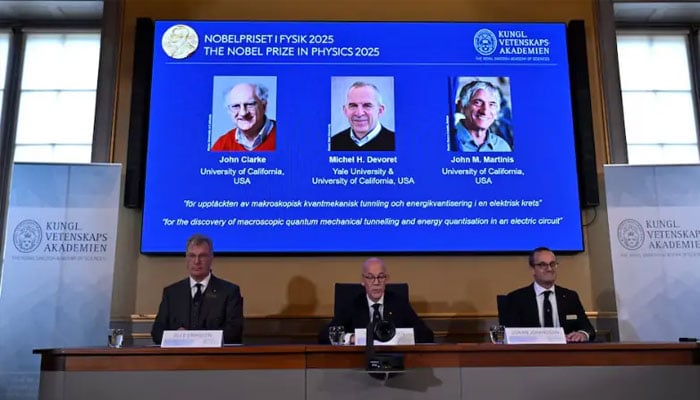
On October 7, 2025, the Nobel Committee handed the Physics Prize to three researchers whose experiments helped quantum mechanics step out of the textbook and into the workshop – John Clarke, Michel H Devoret and John M Martinis.
Most people imagine quantum technology as something exotic and futuristic – machines operating at temperatures colder than outer space, housed in secret laboratories, accessible only to physicists in white coats. The truth is far less dramatic and far more fascinating: quantum processes are already at work all around us, every day, embedded so deeply in modern devices that we rarely stop to notice them. In fact, the global digital economy – including the rise of companies like NVIDIA – rests squarely on quantum foundations laid down decades ago.
Imagine a playground swing. In a classical world, the swing can have any energy you like, depending on how hard you push. In a quantum world, the swing is picky: it can only have certain allowed energies, like steps on a staircase. And sometimes it can do something stranger: instead of climbing over a hill, it can appear on the other side – as if it tunneled through the hill. That’s quantisation and tunnelling.
Life would not have existed without quantum tunnelling. The heat and light produced by the sun and stars are due to quantum tunnelling. Without quantum tunnelling, the universe will be cold and dark, with no planets forming and no life. So what happens in the sun that leads to the production of light and heat? The sun comprises hydrogen and helium. Heat and light are produced when hydrogen atoms (or positively charged protons) fuse, leading to enormous bursts of energy that manifest in the light that illuminates our planet and the warmth that sustains life. However, this fusion should not occur according to the laws of classical physics.
For the positively charged protons to fuse, they must come close. This is not easy as the positive charges on the protons lead to strong repulsive forces and create an energy barrier. The sun, while hot, is not hot enough for the protons to overcome this barrier, nor is the gravitational force sufficient. That is where quantum processes come in. Instead of going over the energy barrier, they go through it. The fusing hydrogen atoms exist both as particles and waves; it is these waves that penetrate through the barrier, resulting in the fusion process. This process is known as quantum tunnelling.
Similar processes are witnessed in electronic devices and lasers. Modern electronic devices depend on semiconductors, and semiconductors only work because electrons obey the rules of quantum mechanics. The ability of electrons to occupy discrete energy levels inside solids, to tunnel across barriers and to respond collectively to electric fields is not a classical phenomenon. It is quantum physics in action.
Without this understanding, there would be no transistors, no integrated circuits, no smartphones, no laptops, no data centres – and no artificial intelligence. Even the vivid colours on your phone’s screen rely on quantum physics, as light-emitting diodes (LEDs) and laser-based displays exploit quantum energy transitions inside materials to produce precise wavelengths of light. Lasers scan supermarket barcodes, transmit data through fibre-optic cables, enable high-speed internet, perform eye surgery and manufacture everything from microchips to car parts.
Medical technology provides another striking example. Magnetic resonance imaging (MRI) scanners rely on quantum properties of atomic nuclei to create detailed images of the human body. Quantum effects also underpin ultrasensitive sensors used in diagnostics, navigation and environmental monitoring. These are not experimental curiosities; they are routine tools in hospitals, laboratories and industry.
Today the largest company in the world in terms of capitalisation is not Microsoft, Apple, Google or Amazon. It is Nvidia. It has a capitalisation of about $4500 billion. The company’s graphics processing units (GPUs) depend on quantum-designed semiconductor materials, nanoscale transistor physics, and advanced photolithography. These GPUs now power artificial intelligence, scientific simulation, autonomous vehicles, climate modelling and large-scale data analysis.
Quantum computers normally function at extremely low temperatures of minus 459 degrees Fahrenheit, just a few degrees above absolute zero. This makes them very expensive. However, this too is changing. For example, ETH Zurich scientists reported a room-temperature quantum advance in nanomechanical systems, using optical control to suppress classical motion and observe quantum behaviour with high ‘quantum purity’ at room temperature – an achievement that could accelerate quantum sensors without expensive cooling. And Stanford’s room-temperature quantum communication device developed in November 2025 is another strong indicator.
The superconducting circuits explored by Clarke and his colleagues evolved into the qubits that now sit at the heart of the most powerful quantum processors ever built. One of the most famous is Google’s Sycamore chip, a device that stunned the scientific community when it performed a calculation in seconds that would take the world’s fastest classical supercomputers thousands of years to complete. These machines can simulate weather, design aircraft and model nuclear reactions. And Sycamore is no longer alone. Google’s newer quantum processor, known as Willow announced by Google in 2024, pushes this idea even further. It can solve a problem in less than five minutes that would have taken millions of times longer than the age of our universe for the fastest supercomputer on our planet to solve.
Looking ahead, the boundary between ‘quantum technology’ and ‘ordinary technology’ will continue to blur. Quantum sensors will become standard in navigation and healthcare. Quantum sensors could help detect disease earlier by measuring tiny signals: subtle changes in tissues, weak magnetic signatures, faint chemical traces. Even incremental improvements here save lives.
Quantum simulation could speed up discoveries in batteries, catalysts, drugs, fertilisers, and superconductors. That could mean predicting weather patterns years ahead of major storms and the development of personalised medicines tailored to your genetic profile. The blending of super-fast quantum computing with artificial intelligence now heralds the dawn of a new age.
In Pakistan, we must prepare our children for this strange new world of tomorrow, where truth will truly be stranger than fiction.
The writer is a former federal minister, Unesco science laureate and founding chairperson of the Higher Education Commission (HEC). He can be reached at: [email protected]